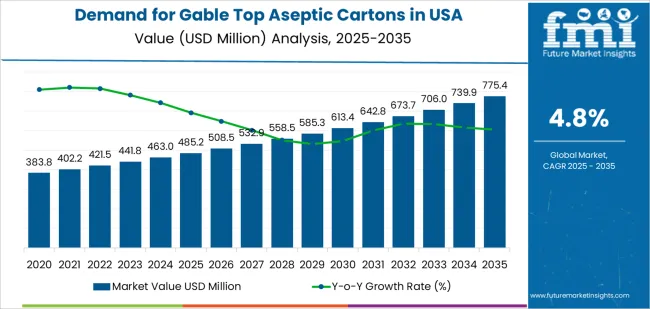
The packaging landscape in the United States is poised for a transformation. According to a new market forecast, demand for gable-top aseptic cartons is projected to grow from USD 485.2 million in 2025 to approximately USD 775.4 million by 2035 — a compelling growth of nearly 62 percent over the decade, at a compound annual growth rate (CAGR) of 4.8 percent. This growth spells opportunity not only for established players, but also for newer manufacturers and innovators seeking entry into the evolving aseptic packaging market.
Aseptic gable-top cartons have become increasingly attractive to food and beverage processors — especially dairy and juice producers — because they provide superior shelf-life, contamination protection, and distribution flexibility. The shift is driven by rising emphasis on food safety, stricter sterilization standards, and consumer demand for safe, long-lasting products. As the industry moves toward minimal waste and maximal preservation, packaging suppliers are racing to bring next-generation technologies to market.
Legacy Leaders — Cementing Their Edge
Traditional giants of the aseptic packaging industry are enjoying a moment of strength. Companies such as Tetra Pak USA, SIG Combibloc USA, Elopak Americas, Greatview USA, and International Paper continue to lead the segment, leveraging their experience, proven supply chains, and wide distribution networks.
-
Tetra Pak USA, with its deep expertise and extensive infrastructure, retains a leading share of the market — a testament to long-standing trust in its capability to consistently supply high-quality aseptic cartons.
-
SIG Combibloc USA, known for robust engineering and reliable sterile packaging solutions, continues to support large-scale dairy and beverage operations across the country.
-
Elopak Americas, Greatview USA, and International Paper round out a competitive field, offering tailored solutions in barrier technology, sterilization, and full-scale supply services to meet varying client needs.
These established manufacturers now find themselves in a rapidly expanding market, where demand is being pushed not only by traditional dairy usage but also by emerging beverage categories and sustainability-minded buyers.
New Entrants & Emerging Manufacturers — A Window of Opportunity
While incumbent players anchor the market, the forecast points to fertile ground for new manufacturers and innovators. The latter half of the projection period (2030–2035) is expected to see increasing demand for aluminum-free and bio-based cartons, as well as smart packaging solutions that incorporate performance monitoring, advanced barrier coatings, and sterilization-integrated filling systems.
This opens the door for manufacturers capable of innovating and adapting — whether through developing eco-friendly carton materials, integrating digital technology into packaging, or offering flexible production capacities. For new entrants, this isn’t just competition: it’s a chance to differentiate by offering next-gen technologies that speak to modern consumer demands for safety, sustainability, and convenience.
To succeed, newcomers must align with evolving regulatory and industry standards, ensure sterilization and safety compliance, and offer cost-effective solutions without compromising on quality. Those who do so could well become tomorrow’s market leaders, complementing or challenging the dominance of established brands.
Market Drivers: What’s Fueling the Growth?
Several interlocking factors are propelling the surge in demand:
-
Food safety and preservation demands: As consumers and regulators demand higher hygiene and longer shelf lives, aseptic packaging has become a near-essential for dairy and liquid food producers.
-
Technological advancements in packaging: Notably, improvements in barrier coatings, sterilization methods, and lightweight materials are making aseptic cartons more effective, cost-efficient, and eco-friendly.
-
Shift toward sustainability and alternative materials: With rising environmental awareness, aluminum-free and bio-based carton types are gaining traction, opening a pathway for innovative packaging manufacturers.
-
Modernization of food processing infrastructure: As manufacturers invest in sterile, automated filling and packaging lines, especially in regions with dense dairy and beverage operations, demand for aseptic cartons rises accordingly.
-
Growing beverage and plant-based beverage segments: Beyond traditional dairy, juices, plant-based milks, and other liquids are increasingly adopting aseptic carton packaging, expanding the market’s application base.
Regional Dynamics and Segment Highlights
The demand growth spans across all major U.S. regions — West, Southeast, Midwest, and Northeast — with the West region emerging as the leader, thanks to its dense food-processing infrastructure, innovation-driven environment, and early adoption of advanced aseptic technologies.
In 2025, the dairy segment accounts for more than half of total demand (52.3 percent), reaffirming the central role of traditional milk and dairy products in driving packaging demand. Standard aseptic cartons remain dominant (comprising 64.7 percent share), though aluminum-free and bio-based cartons are steadily gaining ground.
Looking ahead to 2030–2035, industry watchers expect a shift: as food processors and beverage companies embrace sustainability and advanced packaging functions, demand for eco-friendly and smart cartons will strengthen. This presents a compelling value proposition for both established players and emerging manufacturers alike.
Call to Action: Invest in the Future of Aseptic Packaging
The coming decade offers a pivotal moment for packaging manufacturers. For established firms, it’s a time to reinforce supply chains, invest in barrier and sterilization technology, and maintain leadership as the market expands. For new or smaller manufacturers, now is the time to innovate — explore aluminum-free and bio-based carton technologies, invest in smart packaging solutions, and position your business as a future-forward partner for food and beverage producers.
Businesses that act now stand to benefit from a surge in demand, shifting consumer preferences, and evolving regulatory landscapes — helping build a safer, more sustainable packaging future.