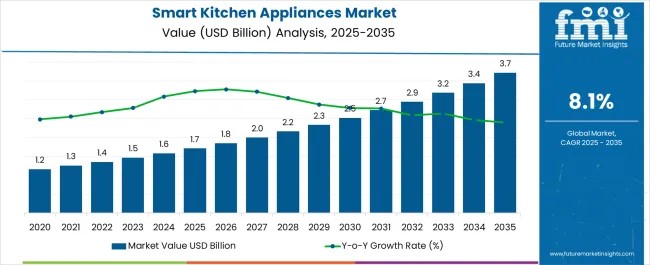
The Smart Kitchen Appliances Market is undergoing a remarkable transformation as technology and innovation redefine modern kitchens around the world. Valued at an estimated USD 1.7 billion in 2025, the market is projected to more than double over the next decade, reaching USD 3.7 billion by 2035 with a robust compound annual growth rate (CAGR) of 8.1%.
This surge is fueled by a combination of factors including increasing consumer demand for convenience, energy efficiency, and connected living solutions. Both established manufacturers and emerging players are actively expanding their footprint and introducing new technologies, accelerating the evolution of smart kitchen appliances.
Subscribe for Year-Round Insights → Stay ahead with quarterly and annual data updates – https://www.futuremarketinsights.com/reports/sample/rep-gb-5810
A Market Driven by Innovation and Consumer Demand
Smart kitchen appliances are no longer just a futuristic concept; they are becoming essential elements in households globally. Innovations such as AI-driven food management, voice assistant integration, and IoT-enabled connectivity have transformed these appliances into smart assistants that simplify cooking and food storage.
The Smart Refrigerator segment leads the pack, capturing nearly 30% of the market share by 2025. These refrigerators offer features like inventory tracking, freshness monitoring, and automated grocery ordering, perfectly aligning with consumers’ desires to minimize food waste and maximize convenience. Premiumization trends are encouraging consumers to invest in multi-functional, connected appliances that offer both luxury and sustainability.
Connectivity technology plays a pivotal role in this market’s expansion, with Wi-Fi-enabled appliances accounting for almost half of the connectivity segment. Wi-Fi allows users to control and monitor appliances remotely, receive real-time updates, and seamlessly integrate with other smart home devices, making it the preferred choice among consumers.
Established and Emerging Players Embracing New Technologies
The competitive landscape is vibrant and dynamic, featuring major players like Whirlpool Corporation, LG Electronics, Samsung Electronics, Electrolux, and Panasonic alongside new entrants keen to capitalize on the smart kitchen revolution.
Recent developments include:
- Samsung Electronics’ launch of the Samsung Food app (Aug 2025): This app enhances user experience by scanning food items and suggesting recipes, synced directly with Samsung smart ovens.
- Whirlpool Corporation’s adoption of the Matter connectivity protocol (Nov 2025): Enhancing interoperability between smart home appliances from different brands, enabling a smoother user experience.
- Sharp Corporation’s introduction of the Sharp Smart Dishwasher (July 2025): Featuring Wi-Fi and voice assistant integration for hands-free control.
- LG Electronics’ expansion into India (April 2025): Launching smart refrigerators, AI-powered washing machines, and innovative microwaves targeting one of the fastest-growing smart appliance markets.
These advancements reflect how companies are investing heavily in R&D to innovate continuously, improving both product functionality and user convenience.
Market Segmentation and Growth Opportunities
The market breaks down into three key categories, highlighting areas ripe for investment and innovation:
By Appliance:
- Smart Refrigerator (Leading segment with 29.4% share)
- Smart Coffee Maker (Rapidly gaining traction)
- Smart Dishwasher (Emerging growth)
- Smart Cookware & Cooktop
- Smart Oven
- Other Appliances
By Connectivity Technology:
- Wi-Fi (Dominant with 46.8% market share)
- Bluetooth
- NFC
- Other emerging connectivity options
By Region:
- North America (Market leader, with the U.S. accounting for 23% of global share)
- Europe (Strong growth in Germany and the UK)
- Asia-Pacific (Rapid expansion in China, Japan, and India)
- Latin America
- South Asia
- Oceania
- Middle East and Africa
Regional Insights
North America leads smart kitchen appliance adoption, supported by widespread smart home integration, high disposable incomes, and government incentives promoting smarter living. The U.S. alone holds nearly a quarter of the global market share.
Europe showcases strong demand in the UK and Germany, driven by technological innovation and high consumer acceptance.
Asia-Pacific is a rapidly expanding market with China and Japan at the forefront. The blend of international brands and local manufacturers caters to a growing consumer base with increasing disposable incomes and urbanization.
Trends Shaping the Future of Smart Kitchens
- Smart Home Integration: With more consumers embracing smart homes, smart kitchens are becoming a natural extension, driving demand for connected appliances.
- Sustainability Focus: Smart appliances that reduce energy consumption and food waste align with consumers’ eco-friendly lifestyles.
- Health-Conscious Consumers: Smart kitchen appliances assist users in monitoring dietary habits and food consumption, appealing especially to younger, health-aware demographics.
- Hospitality Sector Adoption: Hotels and restaurants are integrating smart kitchen technologies to enhance operational efficiency and customer service.
- Voice Assistant Integration: Appliances compatible with Alexa, Google Assistant, and others are growing in popularity, providing hands-free convenience.
- IoT and AI Innovations: Continuous improvements in artificial intelligence and IoT connectivity are transforming appliances into personalized kitchen assistants.
Conclusion: A Smart Kitchen Revolution in the Making
The Smart Kitchen Appliances Market stands at the cusp of a major evolution. Established manufacturers are leveraging their innovation capabilities to maintain leadership, while new players are entering the market with fresh technologies and competitive offerings. Together, they are redefining the kitchen experience—making it more connected, sustainable, and user-friendly.
With significant growth expected over the next decade, this market presents lucrative opportunities for manufacturers, investors, and technology developers alike. As smart kitchens become the heart of smart homes globally, the convergence of AI, IoT, and consumer lifestyle trends will continue to fuel innovation and growth.
For manufacturers aiming to expand their business, embracing emerging technologies such as AI integration, Wi-Fi connectivity, and interoperable platforms will be critical to capturing the market share in this fast-growing landscape.
Why FMI: https://www.futuremarketinsights.com/why-fmi
About Future Market Insights (FMI)
Future Market Insights, Inc. (FMI) is an ESOMAR-certified, ISO 9001:2015 market research and consulting organization, trusted by Fortune 500 clients and global enterprises. With operations in the U.S., UK, India, and Dubai, FMI provides data-backed insights and strategic intelligence across 30+ industries and 1200 markets worldwide.
Contact Us:
Future Market Insights Inc.
Christiana Corporate, 200 Continental Drive,
Suite 401, Newark, Delaware – 19713, USA
T: +1-347-918-3531
For Sales Enquiries: sales@futuremarketinsights.com
Website: https://www.futuremarketinsights.com
LinkedIn| Twitter| Blogs | YouTube