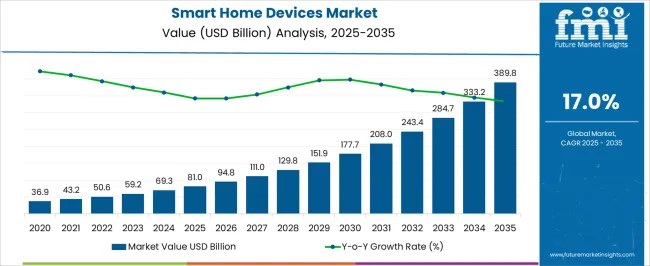
The smart home devices market is on the cusp of a transformative growth phase, expected to expand from an estimated USD 81.0 billion in 2025 to a staggering USD 389.8 billion by 2035. This impressive rise, reflecting a robust CAGR of 17.0%, underscores the rapidly evolving landscape of home automation driven by both established industry leaders and innovative newcomers leveraging cutting-edge technologies.
Subscribe for Year-Round Insights → Stay ahead with quarterly and annual data updates – https://www.futuremarketinsights.com/reports/sample/rep-gb-5840
Market Overview
The accelerating demand for smart home solutions is fueled by consumers’ increasing desire for convenience, security, and energy efficiency. Technologies like IoT integration, AI-driven platforms, and voice assistant compatibility are making smart homes more accessible, intelligent, and user-friendly than ever before.
Leading the market are heavyweight corporations such as Samsung Electronics, LG Electronics, Siemens AG, Honeywell International, Schneider Electric, Amazon, Apple, Nest Labs, Panasonic, Sony, and Midea Group, all aggressively innovating and expanding their portfolios. Alongside these titans, nimble startups are introducing inventive products and fresh perspectives that complement and challenge traditional offerings.
Key Market Segments
The Smart Home Devices Market can be broken down into crucial segments, each contributing uniquely to the sector’s dynamism:
- By Product:
- Security Lighting Control Smart Home Devices
Commanding the largest share at 28.6% in 2025, these devices are favored for their blend of safety, energy management, and convenience. Features like motion sensors, remote monitoring, and app integration empower homeowners to secure their properties efficiently. - Access Control Devices
Including smart locks and video doorbells, these are increasingly popular due to heightened security concerns. - HVAC Control Devices
Smart thermostats and climate control solutions optimize comfort while reducing energy consumption. - Entertainment & Other Controls
Smart speakers, smart TVs, and multi-device hubs enhance home leisure experiences. - Kitchen & Home Appliances
Smart refrigerators, ovens, and washing machines deliver greater control and automation. - Healthcare Smart Devices
Monitoring and wellness devices, especially relevant for aging populations.
- By Price Range:
- Below USD 25
Representing 41.3% of the market revenue, affordable devices are critical for mass adoption, enabling a broad consumer base to enter the smart home ecosystem. - USD 25 – USD 35
- Above USD 35
Higher-end devices focus on advanced features and premium designs.
- By Sales Channel:
- Direct Sales (36.8%)
Dominating distribution with better margins and closer consumer interaction, direct sales via brand stores and online platforms are pivotal. - Mono Brands, Supermarkets/Hypermarkets, Department Stores, Specialty Stores, Online Retailers, and Others make up the rest of the channels.
- By Region:
- North America, Asia-Pacific, Europe
Leading regions in smart home device adoption, driven by technological infrastructure and consumer demand.
Industry Trends and Technological Innovations
- Integration of Voice Assistants: Devices increasingly support Amazon Alexa, Google Assistant, and Apple Siri, enhancing ease of use through voice control.
- AI and Machine Learning: Personalization and predictive automation are becoming hallmarks of smart devices, enabling homes to learn user preferences and optimize routines.
- Energy Efficiency: Government incentives and consumer focus on sustainability drive the popularity of smart thermostats, lighting systems, and appliances.
- Advanced Security Features: From AI-powered cameras to smart locks, security enhancements protect homes from physical and cyber threats.
- Growth of Smart Entertainment: Smart TVs, speakers, and multimedia systems enrich home leisure, expanding the ecosystem.
Regional Insights: Growth Hotspots and Market Drivers
United States:
With a 17.6% forecast CAGR through 2035, the U.S. remains the global leader in smart home adoption. Factors like rising disposable incomes, environmental regulations, and aging demographics create strong demand for energy-efficient, secure, and health-monitoring devices. Amazon’s Echo ecosystem exemplifies innovation in voice-controlled smart homes.
United Kingdom:
UK consumers prioritize energy-efficient solutions and have embraced voice-assisted smart devices. Online retail dominates distribution, offering convenience and broad product choices.
Germany:
Germany’s focus on sustainability and energy savings supports robust demand for smart heating and connected home devices that help reduce energy consumption up to 36%. Regulatory frameworks encourage adoption in both residential and commercial settings.
Asia-Pacific:
Japan and China are leading markets, backed by advanced internet infrastructure and increasing disposable incomes. Japanese manufacturers blend minimalist design with technology, while China’s government actively promotes smart technologies through smart city initiatives. Xiaomi’s extensive “Mi Ecosystem” exemplifies regional innovation.
India:
Rapid urbanization and growing awareness drive India’s smart home market, with companies like Wipro innovating in lighting and automation. Voice assistants and energy management devices meet the demands of a cost-conscious but tech-savvy population.
Emerging Innovators and Startups: Shaping the Future
The competitive landscape is enriched by startups introducing smart solutions with unique value propositions:
- Caavo: Offers universal remote controls with centralized content libraries and streaming/gaming integration.
- Bond: Provides smart home bridges controllable via Alexa and Google Home.
- Seven Hugs: Combines remote control with AI-powered contextual awareness.
- Aqara: Delivers a diversified product lineup from sensors to smart switches, targeting B2B sectors like hospitality and offices.
These emerging players complement established manufacturers by focusing on niche segments, ease of use, and integration capabilities, fostering an environment ripe for innovation.
Recent Developments by Leading Players
- Samsung Electronics: Launched the SmartThings Station hub and enhanced its SmartThings Find asset tracker.
- Eve Systems: Released smart plugs and sensors with Matter compatibility for seamless platform integration.
- Shelly: Unveiled a new series of automation devices at CES 2025 for professionals and DIY enthusiasts.
- Amazon: Expanded its Echo product line with improved audio and vehicle-friendly devices.
- Honeywell: Partnered with Latch app to enable remote temperature and energy management.
- ABB India: Rolled out ISI-certified smart switches tailored for smart buildings.
- Schneider Electric: Introduced Easy Homes, an IoT-enabled system transforming conventional homes into smart residences.
Conclusion
The smart home devices market is on a path of unprecedented growth, driven by innovation, consumer demand, and technological advancements. With key players both established and emerging actively pushing boundaries, the future of home automation promises safer, smarter, and more sustainable living environments. Companies embracing new technologies and customer-centric strategies will be poised to lead this flourishing market through 2035 and beyond.
Why FMI: https://www.futuremarketinsights.com/why-fmi
About Future Market Insights (FMI)
Future Market Insights, Inc. (FMI) is an ESOMAR-certified, ISO 9001:2015 market research and consulting organization, trusted by Fortune 500 clients and global enterprises. With operations in the U.S., UK, India, and Dubai, FMI provides data-backed insights and strategic intelligence across 30+ industries and 1200 markets worldwide.
Contact Us:
Future Market Insights Inc.
Christiana Corporate, 200 Continental Drive,
Suite 401, Newark, Delaware – 19713, USA
T: +1-347-918-3531
For Sales Enquiries: sales@futuremarketinsights.com
Website: https://www.futuremarketinsights.com
LinkedIn| Twitter| Blogs | YouTube