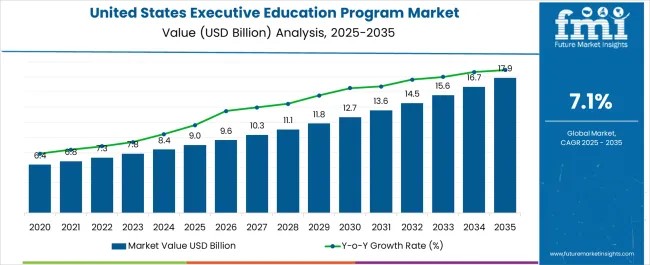
The United States executive education program market is on an unprecedented growth trajectory, projected to nearly double from USD 9.1 billion in 2025 to USD 18.0 billion by 2035. This robust expansion, marked by a compound annual growth rate (CAGR) of 7.1%, signals not only a rising demand for executive learning but also exciting opportunities for both established institutions and innovative newcomers to redefine leadership development.
Subscribe for Year-Round Insights → Stay ahead with quarterly and annual data updates – https://www.futuremarketinsights.com/reports/sample/rep-gb-17078
Established Institutions Lead the Charge While New Entrants Drive Innovation
The market is anchored by prestigious universities and business schools, including Harvard Business School, MIT Sloan, Stanford Graduate School of Business, Wharton, and Kellogg School of Management, whose globally recognized programs continue to attract senior professionals seeking credible and impactful education.
However, the landscape is also welcoming a wave of new players and technologies. Emerging institutions and tech-enabled learning platforms are leveraging cutting-edge tools such as virtual reality, AI-driven personalized coaching, and hybrid learning models to capture growing demand. This blend of tradition and innovation is shaping the future of executive education, expanding accessibility and relevance in a fast-evolving corporate world.
Leading Market Segments by Type
- Educational Institutes (41.7% market share in 2025): These institutions dominate due to their academic rigor, research-driven curricula, and strong industry connections. Universities and business schools remain the preferred choice for executives seeking globally recognized certification and thought leadership.
- Other types include B-schools, management consultancies, industrial training institutions, personality development centers, employment consultancies, and industry associations.
Course Category Insights
- Personal Counseling, Social & Behavioural, and Leadership Courses (36.5% market share in 2025): These courses are in high demand as executives prioritize emotional intelligence, leadership resilience, and interpersonal skills vital for managing diverse teams and navigating complex business environments.
- Other popular categories include marketing, organizational leadership, data analytics, finance, technology, HR, entrepreneurship, supply chain management, and corporate governance.
Duration Preferences
- Less Than 1 Week (54.2% of revenue in 2025): Short, intensive programs that provide high-impact learning without significant disruption to professional duties dominate. These formats combine workshops, case studies, and simulations to deliver practical skills quickly.
Mode of Delivery
- Virtual Learning (61%+ market share in 2025): Flexibility, convenience, and cost savings from eliminating travel and accommodation have accelerated adoption. Hybrid and live-online models are increasingly favored, reflecting a shift towards personalized and accessible education.
Regional Outlook
- West Region (25.9% market share in 2025): Home to top-ranked universities like Stanford, UC Berkeley, and USC, this region is expected to remain the most lucrative.
- Southwest Region (17% market share in 2025): Maintains dominance through strong business partnerships offering real-world learning experiences.
- Midwest Region (16.1% market share in 2025): Driven by its diverse industrial base, including agriculture, manufacturing, healthcare, and tech, the Midwest fuels demand for executive leadership courses.
Innovation and Collaboration: Shaping the Future of Executive Education
The United States executive education market is evolving rapidly with significant innovation across content delivery, course design, and industry engagement:
- Technology Integration: Leading players are adopting online platforms, virtual reality, and AI to personalize learning, enhance engagement, and facilitate real-time feedback. This trend is helping bridge geographic gaps and offering flexible learning schedules for busy executives.
- Corporate Partnerships: Universities and business schools are deepening collaborations with corporations to tailor curricula aligned with real-world business challenges and emerging industry trends. For example, Kellogg School of Management’s 2024 partnership with the University of Hong Kong to deliver a hybrid Executive MBA program exemplifies the drive towards globalized, flexible education.
- Experiential Learning: Emphasis on hands-on experiences through case studies, simulations, and live projects is becoming standard, reinforcing practical application over theoretical knowledge.
- Focus on Leadership and Behavioral Skills: Personal counseling and leadership courses are expanding, recognizing that emotional intelligence and social adaptability are key differentiators in effective management.
Opportunities for New Entrants and Emerging Technologies
As demand for executive education grows, new entrants have fertile ground to innovate and capture market share by:
- Introducing micro-credentialing and modular courses to provide targeted skill upgrades.
- Developing AI-driven personalized learning paths that adapt to individual executive needs and learning styles.
- Offering immersive virtual reality experiences to simulate leadership scenarios and complex decision-making.
- Building global executive networks through online platforms to foster peer learning and collaboration across borders.
- Leveraging data analytics to continuously improve curriculum relevance based on learner feedback and evolving market needs.
These innovations complement traditional strengths, offering busy executives more options to develop leadership capabilities in a way that fits their professional lives.
Why Executive Education Matters More Than Ever
The business environment today is more dynamic and complex than ever before. Executives face challenges from digital disruption, global competition, and rapid technological change. As a result, continuous skill development and leadership renewal are critical.
Executive education programs in the U.S. are uniquely positioned to:
- Equip leaders with digital transformation skills and strategic agility.
- Foster resilience and emotional intelligence for managing change.
- Promote inclusive leadership to manage diverse, global teams effectively.
- Drive innovation and entrepreneurial thinking across industries.
Final Thoughts
The United States executive education program market is entering a decade of dynamic growth and transformation. Established players with strong reputations continue to drive demand, while new manufacturers and technology providers are injecting innovation that expands access and relevance.
This evolving landscape offers enormous opportunities for collaboration, new program development, and technological advancements, making executive education an essential pillar for individual career growth and corporate success.
Why FMI: https://www.futuremarketinsights.com/why-fmi
About Future Market Insights (FMI)
Future Market Insights, Inc. (FMI) is an ESOMAR-certified, ISO 9001:2015 market research and consulting organization, trusted by Fortune 500 clients and global enterprises. With operations in the U.S., UK, India, and Dubai, FMI provides data-backed insights and strategic intelligence across 30+ industries and 1200 markets worldwide.
Contact Us:
Future Market Insights Inc.
Christiana Corporate, 200 Continental Drive,
Suite 401, Newark, Delaware – 19713, USA
T: +1-347-918-3531
For Sales Enquiries: sales@futuremarketinsights.com
Website: https://www.futuremarketinsights.com
LinkedIn| Twitter| Blogs | YouTube