

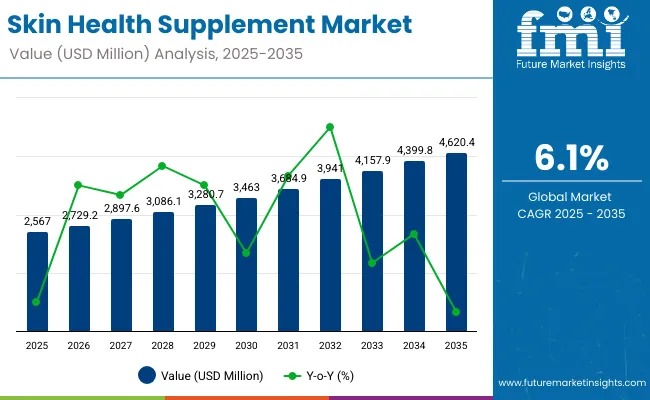
The skin health supplement market is expected to grow from USD 2,567 million in 2025 to USD 4,620.4 million by 2035, driven by rising beauty-from-within adoption, advanced dermatological wellness systems, and increasing consumer shift toward preventive skin health solutions.
The first half of the forecast period (2025–2030) will see the market climbing from USD 2,567 million to USD 3,463.0 million—an increase of USD 896 million, accounting for 44% of total decade growth. This surge is propelled by mainstreaming of collagen-based formulations, expanding antioxidant usage, and the normalization of enhanced bioavailability and targeted nutrient delivery technologies across global wellness markets.
Explore trends before investing – request a sample report today! https://www.futuremarketinsights.com/reports/sample/rep-gb-29080
Market Outlook Strengthens as Wellness and Beauty Converge
Between 2030 and 2035, the sector is expected to add USD 1,157.4 million to reach USD 4,620.4 million, representing 56% of total decade expansion. This phase is characterized by widespread integration of skin supplements into personalized nutrition ecosystems, health tracking platforms, and premium beauty-wellness programs.
Consumers are moving from topical routines toward comprehensive internal-external skin wellness, raising demand for clinically backed formulations with proven absorption and measurable dermal benefits.
Science-Driven Formulations Lead Market Adoption
Modern skin health supplement formulations rely on advanced peptide engineering, nutrient stabilization, and controlled-release delivery systems. Hydrolyzed collagen peptides (2,000–5,000 daltons) continue to set performance benchmarks due to superior absorption and efficient collagen synthesis support.
Antioxidant systems—featuring vitamin C, vitamin E, and polyphenols—provide essential cellular protection against oxidative stress and environmental exposure. Meanwhile, marine collagen, hyaluronic acid, carotenoids, and probiotics are gaining traction across specialized beauty and wellness applications.
The segment’s transformation reflects growing global prioritization of anti-aging outcomes, hydration support, skin barrier strengthening, and cellular repair.
Key Market Takeaways
- Market Value 2025: USD 2,567 million
- Market Forecast 2035: USD 4,620.4 million
- CAGR: 6.1%
- Top Product Segment: Collagen-based supplements
- Leading Growth Regions: Europe, South Asia Pacific, East Asia
- Major Companies: Amway, Shiseido, Blackmores, Herbalife Nutrition
Strategic Imperatives for Stakeholders
To capture long-term value in the evolving skin wellness ecosystem, companies should prioritize:
- Complete beauty-wellness ecosystems
Integrated offerings combining supplements, digital wellness tools, skin-health monitoring, and personalized nutrition guidance. - Beauty 4.0 technology readiness
Adoption of predictive analytics, IoT-enabled monitoring, and AI-supported wellness personalization. - Wellness-by-design innovation
Automated tracking, real-time skin health assessments, and smart supplementation programs. - Value-based pricing models
Tiered wellness subscriptions, performance-based supplement packages, and transparency in ingredient sourcing and efficacy claims.
Segmental Landscape
By Product Type
The collagen-based segment holds a commanding 32% share, supported by its proven bioactivity, high consumer trust, and compatibility with both daily wellness routines and functional beauty programs.
Herbal and botanical extracts maintain a 16% share, benefiting from natural positioning and clean-label preferences. Antioxidants represent 14%, addressing anti-aging and environmental defense needs.
By Ingredient
Collagen ingredients lead with 28% share, followed by vitamin/mineral complexes at 18%, and polyphenols at 12%, reflecting diverse nutritional strategies for skin repair, protection, and radiance enhancement.
By Format
Capsules lead with 28% due to convenience and dosing accuracy, while gummies command 22% based on taste appeal and lifestyle compatibility. Tablets remain relevant at 18% through clinical and therapeutic applications.
Market Drivers, Restraints, and Trends
Key Growth Drivers:
- Rising global beauty awareness and anti-aging demand
- Expanding aging population and health consciousness
- Strong influence of social media and wellness influencers
Key Restraints:
- Regulatory scrutiny and approval challenges
- Competition from topical skincare and alternative wellness remedies
Key Trends:
- Personalized nutrition and individualized skin-health profiling
- Regional expansion in Asia driven by beauty innovation and affordability
Country-Wise Growth Highlights
- France (6.9%) – Leads in premium beauty integration and dermatological wellness infrastructure.
- UK (6.6%) – Rapid advancement of comprehensive wellness services and professional beauty programs.
- Germany (6.4%) – High adoption of precision wellness systems and clinically validated supplements.
- China (6.3%) – Scaling high-volume beauty-wellness use with strong urban demand.
- India (6.0%) – Cost-effective supplement solutions fuel mass adoption.
- USA (5.3%) – Strong regulatory compliance and health-centric consumer preferences sustain growth
