

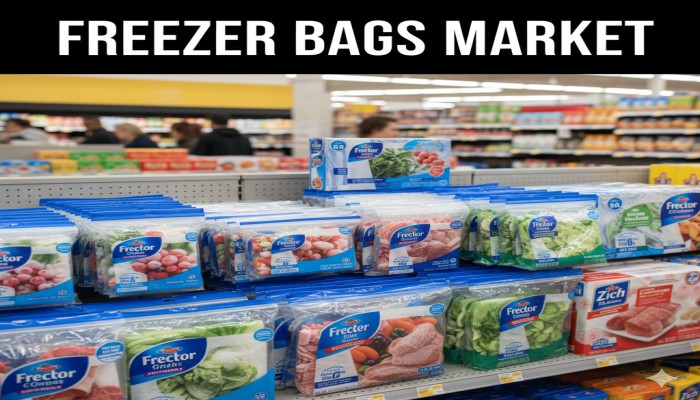
The global freezer bags market is poised for substantial expansion, reaching an estimated USD 5.2 billion by 2025 and projected to hit USD 7.5 billion by 2035, growing at a CAGR of 3.8%. The industry’s evolution is driven by consumer demand for convenient, reusable, and sustainable food storage solutions and by technological innovations that make food preservation smarter and safer than ever before.
A Market Built on Durability, Sustainability, and Innovation
Consumers today expect their food storage products to be leak-proof, puncture-resistant, and temperature-stable, while also aligning with their environmental values. In response, manufacturers are developing biodegradable, recyclable, and multi-layered barrier freezer bags designed for longevity and eco-friendliness.
Technological advancements such as resealable closures, vacuum-sealing systems, and smart labeling—have transformed freezer bags from simple storage tools into intelligent food preservation solutions. With the rise in meal prepping, e-commerce grocery delivery, and frozen food consumption, the freezer bags market is becoming a crucial component of modern lifestyles.
Subscribe for Year-Round Insights → Stay ahead with quarterly and annual data updates – https://www.futuremarketinsights.com/reports/sample/rep-gb-6575
Regional Market Dynamics
Asia-Pacific: Fastest-Growing Regional Hub
Asia-Pacific leads the freezer bags market, supported by booming online grocery services, an expanding middle class, and a surge in frozen food consumption. Countries like China, India, and Japan are at the forefront, where local producers focus on affordable, puncture-resistant, and eco-friendly freezer bags. Government initiatives promoting biodegradable packaging are accelerating adoption across the region.
North America: The Epicenter of Smart and Sustainable Packaging
In the United States and Canada, freezer bags are evolving into smart food storage tools with RFID tracking, AI-based defect detection, and leak-proof technologies. Brands are heavily investing in bio-based plastics, compostable materials, and resealable options to comply with environmental standards while enhancing convenience. The region also leads in customized packaging designs, catering to the growing trend of branded, reusable storage products.
Europe: Regulations Fueling Green Transformation
Europe’s strict environmental policies are catalyzing rapid change toward plastic-free, compostable, and reusable freezer bags. Markets in Germany, France, and the UK are seeing partnerships between sustainability startups and packaging giants. Innovative products such as moisture-proof paper freezer bags and plant-based plastic films—are reshaping the regional landscape.
Challenges and Opportunities in the Freezer Bags Market
Challenges
- Rising concerns over plastic-based waste and disposal.
- Fluctuating raw material costs impacting sustainable production.
- Compliance with recyclability and food safety standards across regions.
Opportunities
- Integration of AI-driven manufacturing for defect detection and process optimization.
- Adoption of smart freezer bags with freshness indicators, RFID tracking, and vacuum-sealing.
- Growing demand for biodegradable, reusable, and plant-based freezer storage solutions.
Country Insights and Growth Outlook (2025–2035)
- United States (CAGR 6.5%) – Growth fueled by demand for high-barrier, leak-proof, and eco-friendly freezer bags; advancements in resealable zippers and smart labeling.
- United Kingdom (CAGR 6.2%) – Driven by plastic waste reduction policies and increasing adoption of compostable, durable freezer bags with anti-frost coatings.
- Japan (CAGR 5.9%) – Known for precision-engineered, tear-resistant, and vacuum-sealable freezer bags made with biodegradable materials.
- South Korea (CAGR 6.3%) – Focused on AI-powered engineering, RFID tracking, and sustainable, reusable food storage solutions.
Segmentation Outlook: Resealable, Biodegradable, and Smart Bags Lead the Charge
- Resealable Freezer Bags – Remain market leaders, offering airtight and reusable options with innovations like dual-zipper and tamper-proof systems.
- Biodegradable Freezer Bags – Gain traction as consumers embrace plant-based bioplastics and compostable films. Their use in organic food packaging and meal kits is rapidly expanding.
- Smart Freezer Bags – Integrate digital freshness monitoring, QR codes, and RFID tracking, offering users real-time visibility of food conditions.
Technological Advancements Shaping the Market
The next decade will witness a surge in AI-powered material optimization, biodegradable coatings, and moisture-resistant barriers. Companies are integrating intelligent freezer bags with temperature indicators and automated freshness tracking. These innovations not only enhance food safety and shelf life but also align with global sustainability targets.
The Road Ahead: Smarter, Greener, and More Efficient
Between 2025 and 2035, the freezer bags market will undergo a transformation—from traditional plastic storage to intelligent, sustainable, and data-driven food preservation. Manufacturers who embrace biodegradable materials, automation, and smart labeling will not only meet evolving consumer demands but also lead the charge in shaping a circular, eco-conscious packaging economy.
Why FMI: https://www.futuremarketinsights.com/why-fmi
About Future Market Insights (FMI)
Future Market Insights, Inc. (FMI) is an ESOMAR-certified, ISO 9001:2015 market research and consulting organization, trusted by Fortune 500 clients and global enterprises. With operations in the U.S., UK, India, and Dubai, FMI provides data-backed insights and strategic intelligence across 30+ industries and 1200 markets worldwide.
Contact Us:
Future Market Insights Inc.
Christiana Corporate, 200 Continental Drive,
Suite 401, Newark, Delaware – 19713, USA
T: +1-347-918-3531
For Sales Enquiries: sales@futuremarketinsights.com
Website: https://www.futuremarketinsights.com
LinkedIn| Twitter| Blogs | YouTube




