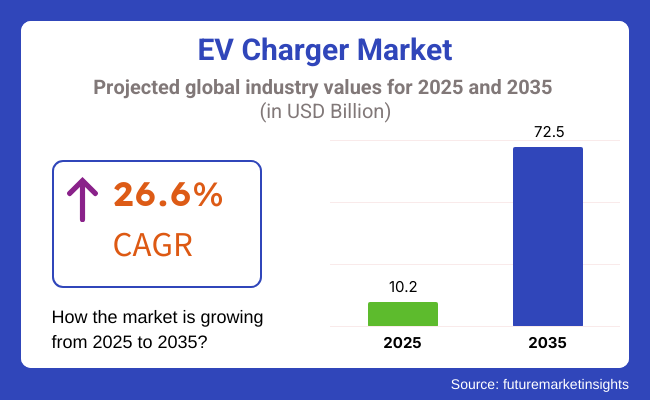
The global electric vehicle (EV) charger market is accelerating at an unprecedented pace, rising from USD 6.5 billion in 2023 to an estimated USD 10.2 billion by 2025, representing a compound annual growth rate (CAGR) of 26.6%. Market projections indicate a surge to USD 72.5 billion by 2035, driven by rapid EV adoption, robust government incentives, and massive infrastructure development.
The market landscape is evolving across a spectrum of technologies-from home chargers to ultra-fast public DC chargers-designed to address range anxiety and improve user convenience. Fast, reliable, and universally compatible chargers are becoming critical as more consumers transition to electric mobility.
Get access to comprehensive data tables and detailed market insights – request your sample report today!
https://www.futuremarketinsights.com/reports/sample/rep-gb-16619
Infrastructure and Investment Trends
Government and private investments are the backbone of the EV charging boom. Nations including Norway, Germany, and China lead the deployment of dense public charging networks, while emerging markets face challenges in establishing infrastructure due to capital intensity and uneven distribution. Workplace and home charging solutions are also rising, enabling convenient and cost-efficient access for users.
The integration of renewable energy is increasingly shaping the market. Solar- and wind-powered charging stations are gaining prominence, with companies like Ionity and BP Pulse investing in ultra-fast, green charging networks that align with global sustainability targets.
Strategic Decision Drivers for Stakeholders
EV charger providers prioritize network coverage, reliability, and smart grid integration. Original Equipment Manufacturers (OEMs) and utility companies emphasize future-proof, AI-enabled solutions, while infrastructure providers balance cost and performance. Sustainability and energy efficiency remain critical, particularly in regions with high renewable energy penetration.
Market Evolution: 2020 to 2035
From 2020 to 2024, rapid EV adoption and government incentives propelled the growth of fast and ultra-fast charging networks. Level 2 home chargers, workplace solutions, and vehicle-to-grid (V2G) technology gained traction, although regulatory and compatibility issues limited large-scale adoption.
Looking ahead to 2025-2035, the EV charging market will be defined by ultra-fast, wireless, and AI-optimized chargers. Predictive energy management and seamless integration with renewable sources will become standard. Governments, automotive players, and technology providers will collaborate to enable smart, efficient, and globally connected charging networks.
Timeline Key Developments
2020-2024 Expansion of fast-charging networks, smart home chargers, initial solar-powered stations
2025-2035 Wireless & megawatt chargers, AI-based energy management, robotic charging arms, decentralized energy trading
Risk and Pricing Considerations
Despite robust growth, the market faces challenges including non-standardized connectors, permitting delays, supply chain disruptions, and volatile electricity pricing. Companies must prepare for regulatory uncertainty, cyber threats, and underutilization in slower-adopting regions.
Pricing strategies vary between hardware sales and charging services. Level 2 home chargers face intense competition, while public DC fast-charging stations implement dynamic pricing, subscriptions, and cross-subsidization. Networks are balancing affordability with profitability, factoring in electricity tariffs, peak-demand charges, and location density.
Regional Insights
• USA – The market is projected to grow at 9.0% CAGR from 2025 to 2035, driven by federal incentives, 500,000+ charging stations, and AI-powered, renewable-linked grids. Tesla, ChargePoint, and Electrify America are leading innovations in ultra-fast and wireless charging.
• UK – With ICE vehicles set to phase out by 2035, EV adoption is rising, supported by BP Pulse and Shell Recharge’s smart charging networks. Market growth is expected at 8.6% CAGR.
• European Union – Germany, France, and the Netherlands are investing heavily in city-center and highway fast chargers, achieving an 8.8% CAGR. AI-enabled stations integrating solar and wind energy are increasingly common.
• Japan & South Korea – Japan’s smart mobility and carbon-neutral initiatives drive an 8.2% CAGR, while South Korea’s government-backed wireless and high-speed charging infrastructure grows at 8.7%. Companies like Hyundai Mobis and SK Innovation lead deployment.
Purchase Full Report for Detailed Insights
For access to full forecasts, regional breakouts, company share analysis, and emerging trend assessments, you can purchase the complete report here: Buy Full Report – https://www.futuremarketinsights.com/checkout/16619
Segment Outlook
• By Vehicle Type: Battery Electric Vehicles (BEVs) dominate due to longer electric ranges and dependency on high-speed charging, while Plug-in Hybrid EVs (PHEVs) benefit from Level 1 and Level 2 chargers for convenience.
• By Charging Type: Off-board DC fast chargers are gaining ground for rapid long-distance charging, while on-board chargers ensure home and workplace compatibility. Innovations in silicon carbide (SiC) and gallium nitride (GaN) semiconductors are enhancing efficiency.
• By End User: Residential, commercial, and public charging networks are expanding, with commercial fleet electrification driving a substantial share of infrastructure investments.
Competitive Landscape
Leading players including Tesla (18-22% market share), ChargePoint (15-20%), ABB (12-16%), Siemens (10-14%), and Blink Charging (6-10%) are leveraging ultra-fast charging, AI-based energy management, and renewable integration to gain competitive advantage. Tesla’s Supercharger network remains an industry benchmark, while ABB, Ionity, and Shell Recharge focus on scalable, modular solutions. New entrants differentiate with bidirectional charging, wireless solutions, and AI-optimized energy networks.
Market Overlook
The EV charger market is entering a transformative phase, fueled by government incentives, technology innovation, and sustainability imperatives. Ultra-fast, AI-enabled, and renewable-integrated charging infrastructure will be crucial in supporting global EV adoption, ensuring reliability, efficiency, and a seamless user experience. Companies investing in scalable, grid-friendly, and innovative solutions are positioned to lead this electrified mobility revolution.
About Future Market Insights (FMI)
Future Market Insights, Inc. (FMI) is an ESOMAR-certified, ISO 9001:2015 market research and consulting organization, trusted by Fortune 500 clients and global enterprises. With operations in the U.S., UK, India, and Dubai, FMI provides data-backed insights and strategic intelligence across 30+ industries and 1200 markets worldwide.