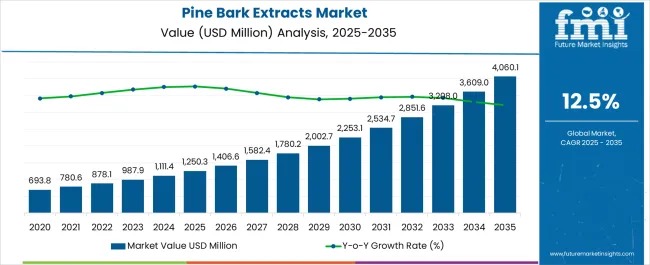
The global pine bark extracts market is set for significant expansion, projected to rise from USD 1,250.3 million in 2025 to USD 4,060.1 million by 2035, marking an absolute increase of USD 2,809.8 million. This reflects a robust 225.8% surge and a healthy 12.5% CAGR, supported by growing consumer inclination toward natural skincare, clinically backed botanicals, and antioxidant-rich formulations.
Growing recognition of pine bark extract’s efficacy in anti-aging, skin repair, and UV protection is strengthening its integration across topical skincare, nutricosmetics, and premium beauty categories. With the market expected to grow 3.26X by 2035, manufacturers are accelerating R&D investments to capture high-value opportunities across regions.
Explore trends before investing – request a sample report today! https://www.futuremarketinsights.com/reports/sample/rep-gb-25547
Market Growth Highlights
Between 2025 and 2030, the market is expected to climb from USD 1,250.3 million to USD 2,251.1 million, contributing 35.9% of the decade’s total value surge. This phase benefits from rising clean-label adoption and expanding natural skincare portfolios across global beauty brands.
From 2030 to 2035, the market is forecast to add another USD 1,801.8 million, driven by the expansion of e-commerce, ingredient standardization, and widespread consumer acceptance of advanced botanical extracts. The rise of personalized skincare and nutricosmetics will further support category acceleration.
Key Market Drivers
- Strong Consumer Shift Toward Natural Beauty
A global preference for organic, dermatologically backed, and plant-derived ingredients is intensifying demand for antioxidant-rich actives. Pine bark extract’s proven role in collagen support, skin elasticity improvement, and protection against environmental stress is fueling adoption worldwide.
- Growing Scientific Validation
Clinical studies supporting OPC-based pine bark extracts are strengthening product credibility. Manufacturers are adopting standardized extraction technologies to ensure consistent potency, purity, and performance—key purchase drivers for premium skincare consumers.
- Expansion of Digital Retail
E-commerce and social commerce ecosystems are enabling targeted consumer education, personalized recommendations, and direct-to-consumer distribution—particularly in Asia Pacific, North America, and Europe.
- Technological Advancements
Innovations in encapsulation, nanotechnology, and bioavailability enhancement are enabling more effective delivery systems. Improved stability and concentration formats are unlocking new opportunities across serums, supplements, and advanced cosmetic formulations.
Segmental Overview
By Function
- Antioxidant & Anti-aging (55.1%)
This remains the dominant segment owing to intense demand for prevention-focused and results-driven skincare. Pine bark extract’s OPC content supports collagen and shields skin from UV-induced oxidative stress.
By Product Type
- Serums (48.7%)
Serums lead due to their high-concentration delivery, premium positioning, and fast adoption among consumers seeking visible anti-aging effects. Combinations with vitamin C, peptides, and hyaluronic acid are strengthening this segment’s appeal.
By Claim
- Natural/Organic (53.1%)
Clean beauty momentum, stricter regulations, and rising sustainability expectations are elevating the demand for certified natural pine bark extract formulations.
Regional Insights
North America & Europe
Mature markets with high consumer awareness of antioxidants and strict regulatory frameworks. Germany and France lead European demand, driven by scientific validation and advanced botanical extraction capabilities.
Asia Pacific
One of the fastest-growing regions, led by India (23.8% CAGR) and China (20.5% CAGR). Rising beauty consciousness, digital-first consumers, and rapid premiumization are accelerating adoption.
Japan
Growth at 17.5% CAGR is supported by innovation-led beauty culture, high product loyalty, and preference for clinically verified formulations.
United Kingdom & USA
The UK grows at 13.2%, driven by clean beauty preferences, while the USA grows steadily at 9.3% due to strong retail networks and market maturity.
Country-Level CAGR Snapshot (2025–2035)
- India: 23.8%
- China: 20.5%
- Japan: 17.5%
- UK: 13.2%
- Germany: 10.5%
- USA: 9.3%
Competitive Landscape
The market is moderately fragmented, with leading companies emphasizing sustainable sourcing, standardized formulations, clinical trials, and advanced extraction technologies.
Key players include:
- Horphag Research (Pycnogenol)
- Swanson
- Now Foods
- Givaudan
- Nature’s Way
- Twinlab
- Solgar
- Bioforce
- Life Extension
- Pure Encapsulations
- ISDIN
ISDIN holds an 8.5% share, while specialized botanical ingredient suppliers dominate scientific innovation in the category.
Conclusion
With natural skincare, clean-label formulations, and science-backed botanicals shaping global beauty preferences, pine bark extracts are positioned for sustained momentum through 2035. From advanced serums to nutricosmetics, the ingredient’s wide applicability and strong clinical foundation continue to attract both consumers and manufacturers aiming for efficacy-driven innovations.