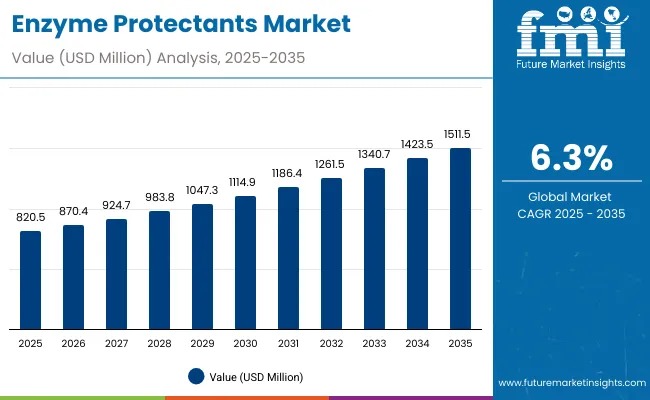
The global enzyme protectants market is projected to reach USD 1,511.5 million by 2035, rising from USD 820.5 million in 2025 and adding nearly USD 691 million in value over the decade. This growth trajectory reflects a steady CAGR of 6.3%, driven by the expanding use of enzymes in pharmaceuticals, diagnostics, food biotechnology and advanced bioprocessing.
Growing dependence on high-performance enzymes across biologics, precision fermentation, and industrial biotechnology is reshaping market requirements. As enzyme formulations become more sensitive to storage, processing and environmental variability, the demand for advanced protectants—stabilizers, polymers, coatings, antioxidants, and bio-based protectants—is rising sharply worldwide.
Explore trends before investing – request a sample report today! https://www.futuremarketinsights.com/reports/sample/rep-gb-26162
Decade Outlook: Strong Momentum Across Biopharma, Diagnostics and Industrial Biotechnology
During the first growth phase (2025–2030), the market is expected to expand from USD 820.5 million to USD 1,114.9 million, adding nearly USD 294 million, or 43% of total decade growth. Increased integration of enzymes in biologics, diagnostic reagents, and functional food formulations will support this steady climb.
From 2030 to 2035, the market is projected to add another USD 397 million, accounting for 57% of decade growth, as enzyme adoption accelerates in synthetic biology, precision fermentation and high-value bioprocessing. Application-driven innovation and sustainability-aligned sourcing strategies are expected to define competitive advantage in this period.
Market Fundamentals Strengthened by 2020–2024 Performance
Between 2020 and 2024, demand increased consistently across pharmaceuticals, food processing and industrial biotechnology. Stabilizers and specialized polymers dominated product sales, driven by their reliability, scalability and regulatory compliance. By 2025, the market is on track to reach USD 820.5 million, supported by heightened adoption in biologics, diagnostics and functional food innovation.
Over the long term, a noticeable shift toward bio-based, encapsulated and sustainable protectants is expected, with companies investing heavily in natural alternatives without compromising efficacy.
Key Market Drivers
- Rising reliance on biologics and precision fermentation
Pharma and biotech manufacturers require robust protectants to ensure enzyme stability in sensitive drug, protein and fermentation systems. - Advanced encapsulation and coating systems
Innovations in microencapsulation and protective polymer coatings are strengthening enzyme resilience during high-intensity industrial processing. - Growing clean-label and sustainability preferences
Bio-based protectants, plant-derived stabilizers and fermentation-based agents are gaining acceptance as companies shift toward greener ingredient strategies. - Regulatory push for product consistency
Pharmaceutical and food safety regulations reinforce the adoption of high-performance enzyme stabilizers.
Segmental Highlights
By Product Type (2025):
- Stabilizers – 33.6% (largest segment with broad adoption across pharma, food and diagnostics)
- Protective Polymers & Coatings – 22.7%
- Antioxidants – 16.8%
Stabilizers remain integral due to their performance under storage and processing stress, while specialized polymers and coatings are growing faster due to their role in precision bioprocessing.
By Source (2025):
- Synthetic Protectants – 61.4%
- Natural/Bio-Based – 38.6%
Synthetic protectants continue to dominate, though the share of bio-based solutions is rising steadily.
By End-Use (2025):
- Pharmaceuticals & Biologics – 34.2% (largest)
- Food & Beverage – 26.2%
- Industrial Biotechnology – 18.9%
The pharmaceutical sector is expected to remain the primary demand center due to the stability requirements for biologics, therapeutic enzymes and diagnostic tools.
Regional and Country-Level Outlook
North America, Europe and Asia-Pacific remain the leading growth regions, with emerging markets accelerating expansion.
Forecast CAGR (2025–2035):
- India – 8.8% (fastest globally)
- Brazil – 8.1%
- UK – 7.6%
- France – 7.2%
- Germany – 6.6%
- USA – 6.1%
- China – 5.8%
The United States will rise from USD 202.8 million in 2025 to USD 366.4 million in 2035, supported by biologics manufacturing and adoption in diagnostics and clean-label food systems.
The United Kingdom is set for a 7.6% CAGR, driven by strong biotech clusters in Cambridge and Oxford. Germany will maintain leadership in industrial biotechnology with stable 6.6% growth. India and Brazil will emerge as high-potential markets supported by expanding pharma, food processing and agricultural biotechnology.
Competitive Landscape
The market is moderately fragmented, led by multinational players such as BASF SE, Evonik Industries AG, Merck KGaA (Millipore Sigma), Croda International, DSM-Firmenich AG, Kerry Group plc, Ingredion, Lonza, Roquette Frères, and Nagase & Co. BASF SE holds approximately 5.2% share in 2025.
Companies are prioritizing:
- Application-specific protectant innovation
- Sustainable and bio-based ingredient development
- Partnerships with biotech and food manufacturers
- Digital R&D platforms for next-generation enzyme stabilization
Recent developments include BASF’s 2025 expansion of its liquid enzyme portfolio for detergents and advancements in nanotechnology-driven immobilization techniques for improving enzyme performance in harsh industrial environments.