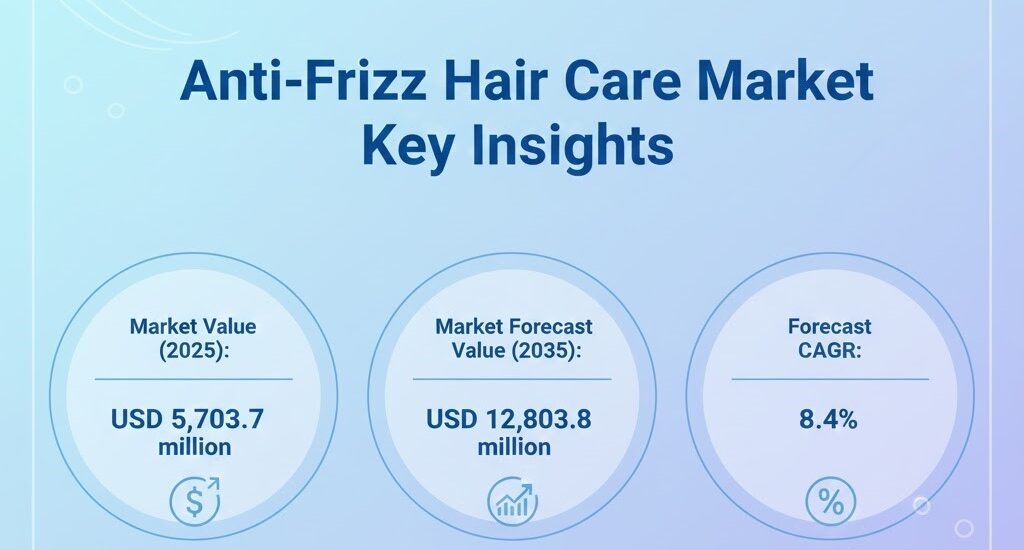
The global Anti-Frizz Hair Care Market is entering its most transformative decade, projected to surge from USD 5,703.7 million in 2025 to USD 12,803.8 million by 2035, marking a robust 125% growth and a steady CAGR of 8.4%. As consumer preferences shift toward natural, silicone-free, and multifunctional solutions, both established leaders and fast-growing new manufacturers are expanding their portfolios and adopting advanced technologies to capture rising demand.
Subscribe for Year-Round Insights → Stay ahead with quarterly and annual data updates – https://www.futuremarketinsights.com/reports/sample/rep-gb-26530
A Decade of Growth: What’s Fueling the Momentum
Between 2025 and 2035, the Anti-Frizz Hair Care Market will add over USD 7,100 million in new revenue, driven by:
- Premiumization of hair care routines, especially serums, oils, keratin leave-ins, and hydrating masks.
- Consumer shift toward natural and argan oil-rich formulations.
- Digital-first expansion via e-commerce, live-streaming platforms, and subscription models.
- Rising demand from Asia-Pacific, particularly India, China, and Japan, where CAGR ranges from 10%–15%.
- Growing adoption of clean-label, vegan, sulfate-free, and dermatologist-certified products.
From 2025–2030, the market adds USD 2,842 million, propelled by premium serums and argan-oil blends. Between 2030–2035, accelerated growth of USD 4,258.1 million emerges through e-commerce dominance, natural butter blends, and texture-specific innovations.
Leading & Emerging Companies Driving Market Expansion
Global powerhouses continue to steer the market—but the competitive landscape is being reshaped by agile, digital-first newcomers.
Established Leaders
- Moroccanoil – Commanding 7.9% global share in 2025 with its argan oil portfolio and salon-led dominance.
- L’Oréal Professional & Kerastase – Strengthening sustainability, sulfate-free formulations, and AI-driven personalization.
- Pantene, Garnier, Tresemmé, Aveda – Scaling mass-to-premium adoption through clean-label innovations.
- John Frieda, OGX, Living Proof – Bridging salon-grade performance with accessible retail solutions.
New & Fast-Growing Entrants
- Indie brands with vegan, silicone-free, dermatologist-tested formulas.
- Digital-first companies using subscription models, influencer campaigns, and D2C channels.
- Regional manufacturers innovating affordable argan blends and herbal anti-frizz products, especially in India and China.
These evolving dynamics create new opportunities for both legacy brands and emerging players to extend global footprint and tap into fast-growing texture-specific categories.
Why the Anti-Frizz Segment Is Growing Faster Than Ever
- Advances in hair cuticle science and humidity-resistance technologies.
- Surging global interest in curly and wavy hair care, reinforced by texture-positivity movements.
- Demand for natural butter blends (shea, cocoa), botanical oils, and keratin complexes.
- Strong push from drugstores, salons, and e-commerce giants enabling global access to premium ranges.
Key Segments of the Anti-Frizz Hair Care Market
- By Product Type
- Serums & Oils (leading, 39.2% share in 2025) – lightweight, instant frizz control; booming in North America & Europe.
- Shampoos & Conditioners – mass adoption in supermarkets and drugstores.
- Leave-In Creams – strong uptake for curly and chemically treated hair.
- Hair Masks – gaining traction for weekly hydration and premium care routines.
- By Ingredient Base
- Argan Oil (dominant at 41.6%) – preferred for hydration, repair, and premium positioning.
- Silicones – facing pushback in mature markets but remain relevant in cost-sensitive regions.
- Keratin Complexes – rising demand for strengthening and long-lasting frizz control.
- Natural Butter Blends – trending due to clean-label and vegan claims.
- By Hair Type
- Curly & Wavy Hair (46.1% share) – fastest-growing due to high frizz susceptibility.
- Straight Hair – growing adoption for shine and humidity protection.
- Chemically Treated Hair – increasing need for repair-focused anti-frizz solutions.
- By Channel
- E-commerce (fastest-growing) – driven by live-streaming, influencers, and subscriptions.
- Salons & Professional Stores – premium category stronghold.
- Supermarkets & Hypermarkets – mass affordability and reach.
- Pharmacies – expanding clean-label and dermatologist-tested product sales.
- By End User
- Women (largest segment) – driving growth in premium serums and masks.
- Unisex – rising rapidly with gender-neutral branding.
- Men – gaining momentum with targeted styling and care solutions.
- By Region
- North America – retains highest value through 2030.
- Europe – sustainability and vegan demand shaping product strategies.
- Asia-Pacific – fastest-growing region fueled by India & China.
- Latin America – wavy-hair population driving mass-market growth.
- Middle East & Africa – rising premium product availability.
- East Asia – Japan leading demand for multifunctional formulations.
Regional Highlights
United States
- Market to reach USD 2,269.82 million by 2035 (CAGR 5.4%).
- Serums & oils hold 34.6% share.
- Strong salon culture and shift to clean-label products.
United Kingdom
- Growth at 8.5% CAGR, driven by multicultural hair types.
- High demand for vegan, sustainable, texture-specific solutions.
India
- Fastest-growing major market (14.6% CAGR).
- Adoption surging across metro and tier-2/3 cities.
- Younger buyers prefer premium serums and argan oil products.
China
- 13% CAGR, second-fastest globally.
- Argan oil leads with 46.1% share.
- E-commerce (Tmall, JD.com, Douyin) dominates sales.
Key Developments
- L’Oréal Professional (March 2024): Launch of sulfate-free, vegan Liss Unlimited line in Europe.
- Moroccanoil (June 2024): Expansion of Frizz Shield Serum using micro-encapsulated argan oil.
Outlook: A Decade of Innovation and New Market Entrants
From 2025 to 2035, the Anti-Frizz Hair Care Market will see intensified competition as brands:
- Develop silicone-free and natural formulations.
- Adopt AI-driven personalization and digital retail ecosystems.
- Introduce texture-specific solutions for curly, wavy, and chemically treated hair.
- Invest in ethical sourcing, especially for argan oil and natural butter blends.
With both legacy brands and agile newcomers innovating rapidly, the next decade will redefine anti-frizz hair care through technology, sustainability, and customized formulations.
Why FMI: https://www.futuremarketinsights.com/why-fmi
About Future Market Insights (FMI)
Future Market Insights, Inc. (FMI) is an ESOMAR-certified, ISO 9001:2015 market research and consulting organization, trusted by Fortune 500 clients and global enterprises. With operations in the U.S., UK, India, and Dubai, FMI provides data-backed insights and strategic intelligence across 30+ industries and 1200 markets worldwide.
Contact Us:
Future Market Insights Inc.
Christiana Corporate, 200 Continental Drive,
Suite 401, Newark, Delaware – 19713, USA
T: +1-347-918-3531
For Sales Enquiries: sales@futuremarketinsights.com
Website: https://www.futuremarketinsights.com
LinkedIn| Twitter| Blogs | YouTube