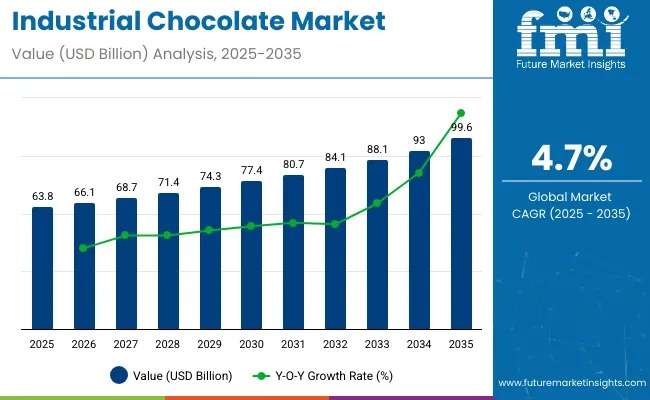
The global industrial chocolate market is projected to advance from USD 63.8 billion in 2025 to USD 99.6 billion by 2035, expanding at a CAGR of 4.7%. With cocoa butter accounting for 42.3% of product share and bakery applications leading with 56.6% usage share, the market is experiencing rapid premiumization across food manufacturing segments. Demand is rising for ethically sourced, high-cocoa, organic, and low-sugar chocolate ingredients, driven by a shift in consumer expectations around transparency, traceability, and health-forward indulgence.
Industrial chocolate now serves as a critical base ingredient across bakery, dairy, confectionery, frozen desserts, and beverage applications. Its versatility in flavor, formulation, coating performance, and texture enhancement is attracting large-scale adoption among global processors. This has pushed major producers to invest in product diversification, cocoa sourcing programs, and advanced processing technologies supporting precision formulation and clean-label certifications.
Explore trends before investing – request a sample report today! https://www.futuremarketinsights.com/reports/sample/rep-gb-16643
Market Growth Snapshot: Industrial Chocolate at a Glance
- Market Size (2025): USD 63.8 billion
- Market Forecast (2035): USD 99.6 billion
- CAGR (2025–2035): 4.7%
- Top Product Segment: Cocoa Butter (42.3%)
- Leading Application: Bakery (56.6%)
- Fastest-Growing Market: China (6.1% CAGR)
Product Leadership: Cocoa Butter Sets Industry Standards
Cocoa butter is set to retain dominance with a 42.3% share in 2025, driven by high usage in premium chocolates and specialty bakery items. Its desirable mouthfeel and melting profile make it a core ingredient for global leaders such as Barry Callebaut, Cargill, and Olam Cocoa. This segment further benefits from expanding use in personal care formulations, adding additional revenue streams.
Cocoa liquor, holding 35% share, continues gaining adoption due to surging demand for dark chocolate with higher cocoa content. Artisanal brands and specialty chocolatiers are boosting consumption by prioritizing high-grade liquor to enhance flavor depth in premium bars and desserts.
Application Outlook: Bakery Leads Industrial Consumption
Industrial chocolate use in bakery manufacturing is projected to represent 56.6% of total demand in 2025, led by growth in artisanal cakes, pastries, cookies, gourmet brownies, and premium dessert chains. Brands such as Grupo Bimbo, Mondelez International, and General Mills integrate high-quality chocolate inclusions to unlock differentiated textures and taste profiles.
Ice cream and frozen desserts are emerging as a lucrative category, holding 18% share, powered by demand for chocolate coatings, dairy-free dessert inclusions, and premium dark chocolate flavors in global portfolios from Nestlé, Unilever, and Häagen-Dazs.
Emerging Trends Shaping Industrial Chocolate Demand
- Shift toward specialty and bean-to-bar sourcing
- Rapid adoption of plant-based, sugar-free, and low-sugar chocolate variants
- Growing preference for sustainable certifications (Fairtrade, Rainforest Alliance)
- R&D investments in heat-resistant, dairy-free, and precision-fermented substitutes
- AI-driven automation for recipe customization and cost optimization
Regional Outlook: Asia-Pacific Outpaces Mature Markets
While North America and Europe continue to command high-volume consumption, Asia-Pacific remains the fastest expanding region, supported by urban lifestyle shifts and rising disposable incomes. China leads global CAGR growth at 6.1%, followed closely by South Korea (5.5%) and the U.S. (5.2%). Quick-service restaurants, e-commerce expansion, premium bakery culture, and demand for imported chocolates are accelerating consumption across these markets.
Competitive Landscape: Innovation Meets Sustainability
The industrial chocolate market is characterized by intense competition among global processors, premium chocolatiers, and regionally specialized brands. Sustainability-led product lines and traceable sourcing are now core differentiators. Major players increasingly invest in cocoa fermentation technology, ethical procurement, and reduced-sugar solutions, while mergers and acquisitions strengthen market reach across evolving premium sectors.
Key Players in the Market
Barry Callebaut | Cargill | Nestlé | Blommer Chocolate Company | Mars Inc. | Puratos Group | Mondelez International | The Hershey Company | Fuji Oil Holdings Inc. | Olam Food Ingredients