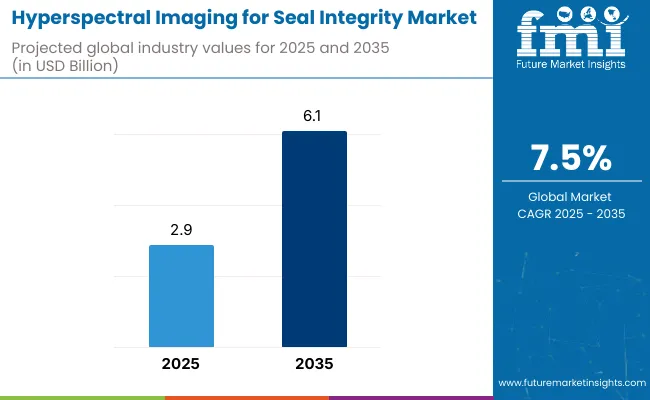
The global hyperspectral imaging (HSI) market in seal integrity is on a fast track — projected to grow from USD 2.9 billion in 2025 to USD 6.1 billion by 2035, nearly doubling over the decade. What’s fueling this surge is a growing demand for advanced, non-destructive inspection systems that can guarantee packaging safety and compliance — especially in sectors like food & beverage, pharmaceuticals, and medical devices.
As the market expands, both established manufacturers and fresh entrants are stepping up with novel technologies, collaborative business models, and AI-driven inspection platforms — all aiming to meet the rising standards for seal reliability, sustainability, and real-time quality control.
🔹 Market Growth & Core Drivers
The shift toward HSI-based seal inspection is being driven by stringent regulatory standards, rising consumer expectations for quality, and the need for absolute assurance in packaging safety. In industries where seal integrity can make or break product integrity — think ready-to-eat meals, vacuum-sealed pouches, sterile medical packaging — HSI stands out because it captures hundreds of spectral wavelengths. That means detecting leaks, seal voids, contamination, or delamination — even when defects are invisible to the human eye or conventional inspection systems.
The near-infrared (NIR) segment leads the market in 2025, capturing 46.1% of revenue, thanks to its strong ability to penetrate packaging materials and reliably detect sub-surface anomalies. Inline conveyor-based systems — which can be integrated directly into production lines — account for more than half of adoption (51.2%). This underscores the industry’s shift toward real-time, high-speed inspection over manual or offline checks.
In terms of end-use, the food & beverage segment is the largest (51.5%), reflecting mounting pressure for compliance under food-safety laws and growing demand for shelf-life reliability and hygiene.
🔹 Changing Competitive Landscape: From Hardware to Smart Ecosystems
The competitive landscape is evolving rapidly. Traditional giants — companies with established reputations in optical systems — have historically dominated, supplying hardware-centric hyperspectral cameras that combine spectral precision and automation compatibility. These vendors have catered especially to high-value packaging operations such as thermoformed trays, pouches, and pharmaceutical blister packs.
But now, a new wave of innovators — mid-sized firms and startup-driven automation providers — is redefining what “HSI for seal integrity” means. By offering open-architecture systems, cloud-connected platforms, inline AI-powered analytics, and software-based subscription models, they are lowering the barrier of entry and making advanced seal inspection systems accessible to mid-tier manufacturers.
Where hardware precision was once the main differentiator, the focus is shifting to intelligent inspection ecosystems, enhanced flexibility across packaging formats, scalability, and recurring revenue through analytics, calibration services, and real-time monitoring.
As one result, by 2035, the revenue mix is expected to shift significantly — with software, remote diagnostics, and subscription-based services making up over 40% of total market revenue.
🔹 Spotlight: Established Leaders & Emerging Players
Legacy players continue to leverage their deep expertise in hyperspectral vision systems, often combining spectral range customization and inline automation to suit flexible packaging lines across industries. Their offerings remain especially vital for high-risk segments like sterile medical packaging and pharmaceutical blister packs.
Meanwhile, newer firms — including mid-sized specialty vendors and automation-first integrators — are gaining momentum by addressing pain points in cost, flexibility, and ease-of-use. These players are introducing modular, format-agnostic HSI solutions with adaptive lighting, remote calibration, and real-time classification algorithms — critical for packaging operations using recyclable or bio-based materials, or handling mixed-material sealants and films.
This evolution is redefining the industry value chain: quality assurance is no longer just about inspection, but about integration — connecting inspection with data logging, analytics, predictive maintenance, and compliance reporting.
🔹 What This Means for Manufacturers — and What’s Next
For established manufacturers, these trends signal a need to evolve: it’s no longer enough to supply powerful cameras or hardware. To stay competitive, they must expand into software, AI-driven analytics, and integrated inspection ecosystems that offer flexibility, scalability, and compliance-ready features.
For newer or niche players — especially those serving mid-sized or diversified packaging operations — this is an opportune moment. More accessible pricing, modular deployment models, and an emphasis on software and services are lowering the barrier for adoption.
Looking ahead, expect continued momentum fueled by:
-
Integration of HSI with inline automation and robotics for high-speed inspection,
-
Expansion into sustainable packaging: recyclable, bio-based films and multilayer seals needing complex optical inspection,
-
AI-driven defect classification and remote diagnostics, reducing reliance on manual calibrations and interpretation,
-
Subscription-based models offering ongoing maintenance, analytics, and reporting — making HSI systems more cost-effective over time, especially for growth-oriented manufacturers.
🔹 Conclusion
The growth forecast for the hyperspectral imaging for seal integrity market points to more than just larger numbers — it reflects a transformation in how packaging quality is assured. As regulatory standards tighten and consumer expectations rise, both established leaders and fresh innovators are reshaping the industry.
For manufacturers, this moment presents a clear choice: adapt, integrate, and evolve — or risk falling behind. Meanwhile, for the industry as a whole, the shift from hardware to smart-systems, from one-time equipment sales to recurring analytics and services, signals a future where quality, compliance, and automation move hand in hand.