The global bioplastic for interior market is poised to grow from USD 4.6 billion in 2025 to USD 8.2 billion by 2035, expanding at a compound annual growth rate (CAGR) of 6.1%, according to Future Market Insights (FMI). This transformation is being shaped by sustainable material adoption in automotive, construction, and commercial interiors, as industries transition toward low-carbon and biodegradable material ecosystems.
Between 2025 and 2030, the market is expected to advance by approximately 32.6%, reaching USD 6.1 billion, supported by consistent annual gains. Growth will favor manufacturers offering high-performance, cost-stable, and design-flexible bioplastics aligned with automotive and furniture production standards.
Sustainability and Material Innovation Lead Market Expansion
The market’s growth is underpinned by the global shift toward environmental compliance, consumer awareness of plastic pollution, and investments in biopolymer processing technologies. Bioplastics are increasingly replacing fossil-based materials in dashboards, trims, door panels, furniture components, and acoustic systems due to improved processability, durability, and recyclability.
Subscribe for Year-Round Insights → Stay ahead with quarterly and annual data updates: https://www.futuremarketinsights.com/reports/sample/rep-gb-23193
Public and private initiatives promoting carbon neutrality, circular economy adoption, and bio-manufacturing infrastructure continue to shape material sourcing and design innovation. As manufacturers align with evolving ESG targets, bioplastics are becoming central to both product differentiation and compliance.
“Sustainability is no longer a design trend—it is a structural market force,” stated an FMI spokesperson. “Bioplastics have transitioned from niche to mainstream as industries integrate renewable materials that perform on par with traditional plastics while meeting strict environmental and quality standards.”
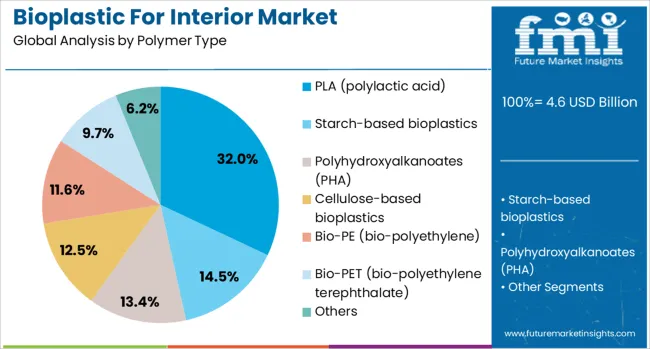
PLA Dominates Material Mix with 32% Market Share
Among polymer types, polylactic acid (PLA) leads with a 32% revenue share in 2025, driven by its moldability, biodegradability, and renewable sourcing. PLA’s thermal stability and compatibility with standard manufacturing techniques—such as injection molding and thermoforming—make it the most preferred biopolymer for high-volume production.
Its use spans automotive interiors, home furnishings, and consumer electronics, where sustainability and performance intersect. Regulatory incentives for compostable materials and advances in PLA-based composite strength further reinforce its dominance through 2035.
Automotive Interiors Remain the Largest Application Segment
The automotive interiors segment is forecast to contribute 39% of total market revenue in 2025, making it the leading application area. Automakers are increasingly deploying bio-based polymers such as PLA, PHA, and bio-PET for dashboards, trims, seat covers, and door panels to achieve lightweighting, recyclability, and emission reduction goals.
The expansion of electric and hybrid vehicles amplifies demand for sustainable interior materials compatible with advanced design tools and digital modeling systems. As OEMs commit to decarbonization and material transparency, bioplastics are emerging as a strategic differentiator in brand sustainability portfolios.
Automotive OEMs Drive End-Use Leadership
By end use, automotive OEMs account for 41% of market share in 2025, maintaining leadership through 2035. OEMs’ focus on circular manufacturing, combined with government regulations on vehicle emissions and waste reduction, has accelerated bioplastic integration into large-scale production.
Manufacturers investing in closed-loop recycling, R&D collaborations, and bio-composite performance testing are gaining a competitive edge. As cost structures improve with scale, OEM adoption will continue to define global market maturity.
Regional Outlook: APAC Leads; Europe, USA, and Saudi Arabia Strengthen Green Transitions
Asia-Pacific (APAC) remains the fastest-growing region, led by China (8.2% CAGR) and India (7.6%).
- In China, national green building policies and smart city projects are boosting bioplastic adoption in furniture, interiors, and modular architecture, supported by local partnerships using PLA and starch-based composites.
- India’s market is expanding due to government bans on single-use plastics and incentives for green manufacturing. Adoption is accelerating in hospitality, wellness, and office interiors, with biocomposites derived from agricultural byproducts gaining traction.
Europe continues to dominate in technological innovation, led by Germany (7.0% CAGR), where circular economy frameworks and eco-labeling drive procurement decisions. France and the UK (5.8%) are expanding bio-interior adoption across public infrastructure, healthcare, and education sectors, supported by post-Brexit sustainability policies and domestic R&D initiatives.
In the United States (5.2% CAGR), demand is supported by LEED certification programs, corporate sustainability commitments, and advanced additive manufacturing for interior components. The growing focus on low-VOC, toxin-free materials and indoor air quality continues to support steady bioplastic penetration across commercial and residential projects.
Saudi Arabia is emerging as a key Middle Eastern growth hub under Vision 2030, integrating bioplastic materials into green construction and automotive diversification programs. Supportive industrial policies and rising regional investments in sustainable building materials position the Kingdom as a pivotal player in GCC’s eco-transition agenda.
Need tailored insights? Request report customization to match your specific business objectives: https://www.futuremarketinsights.com/customization-available/rep-gb-23193
Market Dynamics and Emerging Opportunities
The global bioplastic for interior market is characterized by a strong convergence of design innovation and environmental responsibility. Key drivers include:
- Expanding regulations promoting bio-based materials.
- Increasing adoption in electric vehicles and sustainable architecture.
- Improvements in heat resistance, acoustic insulation, and molding precision.
- R&D advancements in natural fiber hybrid composites for structural interiors.
However, challenges remain related to cost competitiveness, regulatory complexity, and supply chain standardization. Consistent quality assurance, raw material availability, and international testing harmonization will be essential for long-term scalability.
Emerging opportunities include:
- Decentralized manufacturing hubs in Asia and the Middle East.
- Circular economy collaborations among OEMs, polymer producers, and recyclers.
- AI-enabled lifecycle tracking for traceable sustainability validation.
- Bioplastic acoustic panels and decorative solutions for next-generation interiors.
About Future Market Insights (FMI)
Future Market Insights, Inc. (FMI) is an ESOMAR-certified, ISO 9001:2015 market research and consulting organization, trusted by Fortune 500 clients and global enterprises. With operations in the U.S., UK, India, and Dubai, FMI provides data-backed insights and strategic intelligence across 30+ industries and 1200 markets worldwide.
Why Choose FMI: Empowering Decisions that Drive Real-World Outcomes: https://www.futuremarketinsights.com/why-fmi