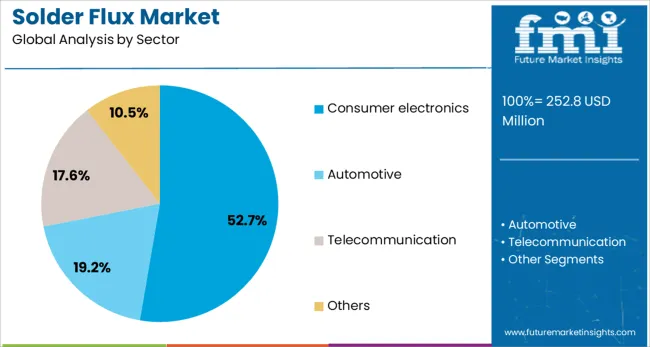
The global solder flux market is on track to grow from USD 252.8 million in 2025 to USD 452.7 million by 2035, expanding at a compound annual growth rate (CAGR) of 6.0%, according to the latest analysis from Future Market Insights (FMI).
The market’s growth is underpinned by the rapid expansion of surface-mount technology (SMT), miniaturized electronics, and the rising integration of lead-free, halogen-free, and low-residue flux formulations across advanced electronic assembly lines worldwide.
Between 2025 and 2030, the market is projected to advance from USD 252.8 million to USD 338.3 million, reflecting accelerating demand in consumer electronics, automotive electronics, and telecommunication systems. By 2035, robust investment in 5G networks, electric vehicles (EVs), and semiconductor packaging will reinforce solder flux as a vital enabler of high-precision manufacturing.
Industry Overview: The Backbone of Modern Electronics Assembly
Solder flux, a critical chemical agent in soldering, plays an indispensable role in ensuring clean, defect-free joints for printed circuit boards (PCBs) and high-reliability components. FMI’s data indicates that flux materials contribute roughly 12–14% of the electronics assembly materials market, and an even larger 18–20% share of the soldering materials market, highlighting their strategic importance.
The adoption of no-clean and water-soluble fluxes, which leave minimal residues and reduce post-solder cleaning requirements, is transforming manufacturing efficiency. This trend is especially strong in automated SMT, BGA, and reflow soldering systems, where flux precision directly impacts component reliability.
Subscribe for Year-Round Insights → Stay ahead with quarterly and annual data updates: https://www.futuremarketinsights.com/reports/sample/rep-gb-23015
“As devices get smaller and manufacturing lines get faster, the chemistry behind solder flux is becoming a differentiator in performance, sustainability, and compliance,” said an FMI industry analyst.
“From Asia’s electronics hubs to Europe’s automotive labs and North America’s semiconductor foundries, solder flux is evolving as both a performance enabler and a compliance driver.”
Market Segmentation Highlights
By Product Type
- No-Clean Flux – Dominates with 46.3% of revenue in 2025, favored for its non-corrosive residue and ability to simplify production workflows without cleaning.
- Rosin-Based Flux – Maintains steady demand in cost-sensitive applications and traditional soldering lines.
- Water-Soluble Flux – Expanding rapidly due to its compatibility with high-speed automated assembly and environmentally friendly cleaning processes.
By Sector
- Consumer Electronics (52.7% in 2025): Smartphones, wearables, and tablets remain key revenue drivers, relying on high-purity flux for micro-soldering precision.
- Automotive Electronics: Growth is tied to EV battery modules, ADAS systems, and infotainment components.
- Telecommunications: The shift toward 5G base stations and IoT networks boosts demand for water-soluble and halogen-free formulations.
- Other Sectors: Aerospace, defense, and industrial automation continue integrating advanced fluxes for high-reliability connections.
Regional Insights
Asia-Pacific (APAC) — The Global Growth Epicenter
APAC leads the global market, contributing the largest share of revenue and fastest growth.
- China is projected to record an 8.1% CAGR, driven by 5G infrastructure rollouts, IoT device manufacturing, and rapid PCB assembly expansion. Water-soluble and no-clean flux types dominate due to high-volume SMT processes and compliance with RoHS directives.
- India follows with a 7.5% CAGR, supported by government programs such as Make-in-India and increasing investments in automotive and renewable energy electronics. Traditional rosin-based flux remains prevalent, though low-residue, lead-free formulations are gaining momentum.
Together, China and India are positioned to account for nearly 48% of total global growth by 2035.
Europe — Precision Manufacturing and Environmental Compliance
Europe’s solder flux market demonstrates strong alignment with sustainability and advanced automation.
- Germany (CAGR 6.9%) continues to lead Europe through its dominance in automotive electronics and EV battery assembly, where no-clean and VOC-free fluxes are now industry standards.
- France (CAGR 6.3%) shows rising adoption in aerospace and defense electronics, driven by low-residue fluxes and AI-enabled process control systems.
- United Kingdom (CAGR 5.7%) focuses on telecommunication equipment and industrial automation, where hybrid water-soluble formulations are being adopted for selective soldering lines.
Across the EU, stringent REACH and RoHS standards have accelerated the shift toward halogen-free flux chemistries, supporting Europe’s clean manufacturing goals.
United States — Innovation in Semiconductor and High-Reliability Electronics
The U.S. solder flux market is projected to expand at a 5.1% CAGR, reflecting increased adoption in semiconductor packaging, defense electronics, and next-gen automotive systems.
Demand for high-purity, no-clean, and low-residue fluxes is rising in aerospace and medical device manufacturing, where reliability and process consistency are paramount.
Investments in AI-assisted flux deposition and automated quality monitoring are expected to drive adoption of advanced materials through 2035.
Saudi Arabia — Emerging Manufacturing Frontier in MENA
In the Middle East, Saudi Arabia is gaining traction as a growing electronics and industrial assembly hub under its Vision 2030 initiative.
Rising investments in automotive parts production, renewable energy systems, and smart infrastructure are fueling demand for environmentally friendly, halogen-free fluxes.
The country’s focus on localized production and import substitution is expected to create new opportunities for regional suppliers by 2030.
Key Growth Drivers and Trends
- Miniaturization and Component Density: The trend toward finer-pitch and high-density packaging demands fluxes with exceptional wetting precision and thermal stability.
- Environmental Compliance: Stricter VOC and halogen restrictions across North America and Europe are accelerating the adoption of eco-friendly fluxes.
- 5G and IoT Infrastructure: Rapid deployment of high-speed networks drives new flux consumption in PCB and telecommunication assembly.
- Automotive Electrification: EVs and hybrid systems increase demand for high-reliability solder joints and fluxes compatible with high-temperature assembly.
- Automation and AI Integration: Smart monitoring systems and AI-guided flux deposition are reshaping assembly efficiency and defect control.
About Future Market Insights (FMI)
Future Market Insights, Inc. (FMI) is an ESOMAR-certified, ISO 9001:2015 market research and consulting organization, trusted by Fortune 500 clients and global enterprises. With operations in the U.S., UK, India, and Dubai, FMI provides data-backed insights and strategic intelligence across 30+ industries and 1200 markets worldwide.
Why Choose FMI: Empowering Decisions that Drive Real-World Outcomes: https://www.futuremarketinsights.com/why-fmi