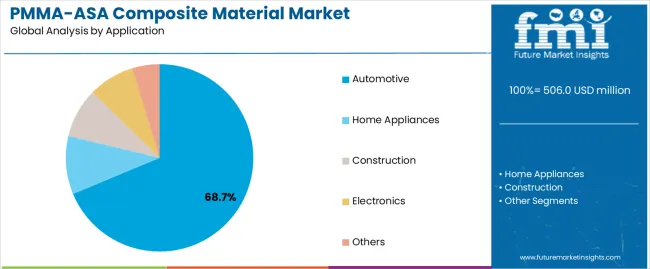
The global PMMA-ASA composite material market is set to witness robust expansion, rising from USD 506 million in 2025 to USD 941 million by 2035, marking a compound annual growth rate (CAGR) of 6.4% over the forecast period. Demand is being fueled by surging applications across automotive, construction, and electronics industries—particularly within Asia-Pacific, Europe, the United States, and Saudi Arabia.
Global Market Snapshot
- Market Size 2025: USD 506 million
- Forecast Size 2035: USD 941 million
- CAGR (2025–2035): 6.4%
- Leading Segment (2025): Automotive Applications – 68.7% Share
- Dominant Grade: Injection Molding Grade – 62.3% Share
- Top Growth Regions: China, India, Germany, USA, Saudi Arabia
PMMA-ASA (Polymethyl Methacrylate-Acrylonitrile Styrene Acrylate) composites are known for their exceptional weatherability, high-gloss finish, impact resistance, and UV stability, making them a preferred material in high-performance and outdoor applications. The market’s expansion is closely tied to the global focus on lightweight, durable, and sustainable materials across manufacturing sectors.
Request the complete report to gain a clear understanding of regional growth patterns, innovation trends, and competitive intelligence! Request Sample Report: https://www.futuremarketinsights.com/reports/sample/rep-gb-27879
Key Market Drivers
- Automotive Lightweighting and Durability
Automotive manufacturers are increasingly adopting PMMA-ASA composites for exterior body panels, trims, mirror housings, and roof modules due to their superior durability and aesthetic quality. The material’s resistance to discoloration, UV degradation, and environmental stress makes it ideal for modern EV and hybrid vehicles, where long-life surface performance is essential.
- Construction and Architectural Innovation
The construction sector’s demand for weather-resistant materials is on the rise. PMMA-ASA composites are being used in façade panels, outdoor cladding systems, and roofing components, especially in hot and humid climates across the Middle East and Asia. Their long-term gloss retention and structural stability are replacing traditional metal and PVC components in modern architectural design.
- Expanding Electronics and Appliance Use
Manufacturers of consumer electronics, outdoor lighting, and appliance housings are turning to PMMA-ASA blends for their combination of strength, gloss, and environmental resistance. The composites offer design flexibility, making them suitable for smart home devices and durable enclosures.
- Sustainable Manufacturing and Recycling
Growing emphasis on environmental compliance and circular economy principles is leading to the development of low-VOC, recyclable PMMA-ASA composites. Industry participants are investing in green polymerization and extrusion processes that minimize emissions and material waste.
Regional Market Insights
Asia-Pacific (APAC): Driving Global Demand
Asia-Pacific remains the epicenter of market growth, projected to register the fastest CAGR of around 8.3% through 2035. China dominates with expanding automotive manufacturing and export-oriented production, while India is witnessing rising demand from both construction and automotive sectors. Increasing urbanization, infrastructure investments, and electric vehicle (EV) adoption are creating a solid foundation for sustained demand.
Europe: Sustainability and Material Innovation
Europe accounts for roughly 28% of global market value in 2025, supported by strong regulatory standards and focus on sustainable materials. Germany, France, and Italy are leading the shift toward environmentally resilient composite systems. The region’s demand for high-performance automotive components and energy-efficient building materials ensures steady consumption through 2035, with an estimated CAGR of 6.4%.
United States: Industrial and Automotive Integration
In the United States, the PMMA-ASA composite market is expanding at an estimated 6.1% CAGR, driven by EV production, smart infrastructure projects, and industrial applications. The U.S. construction sector’s transition toward weather-proof, aesthetic panels is further supporting growth. Automotive OEMs are increasingly specifying PMMA-ASA blends for exterior trims, mirror covers, and fascia components.
Saudi Arabia and the Middle East: Construction Boom and Localization
Saudi Arabia is emerging as a high-growth market, leveraging its large-scale infrastructure projects and localization of polymer industries. The nation’s Vision 2030 development strategy and regional focus on energy-efficient building materials are fostering adoption of PMMA-ASA composites. These materials are being integrated into architectural façades, outdoor installations, and modular construction systems due to their excellent UV resistance and design adaptability.
Segmental Insights
By Grade
- Injection Molding Grade – Holds approximately 62.3% share in 2025, with applications in automotive trims, panels, and consumer goods.
- Extrusion Grade – Expected to gain traction in construction and large-format sheet applications, supporting modular building systems.
By Application
- Automotive: Dominant segment with 68.7% share; driven by EV and high-performance vehicle production.
- Construction: Fastest-growing sector, projected to expand at over 7% CAGR due to increased use in cladding and roofing.
- Electronics: Rising adoption for outdoor and decorative components requiring heat and UV stability.
Challenges and Opportunities
Challenges
- Raw Material Price Volatility: Fluctuations in PMMA and ASA feedstock costs may affect production margins.
- Competition from Substitutes: Alternative polymers like ABS/PC and modified acrylics pose moderate substitution risk.
- Regulatory Compliance: Manufacturers must adhere to evolving global safety, VOC, and recycling standards.
Opportunities
- High-Value Customization: Demand for color-stable, UV-resistant, and design-specific composite materials is creating opportunities for niche manufacturers.
- Localized Production: Expanding regional polymer plants in Asia and the Middle East will reduce logistics costs and ensure sustainable supply.
- R&D in Green Chemistry: Innovation in bio-based PMMA and recyclable ASA variants will attract ESG-focused investors.
Competitive Landscape and Investment Outlook
The global PMMA-ASA composite industry is moderately consolidated, with a mix of global chemical producers and regional compounders focusing on high-purity grades, advanced extrusion technologies, and color-stabilized formulations. Manufacturers are entering strategic partnerships with automotive and construction OEMs to ensure consistent material performance and supply reliability.
Capital expenditure is shifting toward modern compounding lines, precision blending facilities, and closed-loop recycling systems, particularly in APAC and Europe. The increasing focus on low-emission manufacturing and end-of-life recyclability is shaping long-term investment trends.
Outlook (2025–2035)
The PMMA-ASA composite material market is on course to nearly double in value by 2035, reaching approximately USD 941 million. The decade ahead will be defined by:
- Asia-Pacific’s manufacturing expansion,
- Europe’s sustainability-driven innovation,
- U.S. industrial diversification, and
- Saudi Arabia’s infrastructure transformation.
As industries continue to prioritize durability, aesthetics, and environmental performance, PMMA-ASA composites are poised to emerge as a key material platform across global value chains.
About Future Market Insights (FMI)
Future Market Insights, Inc. (FMI) is an ESOMAR-certified, ISO 9001:2015 market research and consulting organization, trusted by Fortune 500 clients and global enterprises. With operations in the U.S., UK, India, and Dubai, FMI provides data-backed insights and strategic intelligence across 30+ industries and 1200 markets worldwide.
Why Choose FMI: Empowering Decisions that Drive Real-World Outcomes: https://www.futuremarketinsights.com/why-fmi