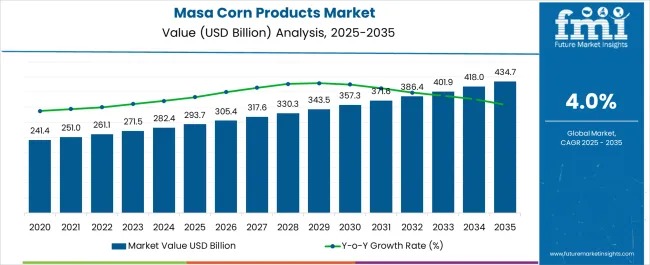
The global Masa Corn Products Market, a rapidly expanding category within the traditional and convenience food industry, is projected to grow from USD 293.7 billion in 2025 to USD 434.7 billion by 2035, achieving a 4.0% CAGR. Consumption trends rooted in cultural authenticity, gluten-free dietary habits, and ethnic food influence are setting the tone for a decade of expansion.
Masa corn, treated through the nixtamalization process, remains a staple in multiple traditional dishes, while its evolving applications in snacks and modern recipes are widening market acceptance.
To Explore Detailed Market Data, Segment-Wise Forecasts, and Competitive Insights, Request Sample Report! https://www.futuremarketinsights.com/reports/sample/rep-gb-4734
Key Market Figures at a Glance
- Market Value 2025: USD 293.7 billion
- Forecast Market Value 2035: USD 434.7 billion
- CAGR (2025–2035): 4.0%
- Top Product Segment 2025: Yellow masa corn (54.2%)
- Leading Application 2025: Tortillas (47.6%)
- Fastest-Growing Channel 2025: Online retail (39.8%)
Drivers Supporting Strong Market Growth
The market is benefitting from a strong convergence of nutrition awareness and cultural food diversity. Health attributes including high protein, dietary fiber, and B-vitamin enrichment position masa corn products as an excellent gluten-free alternative in both household and commercial preparations.
Rapid growth is further supported by:
- Rising consumption of corn-based snacks
- Innovated masa products, including fortified, whole grain, and organic variants
- Regulatory support for non-GMO labeling and organic food certification
With urban consumers seeking healthy, quick-prepare food products, the versatility of masa corn flour is driving mainstream adoption across retail, food service, and online shelves.
Yellow Masa Corn Dominates with 54.2% Share
The Yellow masa corn segment leads with 54.20% of total revenue by 2025. Its nutritional superiority, affordability, and widespread use in staple foods such as tortillas, chips, and tamales make it the preferred product type globally.
The segment is further strengthened by:
- Expanding milling technologies
- Higher production capacities
- Demand from both traditional and modern food manufacturers
Tortillas Hold 47.6% Share as Convenience Food Trend Spreads
Tortillas represent the largest application segment, accounting for 47.60% in 2025, supported by their global mainstream adoption, ease of cooking, and position as a healthier alternative to high-calorie breads.
Product innovations—especially whole grain, organic, and fortified tortillas—are accelerating consumption across North America, Asia Pacific, and Europe.
Online Distribution Captures 39.8% Share
The market’s digital leap is evident, as online platforms account for 39.80% of market share due to rising e-commerce availability and home delivery trends. Online retail allows niche offerings, subscription models, and cross-border product access, supporting both local and global brands in market expansion.
Regional Outlook: North America Leads, Asia Pacific Gains Speed
- North America holds the largest market share, with the U.S. representing 33.90% of global revenue in 2025, driven by high disposable income and established consumption of traditional dishes and snacks.
- Europe emerges as an attractive market due to multicultural cuisine adoption and rising demand for wheat alternatives.
- Asia Pacific stands out as the fastest-growing region, propelled by urbanization, increasing disposable incomes, and strong acceptance of low-calorie, gluten-free diets.
Competitive Landscape
The market is characterized by strong participation from food manufacturers, ingredient providers, and specialty brands. Major companies include:
- Cargill Incorporated
- Archer Daniels Midland
- Buhler AG
- Cornexo GmbH
- Bunge North America Inc
- Gruma, S.A.B de C.V
- Limagrain Cereales Ingredients
- Mesa Foods
- Bob’s Red Mill Natural Foods
Investments are increasingly directed toward processing technology, new product development, packaging innovation, and non-GMO sourcing.
Conclusion
As the world embraces healthy convenience food and multicultural cuisine, the masa corn products market will continue to expand its footprint through diversified applications, digital commerce, and nutritional innovation. The balanced mix of tradition and modern consumption habits positions the market for long-term, stable growth through 2035.