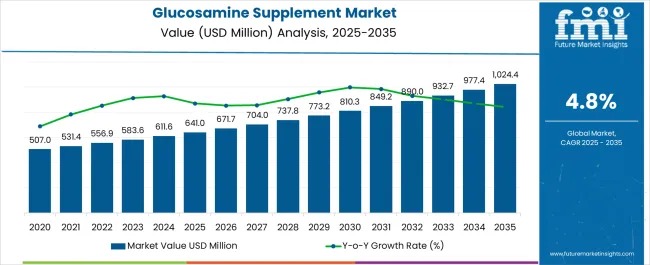
The global glucosamine supplement market is on track for consistent expansion, projected to increase from USD 641.0 million in 2025 to USD 1,024.4 million by 2035. The industry will register a steady CAGR of 4.8% during this period, fueled by a growing consumer shift toward preventive joint health and rising incidence of osteoarthritis worldwide.
Glucosamine, a clinically recognized joint support ingredient, is witnessing heightened consumption among elderly demographics, athletes, and health-conscious consumers seeking long-term mobility solutions without dependence on prescription medication. Increasing awareness of musculoskeletal health, alongside changing dietary patterns and busy lifestyles, is strengthening the nutraceutical demand curve.
To Explore Detailed Market Data, Segment-Wise Forecasts, and Competitive Insights, Request Sample Report! https://www.futuremarketinsights.com/reports/sample/rep-gb-6076
Capsules Surpass 42.7% Market Share, Reinforcing Consumer Preference for Convenience
Capsule formats are expected to generate 42.7% of the global market’s revenue by 2025, making them the leading dosage form across supplement categories. Consumer preference for capsules is attributed to accurate dosing, portability, extended shelf life, and compatibility with vegetarian formulations.
Key formulation advancements—such as capsule combinations containing glucosamine, chondroitin, and MSM—are enhancing product efficacy, further supporting category dominance. Capsule-based products also offer clean label claims and plant-derived shells, improving adoption among vegan and vegetarian users.
N-Acetyl Glucosamine Emerges as the Leading Product Type With 47.3% Share
N-acetyl glucosamine (NAG) is set to represent 47.30% of total revenue by 2025, positioning it as the top-selling glucosamine variant. Besides joint support, the compound offers multifunctional health benefits including skin hydration, immune support, and digestive health functionalities.
Increasing investments in clinical validation, enhanced bioavailability research, and the emergence of plant-based NAG sources have expanded the product’s adoption in nutraceuticals and fortified functional foods. Consumers seeking multi-benefit ingredients are expected to accelerate demand through 2035.
Food & Beverage Applications to Lead with 44.80% Revenue Share
Glucosamine’s entry into mainstream consumption is accelerating through food and beverage applications, projected to account for 44.80% of total revenue by 2025. Fortified beverages, powdered mixes, dietary yogurts, and joint health nutrition bars are gaining traction as consumers prioritize preventive mobility solutions.
Key Growth Drivers in F&B Adoption
- Rising interest in functional beverages and snacks
- Growing influence of clean-label and natural ingredient claims
- Increased consumption among fitness-focused and aging populations
The integration of glucosamine into daily diets is expected to make functional foods one of the fastest-growing application segments throughout the forecast period.
Regional Outlook: North America, Europe, and Asia-Pacific Take the Lead
- North America continues to dominate due to higher osteoarthritis prevalence, aging population growth, and widespread retail supplement access.
- Europe is witnessing strong demand for natural joint support alternatives, especially in Germany, the UK, France, Spain, and Italy.
- Asia-Pacific is emerging as a high-growth regional market, driven by rising incomes, expanding elderly populations in China and Japan, and increased awareness campaigns in India and South Korea.
Competitive Landscape Intensifies With Innovation and Private Labels
The market remains fragmented, with significant investments from major companies including GlaxoSmithKline, Pfizer Inc., Merck & Co. Inc., Sanofi, and Novartis AG, alongside emerging brands such as Solgar, BioTech USA, Nature’s Best, Mylan N.V., and Teva Pharmaceutical Industries Ltd.
Companies are prioritizing:
- Clinical validation of joint-targeted formulations
- Expansion into plant-based variants
- Product diversification into functional foods and beverages
- Affordable private label offerings to expand retail penetration
Private label and store brands continue to challenge major players, increasing competition and driving innovation.
Conclusion
The glucosamine supplement market is set for robust growth, shaped by scientific advancements, demand for preventive mobility solutions, and an aging global population. With capsules, multifunctional ingredients, and functional foods steering market innovation, the sector promises strong investment potential through 2035.