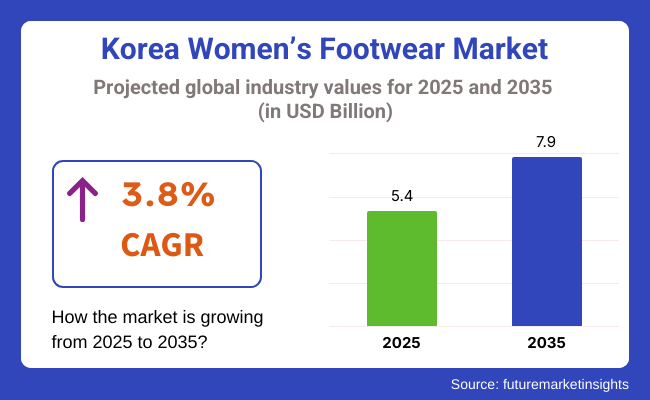
The Korea women’s footwear market is positioned for steady expansion, reaching USD 5.4 billion in 2025 and projected to hit USD 7.9 billion by 2035, growing at a CAGR of 3.8%. Rising purchasing power among urban women, strong influence of K-fashion, and rapid digitalization are reshaping product preferences—from casual comfort wear to high-end couture and athleisure categories. As Korean consumers increasingly blend fashion with functionality, global and domestic brands are intensifying innovation efforts to match evolving lifestyles.
Market Trends Highlighted
- Rise of the fashion-forward urban consumer: Increasing workforce participation among Korean women accelerates demand for premium, stylish, and multifunctional footwear.
- Influence of K-fashion & celebrity culture: K-pop, K-drama, and K-beauty trends continue to shape design preferences across Asia and globally.
- Shift toward casual comfort & athleisure: Sneakers, slip-ons, and loafers lead due to comfort, versatility, and social-media trends.
- Sustainability becoming mainstream: Vegan materials, recyclable packaging, and ethical practices are gaining traction.
- Accelerated e-commerce dominance: Virtual try-on, AI-driven recommendations, and influencer-led promotions reshape buying behavior.
Key Developments
- AI-enabled fitting tools & 3D-printed customization set to transform footwear personalization from 2025 onward.
- Hybrid comfort-fashion footwear gaining ground among professional women balancing style with practicality.
- Boom in sports & outdoor footwear due to growing participation in walking, hiking, and recreational fitness.
- Circular manufacturing models to become industry standard as environmental awareness deepens.
- Omnichannel retailing will blur boundaries between online and offline shopping experiences from 2025–2035.
Key Takeaways of the Report
- Market to grow from USD 5.4 billion (2025) to USD 7.9 billion (2035).
- Casual & athleisure shoes dominate demand, supported by lifestyle shifts and health-conscious consumers.
- Third-party online channels lead sales due to convenience, variety, and competitive pricing.
- Nike, Adidas, and Puma maintain strong dominance in performance footwear, while local brands like YUUL YIE, SOVO, VANILLASHU, and PINK ELEPHANT excel in fashion-forward segments.
- Sustainability, digitization, and comfort-driven fashion remain long-term growth pillars.
Market Drivers
- Rising disposable income among women in metropolitan hubs such as Seoul and Busan.
- Cultural leadership in global fashion, pushing Korean style onto international platforms.
- Social media and influencer culture accelerating trend adoption, especially among Millennials and Gen Z.
- Growing participation in sports and wellness activities, boosting technical and outdoor footwear.
- E-commerce maturity supported by rapid delivery, easy price comparison, and diverse brand access.
Regional Insights
- Seoul Capital Region: Dominates premium and high-fashion footwear due to dense urban population and trend-driven consumers.
- Gyeonggi & Incheon: Strong demand for casual, comfort, and athleisure styles driven by suburban professionals.
- Busan & Southern Provinces: Increasing adoption of outdoor and sports footwear aligning with coastal lifestyles and tourism activity.
- Emerging Tier-2 cities: Rising spending on affordable fashion driven by digital penetration and online retail promotions.
Country-wise CAGR Analysis (2025–2035)
While South Korea’s market grows at 3.8% CAGR, the following comparative insights highlight potential regional influence:
- Japan: 2.6–3% CAGR driven by aging but fashion-conscious consumers.
- China: 5–6% CAGR as K-fashion influences regional purchasing patterns.
- Southeast Asia (Vietnam, Thailand, Indonesia): 6–7% CAGR with Korean brands expanding presence through cross-border e-commerce.
Competition Outlook
The competitive landscape remains intense, led by both global giants and innovative domestic labels.
International Leaders:
- Nike (15–18% share): Strong in athleisure & lifestyle footwear; heavy influencer collaborations.
- Adidas (12–15% share): Popular for streetwear and sports-fashion hybrids.
- Puma (8–10% share): Growing among youthful, athletic consumers.
- SKECHERS (10–12% share): Comfort-driven designs appealing to broad age groups.
- Under Armour (6–8% share): Appeals to performance-focused, fitness-driven shoppers.
- Wolverine World Wide (5–7% share): Known for durability and outdoor utility.
Domestic Champions:
- YUUL YIE (7–10% share): High-end, designer-driven brand with international recognition.
- SOVO (5–7%): Trendy yet practical shoes for younger professionals.
- VANILLASHU (4–6%): Affordable fashion for budget-conscious women.
- PINK ELEPHANT (3–5%): Known for playful, versatile designs.
Key Segments of the Market Report
By Product Type
- Casual Footwear:
Dominant category driven by Korea’s fast-paced urban lifestyle and preference for comfort. Includes sneakers, slip-ons, flats. - Athleisure & Sports Footwear:
Strong growth linked to rising interest in fitness, hiking, and outdoor activities. - Workwear & Office Shoes:
Demand for block heels, refined flats, and comfort-material hybrids. - Occasion & Luxury Footwear:
Designer-led category thriving on Korea’s evolving fashion identity.
By Sales Channel
- Third-party Online Retail (Leading Channel):
Platforms like Coupang, Gmarket, and 11st offer wide assortment, discounts, and fast delivery. - Brand-Owned Online Stores: Increasing traction through direct-to-consumer strategies.
- Offline Stores: Still relevant for fit trials, premium experiences, and luxury purchases.
- Department Stores & Boutiques: Preferred for high-end and limited-edition releases.
Conclusion
The Korea women’s footwear market is transitioning into a highly digital, trend-led, and innovation-driven industry. A blend of fashion influence, e-commerce dominance, rising wellness culture, and sustainability adoption will steer market growth over the next decade. As brands continue investing in omnichannel retail, personalization technologies, and eco-friendly manufacturing, the industry is primed for long-term resilience and global cultural impact.
Subscribe for Year-Round Insights → Stay ahead with quarterly and annual data updates : https://www.futuremarketinsights.com/reports/sample/rep-gb-18645
Why FMI: https://www.futuremarketinsights.com/why-fmi
About Future Market Insights (FMI)
Future Market Insights, Inc. (ESOMAR certified, recipient of the Stevie Award, and a member of the Greater New York Chamber of Commerce) offers profound insights into the driving factors that are boosting demand in the market. FMI stands as the leading global provider of market intelligence, advisory services, consulting, and events for the Packaging, Food and Beverage, Consumer Technology, Healthcare, Industrial, and Chemicals markets. With a vast team of over 400 analysts worldwide, FMI provides global, regional, and local expertise on diverse domains and industry trends across more than 110 countries.
Contact Us:
Future Market Insights Inc.
Christiana Corporate, 200 Continental Drive,
Suite 401, Newark, Delaware – 19713, USA
T: +1-347-918-3531
For Sales Enquiries: sales@futuremarketinsights.com
Website: https://www.futuremarketinsights.com
LinkedIn| Twitter| Blogs | YouTube