

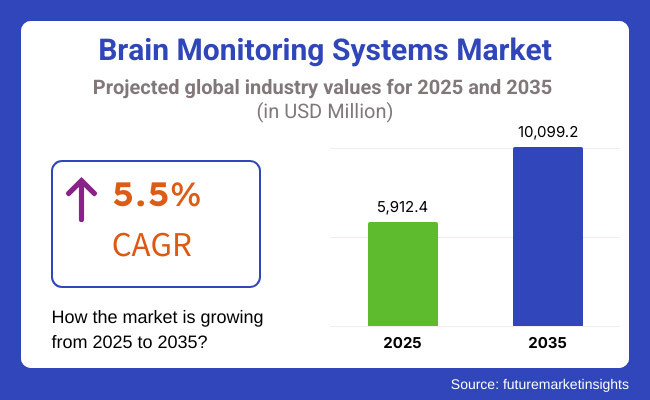
The U.S. Brain Monitoring Systems Market is entering a transformative decade as demand surges for advanced neurodiagnostic tools. The market is projected to reach USD 5,912.4 million by 2025 and climb steadily at a CAGR of 5.5%, ultimately achieving USD 10,099.2 million by 2035. This follows a strong 2024 performance, with revenues reaching USD 5,604.2 million amid heightened attention to brain health, early diagnostics, and cognitive well-being.
Increasing Neurological Disorders Drive Diagnostic Innovation
Growing incidences of epilepsy, Alzheimer’s disease, Parkinson’s, depression, and cognitive decline have intensified the need for accurate, non-invasive monitoring systems such as EEG, fMRI, and MEG. These technologies support clinical decision-making, brain-computer interface research, and personalized medicine.
Explore trends before investing – request a sample report today!
https://www.futuremarketinsights.com/reports/sample/rep-gb-1259
Strong Role of AI, Machine Learning, and Wearables
AI and machine learning are reshaping real-time neurological analysis, accelerating detection of complex neural patterns, and enabling customized therapeutic strategies. The emergence of portable and wearable brain monitoring devices—such as EEG headbands and smart helmets—extends brain health tracking from clinical settings into everyday life, fueling adoption in consumer wellness, sports science, and mental health management.
Rising Focus on Mental Health and Cognitive Performance
Awareness of cognitive health, stress tracking, and mental well-being has surged across the U.S. This has positioned brain monitoring technologies as essential tools for preventive care, enhancing diagnostic accuracy, and supporting interventions for psychiatric and neurological conditions. Hospitals continue to lead adoption, followed by growing use across ambulatory surgical centers where quick, cost-effective diagnostics are in high demand.
Market Momentum Strengthened by Investment and Healthcare Advancements
Government funding, private R&D investments, and university-industry partnerships are accelerating neurotechnology innovation, including more precise imaging tools, improved electrode networks, and AI-assisted analytics. With telemedicine expanding nationwide, brain monitoring systems now support remote diagnostics and continuous observation, improving patient access and outcomes.
Subscribe for Year-Round Insights → Stay ahead with quarterly and annual data updates –
https://www.futuremarketinsights.com/reports/brochure/rep-gb-1259
Industry Challenges Create Opportunities for Next-Gen Solutions
While growth is strong, data privacy and accuracy remain critical challenges. Brain monitoring devices frequently capture highly sensitive neural information, driving increased scrutiny around cybersecurity, GDPR-aligned compliance, and ethical use. Yet these challenges also create opportunities for companies specializing in secure, interoperable, AI-enabled platforms that enhance diagnostic precision while safeguarding patient data.
Clinical and Consumer Markets Expand Through Innovation
Manufacturers focusing on wearable neurotech, portable EEGs, and real-time diagnostic solutions are well positioned for future growth. Personalized medicine is becoming a major differentiator, with continuous brain-wave monitoring proving valuable in the treatment of epilepsy, depression, sleep disorders, and cognitive impairments. The convergence of digital health, AI, and neurotherapeutics is expected to strengthen long-term market demand.
Competitive Landscape Intensifies as New Technologies Emerge
The market is dominated by major players including Neurosoft (36.5%), Natus Medical (20.6%), Medtronic (17.0%), and Integra Lifesciences (6.8%). These companies are advancing portable EEG systems, AI-integrated diagnostic tools, intraoperative monitoring solutions, and remote-friendly neurodiagnostic devices. Smaller manufacturers are contributing through cost-effective products, innovative wearable systems, and niche clinical applications.
End-User Trends Reflect Shift Toward Outpatient Neurodiagnostics
Hospitals remain the leading end users due to the need for advanced neurodiagnostic infrastructure and continuous monitoring. Ambulatory surgical centers, however, are growing at the fastest rate as they emphasize efficient, lower-cost neurological procedures supported by portable monitoring tools.
Market Outlook Through 2035
From 2025 to 2035, adoption will expand significantly in home-based care and tele-neurology. Sustainability efforts will accelerate the development of energy-efficient and recyclable devices. With neurological conditions on the rise and personalized healthcare becoming a national priority, the U.S. brain monitoring systems market is poised for strong, long-term growth.
Why Choose FMI Empowering Decisions that Drive Real-World Outcomes:- https://www.futuremarketinsights.com/why-fmi
About Future Market Insights (FMI)
Future Market Insights, Inc. (ESOMAR certified, recipient of the Stevie Award, and a member of the Greater New York Chamber of Commerce) offers profound insights into the driving factors that are boosting demand in the market. FMI stands as the leading global provider of market intelligence, advisory services, consulting, and events for the Packaging, Food and Beverage, Consumer Technology, Healthcare, Industrial, and Chemicals markets. With a vast team of over 400 analysts worldwide, FMI provides global, regional, and local expertise on diverse domains and industry trends across more than 110 countries.
Contact Us:
Future Market Insights Inc.
Christiana Corporate, 200 Continental Drive,
Suite 401, Newark, Delaware – 19713, USA
T: +1-347-918-3531
For Sales Enquiries: sales@futuremarketinsights.com
Website: https://www.futuremarketinsights.com
LinkedIn| Twitter| Blogs | YouTube




