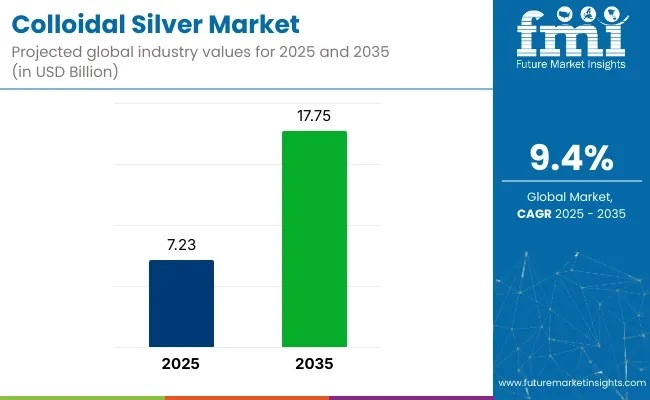
The global colloidal silver market continues its upward growth trajectory, valued at USD 7.23 billion in 2025 and projected to reach USD 17.75 billion by 2035, expanding at a strong CAGR of 9.4%. This momentum is fueled by rising acceptance of natural antimicrobial solutions as consumers and industries move toward cleaner formulations and alternatives to synthetic chemicals.
Growing demand across medical, cosmetic, and personal care sectors remains central to this expansion. With colloidal silver widely recognized for its antibacterial, antifungal, and antiviral properties, it is increasingly incorporated into wound care gels, nasal sprays, topical creams, deodorants, and immune-support supplements.
Request Sample Report With Complete Market Breakdowns And Growth Estimates. https://www.futuremarketinsights.com/reports/sample/rep-gb-7283
The market is advancing rapidly as concerns surrounding antibiotic resistance intensify and consumer preferences shift toward naturally derived therapeutic ingredients. Adoption is particularly high in regions where access to pharmaceuticals remains limited, and wellness-driven purchasing behavior is accelerating product acceptance.
Technological advancements are further reshaping product reliability. Manufacturers are deploying precision particle-size engineering, enhanced bioavailability techniques, and upgraded filtration systems to deliver high-purity, standardized colloidal silver solutions that meet evolving regulatory guidelines. This is especially notable in the cosmetics sector, where silver-infused formulations are used for acne management, anti-aging treatments, and soothing inflamed skin.
Digital distribution channels are also contributing to increased market penetration. Companies are utilizing e-commerce, wellness retail platforms, and influencer-driven health marketing to expand visibility and boost consumer engagement. With global regulations tightening around purity, safety testing, and transparent labeling, producers are aligning their product pipelines with compliance frameworks enforced by the FDA, EMA, and ECHA.
Top Investment Segments Driving the Colloidal Silver Industry
The market is segmented by form, particle size, end use, and region, offering diverse investment opportunities:
By Form – Powder Segment Leads at 72.4% Share
The powder segment is expected to dominate in 2025 with a 72.4% share, driven by advantages including longer shelf life, easy handling, and precise dosing. Powdered colloidal silver is widely used in nutraceuticals, personal care formulations, antimicrobial coatings, and packaging applications.
Its stability and ability to maintain active properties without degradation are crucial for long-term storage and global distribution. Powder forms are especially beneficial in:
- Antimicrobial paints and coatings
- Textile treatments
- Industrial formulations requiring controlled solubility
In contrast, liquid colloidal silver—holding 27.6% share—is favored in consumer-facing products like wound sprays and supplements but presents higher costs related to packaging and shelf-life management.
By Particle Size – 5 to 10nm Category Dominates at 48.1%
The 5 to 10nm segment, accounting for 48.1% of the market in 2025, represents the optimal range for maximum antimicrobial efficacy. Its high surface-area-to-volume ratio allows rapid biological interaction and better membrane penetration, making it ideal for:
- Nasal sprays
- Wound care gels
- Topical creams
- High-efficacy supplements
The 11 to 20nm range, with 27% share, is primarily used in industrial and environmental applications where reduced reactivity is acceptable.
By End Use – Healthcare Holds 52% Share
The healthcare sector leads with 52% share and the highest CAGR of 6.3%. The industry leverages colloidal silver in:
- Burn treatments
- Wound dressings
- Medical device coatings
- Hospital-grade disinfectants
Dietary supplements contribute 38% of demand but face greater regulatory scrutiny concerning nanoparticle ingestion. Cosmetics continue to benefit from rising adoption of clean-label and natural-functional ingredients.
Historical Outlook and Forecast (2020–2035)
Between 2020 and 2024, the market grew at 5.4% CAGR, supported by expanding awareness and R&D advancements. The forecasted 9.4% CAGR for 2025–2035 reflects heightened demand for antimicrobial solutions, improvements in nano-silver stabilization, and increasing application diversification.
Innovations such as soft colloidal silver and advanced nano-formulations have reshaped the landscape, enabling broader medical and consumer applications.
Trends Shaping Global Sales
Key drivers include:
- Rising use of liquid colloidal silver in immunity-support supplements
- Increasing preference for natural substitutes in pharmaceuticals and food
- Expanded consumer awareness about antibacterial and anti-inflammatory benefits
- Growth of cognitive health and wellness-focused formulations
Market statistics indicate consistent yearly performance improvements, strengthening confidence among investors and manufacturers alike.
Country-Level Growth Highlights (2025–2035)
- USA – CAGR 8.8%, growth led by natural health product adoption and robust e-commerce presence
- UK – CAGR 7.7%, strong uptake in skincare and cosmetic innovations
- Japan – CAGR 9.4%, driven by strong interest in natural medicine and nanotechnology
- Germany – CAGR 7.3%, established producer base supporting medical and industrial demand
- France – CAGR 7.0%, rising demand for organic and natural cosmetic formulations
Competitive Landscape
Leading companies are focusing on mergers, acquisitions, and product innovations to strengthen global footprints.
A notable development includes Thermo Fisher Scientific’s 2021 consolidation of its Alfa Aesar, Maybridge, and Acros Organics brands into a single unified brand—Thermo Scientific—enhancing customer experience and supply chain efficiency.
As the industry continues to mature, increased R&D, safety validation, and clean-label product formulation are expected to shape long-term market direction.