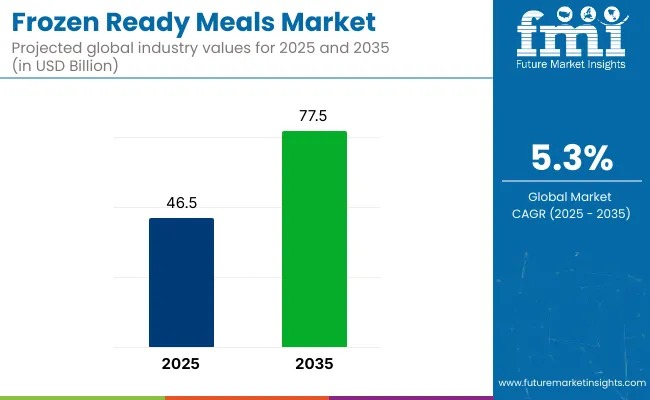
The global frozen ready meals market is set to grow from USD 46.5 billion in 2025 to USD 77.5 billion by 2035, marking a 5.3% CAGR during the forecast period. Demand continues to accelerate as consumers move toward convenient, clean-label, single-serve, and nutritionally balanced frozen meal solutions.
Frozen ready meals now represent:
- Approximately 32% of the total frozen food market
- Nearly 9% of the overall convenience food category
Across developed and emerging markets, frozen ready meals have transitioned from a “quick fix option” to a “premium convenience category,” driven by changes in consumer lifestyles, dietary choices, and digital retail penetration.
Get Exclusive Access To Data Tables, Market Sizing Dashboards, And Analyst Insights. Request Sample Report. https://www.futuremarketinsights.com/reports/sample/rep-gb-6113
Key Market Drivers
Three core forces are shaping category growth:
- Urbanization & Compressed Lifestyles
Consumers are cooking less, working more, and seeking ready-to-eat meals with minimal preparation time. - Premiumization through plant-based and clean-label innovations
Vegetarian frozen meals are projected to hold 35% market share in 2025, reflecting growing adoption of plant-forward diets. - Convenience retail & QSR partnerships
Food chain services are expected to capture 40% of the global distribution share, making them the leading sales channel.
Packaging and Distribution Shifts
Plastic packaging remains the top choice, accounting for 45% of all packaging in 2025. Its durability, cost efficiency, and microwave-safe formats enable seamless retail and consumer usability.
Food chain services, including quick-service restaurants and meal combo offerings, lead the distribution landscape with a 40% share, driven by:
- Menu digitization
- Home delivery integration
- Cross-promotion of frozen SKUs
Online retail is the fastest-advancing channel, supported by aggressive discounting and subscription-based frozen meal kits.
Trend Spotlight: Plant-Based and Single-Serve Frozen Meals
Plant-based and vegetarian SKUs are not fringe innovations — they have become retail drivers. Manufacturers are introducing:
- High-protein vegetarian bowls
- Asian stir-fry and European gourmet meals
- Allergen-friendly variants (gluten-free, dairy-free, nut-free)
Consumers are prioritizing nutrition transparency, selecting products labeled:
- No preservatives
- No artificial colors
- Clean ingredients
The shift reflects a broader trend toward ethical and health-led consumption.
Regional & Country-Wise Growth Highlights
- France leads with the fastest CAGR of 5.1%, fueled by clean-label preference and premiumization.
- USA follows with a 4.9% CAGR, driven by allergen-free and high-protein frozen meals.
- Germany grows at 4.5% CAGR, underpinned by sustainability and eco-friendly packaging norms.
- Japan expands at 4.8% CAGR, driven by premium single-serve ready-to-heat formats for small households.
Saudi Arabia and the broader Middle East show sharp adoption driven by expanding modern trade formats, especially hypermarkets and QSR collaborations.
Regulatory Impact on Market Trust
Agencies like the FDA (USA), EFSA (Europe), and FSSAI (India) enforce stringent standards around storage temperatures, cold chain compliance, and allergen declarations. Certifications such as HACCP and ISO 22000 are increasingly mandatory, pushing manufacturers to elevate food safety and traceability.
These regulatory frameworks are reinforcing buyer trust — enhancing brand loyalty and repeat purchase behavior.
Competitive Landscape
The market is moderately consolidated. Key players include:
- Nestlé S.A.
- Conagra Brands, Inc.
- McCain Foods Ltd.
- General Mills
- Dr. Oetker GmbH
Recent industry developments:
- March 2024: BigBasket launches its frozen brand “Precia,” co-developed with chef Sanjeev Kapoor.
- July 2023: Conagra introduced more than 50 new frozen products, expanding plant-based and value-focused meal lines.
Players are increasingly investing in global flavor profiles, clean ingredients, and subscription delivery models.
Outlook Through 2035
Frozen ready meals are evolving from convenience food to a lifestyle product.
Future growth will be driven by:
- Health-centric frozen bowls
- Direct-to-consumer frozen meal subscriptions
- Smart packaging with freshness and reheating indicators
Quote from Lead Analyst:
“Consumers no longer choose between convenience and nutrition — frozen ready meals now deliver both.”
About the Research
The analysis covers adoption trends across North America, Latin America, Europe, East Asia, South Asia, Oceania, and the Middle East & Africa, including demand insights from more than 40 countries.
Empower Your Business Decisions With Verified Industry Forecasts And Competitor Intelligence. Buy Full Report. https://www.futuremarketinsights.com/checkout/6113
About Future Market Insights (FMI)
Future Market Insights, Inc. (ESOMAR certified, recipient of the Stevie Award, and a member of the Greater New York Chamber of Commerce) offers profound insights into the driving factors that are boosting demand in the market. FMI stands as the leading global provider of market intelligence, advisory services, consulting, and events for the Packaging, Food and Beverage, Consumer Technology, Healthcare, Industrial, and Chemicals markets. With a vast team of over 400 analysts worldwide, FMI provides global, regional, and local expertise on diverse domains and industry trends across more than 110 countries.
Contact Us:
Future Market Insights Inc.
Christiana Corporate, 200 Continental Drive,
Suite 401, Newark, Delaware – 19713, USA
T: +1-347-918-3531
For Sales Enquiries: sales@futuremarketinsights.com
Website: https://www.futuremarketinsights.com
LinkedIn| Twitter| Blogs | YouTube