

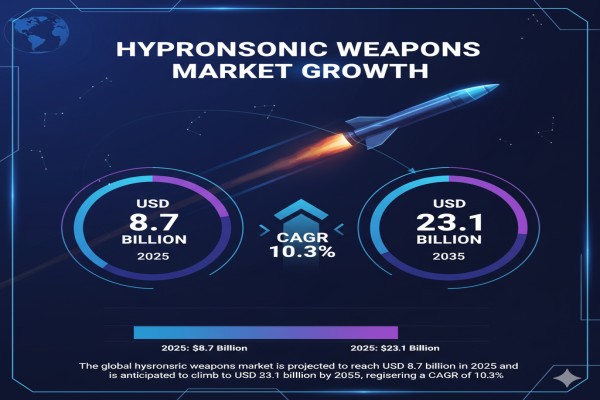
The global hypersonic weapons market is on a robust growth trajectory, projected to expand from USD 8.7 billion in 2025 to USD 23.1 billion by 2035, representing a compound annual growth rate (CAGR) of 10.3% over the next decade. The market’s consistent year-on-year (YoY) growth reflects rising defense expenditures, strategic national security initiatives, and rapid technological advancements in aerospace and propulsion systems.
Early market activity is marked by steady gains, with the market expanding from USD 5.3 billion to USD 5.9 billion in its initial phase, reflecting an 11.3% YoY increase. This momentum continues in subsequent years, reaching USD 6.5 billion and USD 7.1 billion with YoY growth rates of 10.2% and 9.2%, respectively.
By the mid-phase, the market strengthens further, surging from USD 12.8 billion to USD 14.1 billion, a 10.2% growth, and later from USD 14.1 billion to USD 15.6 billion, marking 10.6% growth. In the later years, the market maintains steady gains, ultimately reaching USD 23.1 billion by 2035.
To Explore Detailed Market Data, Segment-Wise Forecasts, and Competitive Insights, Request Sample Report
Market Dynamics and Key Drivers
The hypersonic weapons market is heavily influenced by interconnected sectors including defense and strategic missile systems, aerospace and propulsion technologies, military R&D, space and high-altitude technologies, and precision-guided munitions. Defense and aerospace collectively form the backbone of this market, while specialized R&D ensures technological advancements and competitive edge.
The primary driver of market growth is the strategic capability of hypersonic weapons to travel at speeds exceeding Mach 5 while maintaining high maneuverability. This enables rapid global strike potential, penetration of advanced missile defense systems, and operational flexibility across land, air, and naval platforms. Countries are increasingly prioritizing hypersonic programs to ensure national security and credible deterrence against emerging threats.
Advancements in materials and propulsion systems are accelerating growth. High-temperature alloys, lightweight composites, and scramjet propulsion technologies are enhancing speed, maneuverability, and survivability, while cutting-edge guidance and thermal protection systems are improving precision strike capabilities.
Segment Insights
By type, hypersonic glide vehicles (HGVs) dominate with a 54% market share, owing to their stealth, speed, and unpredictable trajectories. These platforms glide atop ballistic missiles, evading traditional radar systems while enabling mid-course course adjustments for precise strikes.
In terms of range, short-range hypersonic weapons lead with 27% market share, favored for regional deterrence, tactical operations, and rapid deployment in high-intensity conflict zones. For platform, land-based systems account for 38% of the market, providing operational flexibility, rapid mobility, and ease of integration with command networks.
Regional Growth Patterns
Asia-Pacific and North America are emerging as key growth regions. China leads with a projected CAGR of 13.9%, supported by state funding, centralized procurement, and accelerated testing programs. India follows with 12.9% CAGR, leveraging indigenous R&D and private sector integration to expand production capacity and reduce vendor dependency.
In Europe, Germany shows 11.8% growth, emphasizing allied integration and modular subsystem development, while France and the United Kingdom register 10.8% and 9.8% CAGR, respectively, through collaborative programs, flight-test innovations, and advanced propulsion projects. The United States continues to expand at 8.8% CAGR, focusing on multiple concurrent programs across boost-glide and air-breathing cruise designs with strong emphasis on defensive countermeasures.
Competitive Landscape
Key players shaping the hypersonic weapons market
- Lockheed Martin Corporation
- Raytheon Technologies Corporation
- Northrop Grumman Corporation
- L3Harris Technologies
- Leidos
- Thales Group
- BAE Systems
These firms are competing on propulsion performance, thermal management, guidance precision, and seamless integration into existing military platforms.
Collaborations with government agencies, allied nations, and specialized suppliers are accelerating prototype development, field testing, and production scalability. Companies are emphasizing lifecycle maintenance, mission planning, and software assurance packages to differentiate offerings and secure long-term procurement contracts.
To Access The Full Market Analysis, Strategic Recommendations, And Analyst Support, Purchase The Complete Report Here.
Future Outlook
The hypersonic weapons market is set for sustained growth, driven by geopolitical tensions, rising defense budgets, and ongoing technological innovation. As nations race to achieve strategic superiority, both established defense contractors and emerging manufacturers are poised to benefit from increased R&D spending, collaborative ventures, and new production technologies. The evolution of hypersonic weapons is reshaping global defense strategies, emphasizing speed, precision, and survivability as cornerstones of modern military capability.
About Future Market Insights (FMI)
Future Market Insights, Inc. (ESOMAR certified, recipient of the Stevie Award, and a member of the Greater New York Chamber of Commerce) offers profound insights into the driving factors that are boosting demand in the market. FMI stands as the leading global provider of market intelligence, advisory services, consulting, and events for the Packaging, Food and Beverage, Consumer Technology, Healthcare, Industrial, and Chemicals markets. With a vast team of over 400 analysts worldwide, FMI provides global, regional, and local expertise on diverse domains and industry trends across more than 110 countries.
Contact Us:
Future Market Insights Inc.
Christiana Corporate, 200 Continental Drive,
Suite 401, Newark, Delaware – 19713, USA
T: +1-347-918-3531
For Sales Enquiries: sales@futuremarketinsights.com
Website: https://www.futuremarketinsights.com
LinkedIn| Twitter| Blogs | YouTube




