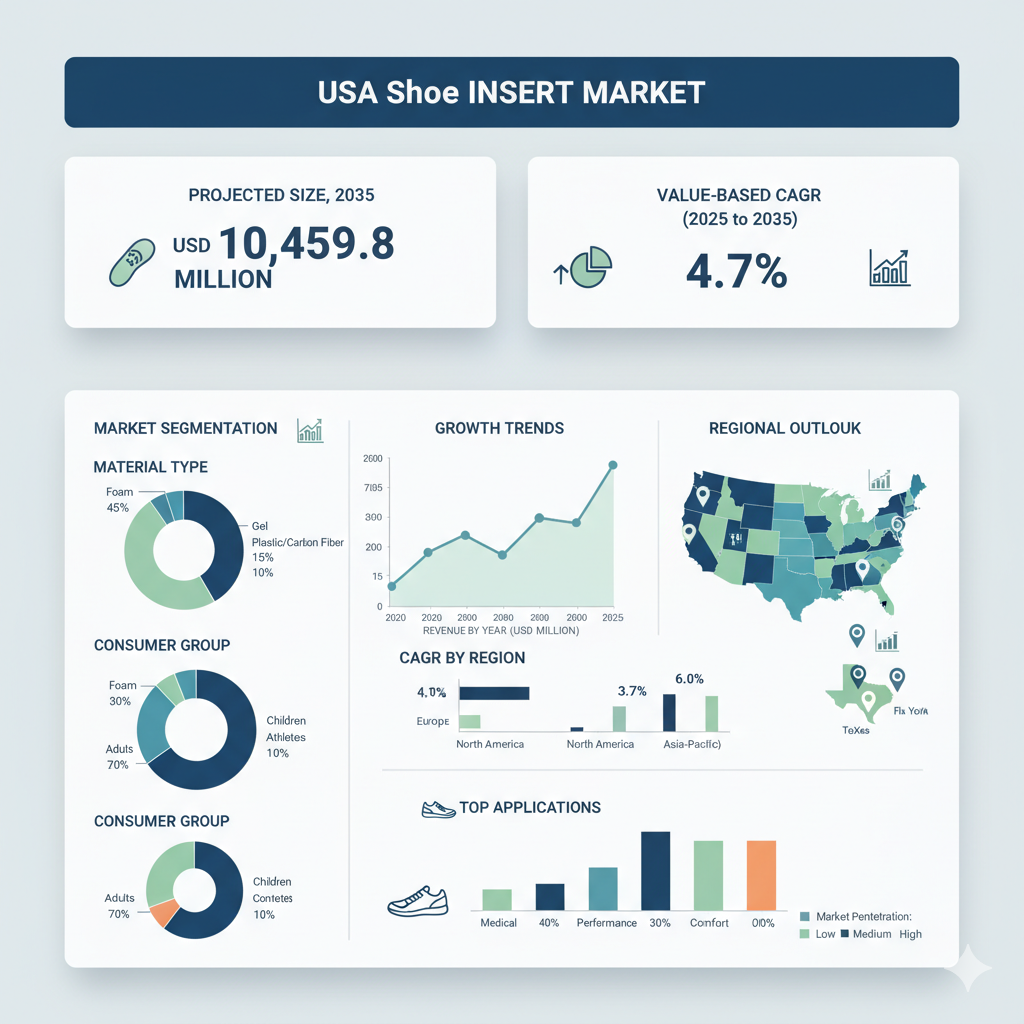
The U.S. shoe inserts market is entering an exciting phase of growth that promises opportunities for both established manufacturers and ambitious newcomers. The market is projected to grow from approximately USD 6,648.6 million in 2025 to reach USD 10,459.8 million by 2035, at a compound annual growth rate (CAGR) of about 4.7%.
A Multiply-Growing Market Tailored to Health and Comfort
With increasing emphasis on foot health, active lifestyles, and ergonomic comfort, consumers are turning to shoe inserts not just as a convenience accessory but as a key element of wellness and performance. Orthotic insoles designed for medical needs, performance-enhancing athletic insoles, and everyday comfort models are each gaining ground.
For manufacturers—whether long-standing players or new entrants—this means more than simply producing a commodity. It means delivering differentiated value through material innovation, customization, meaningful branding, and omnichannel reach.
Opportunities for Established Manufacturers
Brands that have already built scale, manufacturing ecosystems, and brand recognition are well-positioned to leverage this growth. Leading players such as:
- Dr. Scholl’s
- Superfeet
- Spenco
- Sof Sole
- Aetrex Worldwide
- PowerStep
- Footlogics
are cited as dominant forces in the U.S. shoe insert market.
For these established firms, the growth trajectory points to several strategic imperatives:
- Expand into premium and niche segments. With orthotic and athletic insole segments growing swiftly, offering specialized, higher-value products (e.g., custom 3D printed insoles, carbon fibre support, high-end foam or gel composites) is a logical step.
- Leverage e-commerce and digital tools. The online channel is a key growth vector, as virtual fitting tools, subscription models, and direct-to-consumer (D2C) offerings make customization and convenience more accessible.
- Invest in sustainability and new materials. Materials innovation—memory foam, gel, carbon fibre, eco-friendly biodegradable components—is increasingly important to differentiate offerings and appeal to health- and environment-conscious consumers.
Established manufacturers can scale up R&D, expand into adjacent comfort and wellness markets, and deepen partnerships (for example with podiatry clinics or specialty retailers) to maintain leadership while capturing incremental growth.
Entry Opportunities for New Manufacturers and Innovators
For newer players or smaller manufacturers seeking to enter or expand in the U.S. market, the growth scenario provides fertile terrain—but success will depend on choosing distinctive differentiation and nimble business models. Key entry advantages include:
- Customization & direct-to-consumer innovation. 3D scanning and printing technologies are gaining traction, enabling tailor-made insoles for athletes or those with specific foot conditions.
- Eco-friendly and niche specialty segments. Emerging players are differentiating through environmentally sustainable materials and targeting more focused segments (e.g., vegan insoles, industrial-safety insoles, lifestyle comfort segments overlooked by big players).
- Digital native branding and flexible manufacturing. By adopting agile supply-chains, lean production, and online-first marketing, new entrants can bypass some of the legacy burdens that large incumbents have, capitalizing on the rising online sales channel.
- Alternative sales channels. While hypermarkets and supermarkets dominate one portion of the market—with around 27.2% share predicted by 2035—specialty stores and online platforms remain under-exploited for many newer brands seeking visibility and differentiation.
New manufacturers should build a clear value proposition—such as ultra-premium comfort, eco materials, athlete-specific performance, or industrial safety—engage digitally, and exploit lean models to scale cost-effectively.
Why Now is the Right Time
The combination of a sizeable base (over USD 6.3 billion in 2024) and strong forecasted growth through 2035 makes this a compelling time for both existing and new participants. Moreover, the mix of consumer trends—health consciousness, active lifestyles, customization expectations—plus technological enablers like 3D printing, advanced materials, and data-driven fitting, create a platform for meaningful innovation rather than incremental change.
For manufacturers looking to expand, this environment offers the chance to capture growth rather than simply defend share. To succeed: focus on innovation, brand storytelling (comfort + health + performance), distribution agility (online + specialty + D2C), and operational scalability (lean manufacturing, supply-chain flexibility).
Summary
The U.S. shoe insert market is clearly tilting toward growth, differentiation, and innovation. Established manufacturers can expand by doubling down on premium segments, new materials, and channels. New entrants can carve out niche positions with agile models, tech-enabled customization, and purpose-oriented branding—whether eco-friendly, athlete-centric, or wellness-driven.
The future of the shoe insert industry is not just about more of the same products—it’s about smarter, healthier, and more tailored foot-support solutions. Manufacturers of every size who act strategically today can position themselves for strong growth across the next decade.