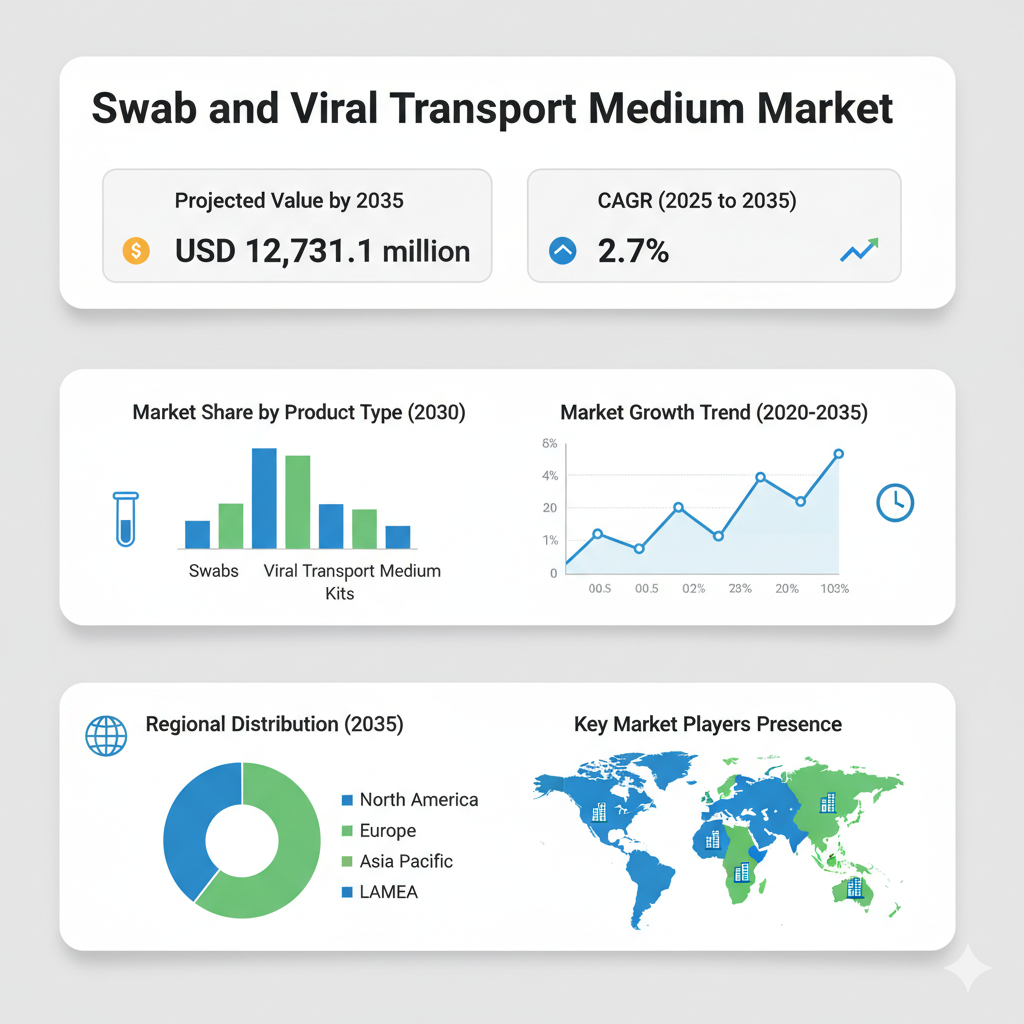
The global swabs and viral transport media (VTM) market is entering a transformative phase, with both long-standing manufacturers and emerging innovators gearing up for expansion. The latest industry projections indicate the market will surpass USD 12.7 billion by 2035, growing steadily at a 2.7% CAGR from 2025 to 2035.
This surge is opening the door for established players to scale production and for new entrants to capture fresh opportunities through advanced technologies, sustainable solutions, and strategic partnerships.
The Changing Market Landscape
Once a niche within the diagnostics industry, the swab and VTM sector has become a cornerstone of global healthcare preparedness. The growing demand for accurate diagnostic testing, particularly for infectious diseases, has strengthened the need for reliable sample collection and preservation tools.
Currently, virus swabs account for nearly 60% of total sales, while VTM contributes around 40%. The market remains highly fragmented—leading multinational corporations command a modest share compared to the large number of regional and specialized manufacturers. This dynamic has created fertile ground for collaboration, technological innovation, and regional diversification.
Established Players Strengthen Global Capabilities
Industry giants are moving swiftly to expand capacity, enhance reliability, and deliver more sophisticated products.
- Becton, Dickinson and Company has scaled up production capabilities for swabs and transport media to meet rising international testing needs, maintaining a focus on quality and sterility.
- Thermo Fisher Scientific has invested heavily in its global supply infrastructure, with facilities capable of producing millions of viral collection kits weekly to support hospitals and testing centers.
- Cardinal Health continues to develop customized viral collection kits designed for seamless integration with diagnostic platforms, improving both accessibility and efficiency across healthcare networks.
These established manufacturers are increasingly focused on next-generation advancements—such as extended shelf-life formulations, temperature-stable transport media, and automation-ready designs that align with modern laboratory systems.
New Entrants Bring Agility and Innovation
While large corporations enhance scale and reach, a new wave of regional and niche manufacturers is redefining innovation at the product level. These companies are focusing on affordability, sustainability, and local adaptability to meet the diverse needs of healthcare systems worldwide.
Emerging brands are developing cost-effective VTMs designed to withstand longer transport times without compromising viral integrity. Others are exploring eco-friendly swabs and biodegradable packaging, aligning product design with global sustainability standards. The introduction of advanced flocked and synthetic swabs has also improved sample yield and diagnostic accuracy, helping smaller firms differentiate through technical performance.
Strategic partnerships are another area of opportunity. New players are forming alliances with retail chains, clinical laboratories, and e-commerce platforms to boost visibility and access. Some are also tailoring product lines for pediatric, point-of-care, and at-home testing applications—segments projected to experience strong growth over the next decade.
Market Drivers and Emerging Trends
Several key factors are shaping the next stage of the swab and VTM industry:
- Rising focus on infectious disease control: Ongoing public health monitoring and pandemic-preparedness efforts continue to drive sustained demand.
- Decentralized diagnostics: The shift toward home-based and rapid testing increases the need for compact, stable, and user-friendly collection kits.
- Technological advancement: Smart labeling, AI-enabled quality assurance, and digital tracking systems are enhancing accuracy and efficiency in specimen management.
- Sustainability and compliance: Governments and healthcare systems are encouraging greener manufacturing practices, reducing medical waste, and prioritizing energy-efficient production.
These trends are encouraging companies across the value chain to modernize operations and explore collaborative approaches to product development and distribution.
Strategic Growth Opportunities
Manufacturers aiming to expand their market presence should focus on several key strategies:
- Invest in advanced technology – Develop VTM formulations that improve viral preservation and design swabs that enhance sample quality and comfort.
- Expand into emerging markets – Establish local production facilities and distribution partnerships in high-growth regions to meet demand efficiently.
- Adopt sustainable practices – Implement recyclable materials and biodegradable components to reduce environmental impact.
- Integrate with diagnostic ecosystems – Partner with molecular test developers and digital tracking providers to offer complete, value-added solutions.
- Enhance brand visibility – Build strong retail and laboratory collaborations to strengthen recognition and accessibility in both developed and developing markets.
A Growing Opportunity for All
The global swab and viral transport medium market is on a clear growth trajectory. Established corporations can leverage their scale, resources, and R&D expertise to advance product quality and operational efficiency. Meanwhile, emerging manufacturers have the agility to specialize, innovate, and localize offerings for targeted markets.
As diagnostic technologies continue to evolve, swabs and VTMs are no longer viewed as simple consumables—they are now critical enablers of global health resilience. Companies that embrace innovation, sustainability, and collaboration today will shape the future of diagnostics tomorrow.