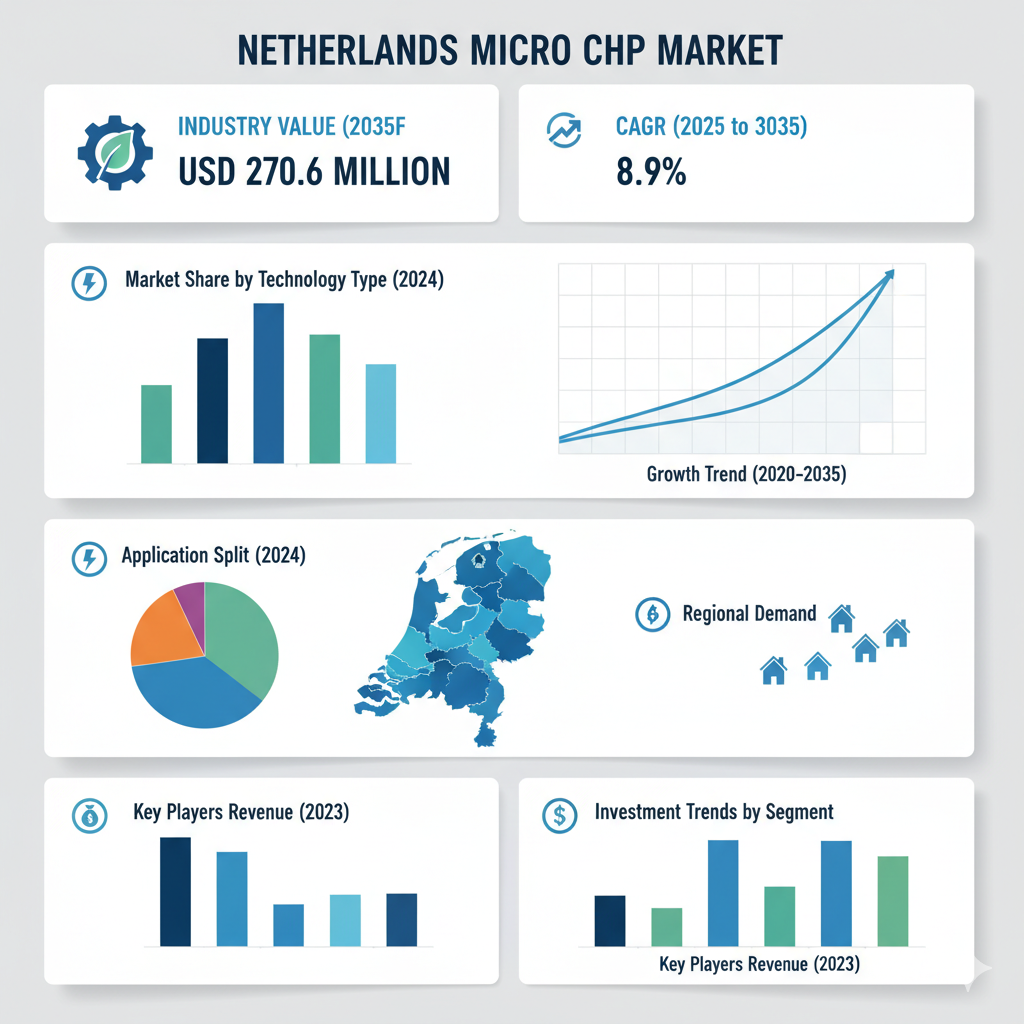
At a time when energy efficiency, decentralization, and climate action take center stage, the Netherlands is emerging as a vital arena of opportunity for both established and new entrants in the micro–combined heat and power (micro-CHP) market. According to a recent market study, the sector is projected to grow from around USD 115.6 million in 2025 to approximately USD 270.6 million by 2035, at a compound annual growth rate (CAGR) of 8.9%.
This surge presents an auspicious moment for legacy manufacturers and emerging players alike to scale their operations, deploy cutting-edge technologies, and cement their presence in the Netherlands’ clean-energy transition.
Established players accelerating their agenda
Major industrial names have already laid strong foundations in the Netherlands’ micro-CHP space. Companies such as ABB Ltd., Siemens AG, Caterpillar Inc., General Electric Company, and Capstone Turbine Corporation are leading the charge in the development and deployment of efficient, low-carbon energy systems.
These companies are taking bold steps:
- ABB recently introduced a dedicated micro-CHP system for the Dutch market, focusing on enhanced efficiency and compact design.
- Siemens entered a strategic partnership with a local energy company to install next-generation micro-CHP units across residential and commercial buildings.
- Caterpillar expanded its micro-CHP product line, targeting small and medium enterprises with flexible, scalable solutions.
- General Electric is collaborating with Dutch universities to develop hybrid micro-CHP systems that integrate renewable energy sources.
For these established players, the Netherlands is not simply another market—it’s a launch pad for innovation. By leveraging deep engineering expertise, global scale, and established manufacturing networks, they can introduce modular and fuel-cell-based micro-CHP systems tailored to local energy needs and sustainability goals.
New entrants and nimble manufacturers: time to amplify
The market also highlights regional and niche players such as Microgen Engine Corporation Holding B.V. and Senertec Kraft-Wärme-Energiesysteme GmbH, each expanding their footprint in the Dutch micro-CHP landscape.
For agile manufacturers, start-ups, and technology pioneers, the Netherlands offers multiple levers to drive growth:
- Focus on fuel-cell technologies like solid oxide and proton exchange membrane systems that deliver higher efficiency and lower emissions.
- Develop hybrid systems that combine micro-CHP with solar, battery storage, or district-heating networks.
- Target the residential segment, where smaller (up to 5 kW) systems are in high demand, while exploring commercial opportunities in the 5–50 kW range.
- Capitalize on government incentives, favorable policies, and growing consumer awareness of energy independence.
For new entrants, the benefits are clear: minimal legacy infrastructure, greater agility to adapt, and the ability to tailor designs for the Netherlands’ unique building stock and sustainability objectives. The country’s energy transition strategy opens the door for smaller innovators to challenge established norms and bring disruptive technologies to market.
Why now? Market dynamics aligned for expansion
Several defining factors are converging to create a powerful growth environment:
- Strong policy commitment to decentralized energy systems and carbon-neutral goals, including the gradual phase-out of natural-gas boilers.
- Rising energy costs and grid-reliability concerns, pushing homeowners and small businesses to seek self-sufficient energy solutions.
- Supportive government programs, including tax credits and installation subsidies that make micro-CHP adoption more attractive.
- Advances in technology, improving both system efficiency and affordability for end-users.
While the future looks bright, challenges remain. High upfront costs, limited installer expertise, and competition from alternative heating systems such as heat pumps and district heating can slow adoption. Yet, for companies that act early—aligning R&D, manufacturing capacity, and go-to-market strategies—these hurdles can be transformed into competitive advantages.
A call to action for manufacturers
Whether you represent a global powerhouse or a rising technology innovator, this is a pivotal moment to engage with the Netherlands’ fast-growing micro-CHP market.
- For established manufacturers: Strengthen your position by leveraging proven engineering capabilities and scaling production of high-efficiency systems that meet local regulatory and consumer demands.
- For emerging manufacturers: Embrace innovation and agility. Develop modular designs, fuel-cell systems, and hybrid solutions that cater to evolving residential and commercial needs.
- For both: Partner with local utilities, installation networks, and research institutions to accelerate adoption and drive the market forward.
The momentum toward decentralized, low-carbon energy solutions is unstoppable. By investing now, manufacturers can not only capture market share but also contribute to the Netherlands’ long-term sustainability agenda.
Final word
The Netherlands’ micro-CHP market is on a clear upward trajectory—set to more than double in size over the next decade. With growing policy support, strong consumer demand, and rapid technological evolution, both established industry leaders and innovative new entrants have the opportunity to shape the future of distributed energy generation.
This is more than a business opportunity—it’s a call to drive sustainable progress and redefine how the Netherlands produces and consumes energy in the years ahead.