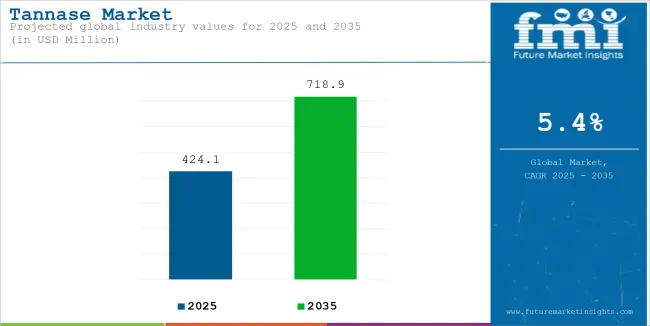
The global tannase market is entering a phase of strong, steady growth as industries embrace enzyme-driven innovation to enhance taste, nutrition, and sustainability. Estimated to be worth USD 424.1 million in 2025, the market is projected to climb to USD 718.9 million by 2035, expanding at a compound annual growth rate (CAGR) of 5.4%, according to the latest industry forecast.
Tannase, an enzyme derived from certain bacteria, fungi, and plants, plays a vital role in improving product quality across multiple industries. Its ability to break down tannins — naturally occurring compounds that add bitterness — has made it invaluable in food and beverage manufacturing, pharmaceutical formulations, and agricultural processing. As global demand for premium taste, improved nutrient absorption, and eco-friendly ingredients grows, tannase adoption is accelerating worldwide.
Tannase’s Expanding Role in Taste Refinement and Nutrition
In beverages such as wine, tea, and craft beer, tannase enhances flavor and smoothness by reducing astringency. The enzyme is widely used to refine taste and balance flavors, creating more enjoyable and consumer-friendly beverages. Major producers such as Novozymes and DSM N.V. have been instrumental in supplying tannase-based solutions to global beverage brands, enabling manufacturers to maintain quality while meeting evolving consumer preferences.
The enzyme’s potential extends far beyond taste enhancement. In the functional food and nutraceutical sectors, tannase is increasingly being used to improve nutrient bioavailability. By breaking down tannins that otherwise inhibit nutrient absorption, manufacturers can deliver products with better health benefits — a trend that aligns with today’s wellness-oriented consumers. Brands like Garden of Life and NOW Foods are leveraging tannase formulations to enhance nutrient uptake in their dietary supplements and functional beverages.
Access Expert Analysis & Forecasts – Buy Now Before Prices Rise! https://www.futuremarketinsights.com/checkout/2064
Semi-Annual Demand Update Reflects Strong Growth Momentum
Recent analysis shows consistent improvement in market performance. The CAGR for the first half of 2025 (H1) is projected at 5.3%, while the second half (H2) is expected to rise slightly to 5.7%, reflecting continued innovation and product expansion across industries. Compared to 2024, where growth stood between 4.8% and 5.0%, these figures highlight a clear upward trajectory for the enzyme market.
This growth momentum reflects the increasing incorporation of tannase into diversified applications — from premium winemaking to functional drinks and pharmaceutical compounds.
Craft and Premium Beverage Sectors Lead Innovation
The booming craft beverage movement has become one of the strongest adopters of tannase. Brewers and vintners seeking unique, refined flavor profiles are turning to enzyme-based innovations to enhance smoothness and complexity. Companies such as Dogfish Head Craft Brewery, known for its experimental brewing techniques, are exploring the use of tannase to craft distinctive beers with balanced taste profiles.
Similarly, premium wineries like Château Lafite Rothschild are using tannase to fine-tune wine flavor, ensuring smoother textures and improved consumer appeal. In rapidly growing wine markets — particularly across the Asia-Pacific region — this innovation is helping winemakers cater to consumers seeking sophisticated, high-quality experiences.
Beyond Beverages: Tannase’s Role in Health, Beauty, and Agriculture
The influence of tannase is now reaching into pharmaceutical, cosmetic, and agricultural sectors. In pharmaceuticals, it aids in improving the efficacy of formulations by helping release nutrients more efficiently. Cosmetic manufacturers use tannase to create smoother, skin-friendly formulations with enhanced natural benefits, while the enzyme’s use in agriculture supports animal feed improvement, making nutrients more digestible and effective.
This versatility is driving more manufacturers — both established leaders and emerging innovators — to expand into the tannase business.
Competitive Landscape: Established Leaders and Emerging Innovators
The tannase market is characterized by a balanced mix of global leaders, mid-size innovators, and local specialists. Tier 1 manufacturers, such as DSM N.V., Novozymes, Creative Enzymes, GlpBio, and Merck KGaA, account for nearly 35–45% of the global market. These players leverage their technological capabilities, strong R&D pipelines, and broad product portfolios to serve a wide customer base.
Tier 2 companies — including MedChemExpress, Beijing Weinuo’en Bio-Technology, Amano Enzyme, and Kikkoman Biochemifa — focus on niche regional markets with strong compliance and regional consumer understanding. Meanwhile, Tier 3 players dominate local markets, offering customized solutions and serving smaller-scale applications, especially across Asia-Pacific.
Collaborations with universities and research institutes are becoming a vital strategy for all three tiers, fostering the discovery of new enzyme sources and innovative formulations.
Explore trends before investing — request a sample report today! https://www.futuremarketinsights.com/reports/sample/rep-gb-2064
Country-Wise Outlook: Key Markets Poised for Expansion
The United States is projected to remain the dominant player, reaching USD 100.6 million by 2035 with a CAGR of 3.9%, driven by its dynamic beverage sector. The nation’s craft brewers and winemakers are increasingly using tannase to refine flavors and reduce bitterness, catering to consumers seeking high-quality drinking experiences.
France, long renowned for its wine culture, is expected to account for 14.3% of European tannase demand by 2035, growing at 4.2% CAGR. French wineries are leveraging tannase to enhance smoothness and complexity, aligning with rising consumer expectations for refined taste and texture.
Meanwhile, China’s tannase market is projected to grow fastest, at 5.8% CAGR, supported by its rapidly expanding wine industry and government support for innovation in beverage manufacturing. As Chinese consumers embrace premium wines and health-oriented beverages, local producers are adopting tannase to differentiate their products in a competitive landscape.
Innovation Spotlight: Sustainability and Plant-Sourced Tannase
Sustainability is shaping the next frontier of tannase development. Plant-sourced tannase, which accounts for 38.2% of the market in 2025, is emerging as a preferred alternative due to its eco-friendly production and minimal environmental impact. Companies focused on clean-label and natural product formulations are investing in plant-based enzyme technologies to meet both consumer and regulatory expectations.
Brands like Health-Ade Kombucha, known for their commitment to natural ingredients, are exploring plant-based tannase to enhance product flavor and maintain sustainability standards.
In the food and beverage sector, which holds a 41.3% market share, the shift toward natural, minimally processed, and functional ingredients continues to drive tannase demand.
About Future Market Insights (FMI)
Future Market Insights, Inc. (ESOMAR certified, recipient of the Stevie Award, and a member of the Greater New York Chamber of Commerce) offers profound insights into the driving factors that are boosting demand in the market. FMI stands as the leading global provider of market intelligence, advisory services, consulting, and events for the Packaging, Food and Beverage, Consumer Technology, Healthcare, Industrial, and Chemicals markets. With a vast team of over 400 analysts worldwide, FMI provides global, regional, and local expertise on diverse domains and industry trends across more than 110 countries.
Contact Us:
Future Market Insights Inc.
Christiana Corporate, 200 Continental Drive,
Suite 401, Newark, Delaware – 19713, USA
T: +1-347-918-3531
For Sales Enquiries: sales@futuremarketinsights.com
Website: https://www.futuremarketinsights.com
LinkedIn| Twitter| Blogs | YouTube