The global industrial water cooling system market is gearing up for a transformative decade, projected to reach USD 3,039.7 million by 2035, growing at a CAGR of 4.7% from an estimated USD 1,920.3 million in 2025. This growth reflects the escalating global demand for energy-efficient, environmentally sustainable, and high-performance cooling solutions across power generation, manufacturing, petrochemical, and metal processing industries.
In 2024, the market generated USD 1,834.1 million, showing a year-over-year growth of 4.3% into 2025. The increasing reliance on water as a core heat exchange medium across industrial processes—ranging from fabrication to product cooling—has established industrial water cooling systems as a critical component in modern operations.
Sustainability and Scale: The Twin Engines of Market Expansion
Industrial expansion, particularly in emerging economies such as India, Brazil, and China, is reshaping global demand for industrial water cooling systems. As manufacturing and energy sectors scale up, cooling solutions are no longer a secondary consideration—they’re essential to maintaining operational stability and compliance with environmental regulations.
In Brazil, government-backed industrial development and foreign investments are catalyzing demand for large-scale cooling systems in petrochemical, automotive, and heavy manufacturing facilities. Meanwhile, Asia-Pacific continues to lead in industrial modernization, with countries like China and India witnessing significant investments in sustainable cooling infrastructure.
Hybrid Cooling Systems: Merging Efficiency with Environmental Responsibility
A major technological evolution is underway as industries transition from traditional open systems to hybrid and closed-loop cooling technologies. These systems merge wet and dry cooling techniques, ensuring maximum heat dissipation while drastically reducing water usage—a crucial advantage in water-scarce regions.
Global players such as Johnson Controls and SPX Cooling Technologies are spearheading innovations in hybrid cooling. Johnson Controls’ York Hybrid Cooling Portfolio stands out for balancing high thermal performance with lower water consumption—making it a preferred solution for large-scale applications in power generation and petrochemical plants.
As industries increasingly prioritize ESG compliance, hybrid systems are gaining traction for offering up to 30–40% energy savings compared to traditional cooling methods.
Renewable Energy Integration: Cooling the Future Responsibly
Integrating renewable energy sources into industrial water cooling operations is one of the most promising frontiers of the decade. Companies are experimenting with solar-assisted chillers, wind-powered pumps, and waste-heat recovery systems to reduce carbon footprints and optimize operational costs.
BECIS and Motivair are leading examples of companies pioneering thermally driven chillers and liquid cooling systems that leverage renewable power. These innovations not only boost energy efficiency but also align with global sustainability targets—a vital step as industries race toward carbon neutrality.
Regional Insights: Growth Anchored in Industrial Transformation
The USA leads North America’s market, capturing a 61.2% share through 2035. Growth here is driven primarily by the booming petrochemical sector, especially along the Gulf Coast, where projects by CPChem and Shell have escalated the need for advanced cooling systems.
In Germany, stringent environmental laws and the nation’s shift toward renewable energy have increased adoption of closed-loop systems for power, metalworking, and food & beverage industries. The upcoming 1,000 MW Brunsbüttel natural gas plant, for instance, will rely heavily on efficient water cooling to maintain productivity and meet regulatory requirements.
Meanwhile, India’s pharmaceutical and automotive industries are emerging as significant growth drivers. As the pharma sector expands its biologics and vaccine production capabilities, demand for precision cooling systems continues to rise. Simultaneously, India’s surging automotive production—growing at a projected 6.79% CAGR from 2024 to 2029—is propelling demand for industrial cooling in engine and component manufacturing.
Market Segmentation: Wet Cooling Takes the Lead
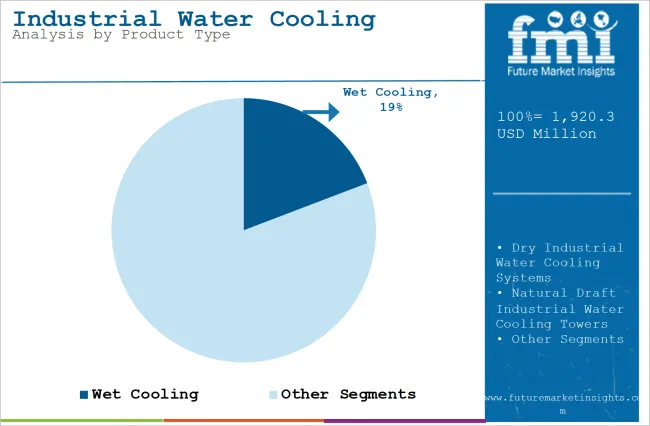
Among product categories, wet cooling systems are expected to hold a 19.2% value share by 2035, expanding at a CAGR of 3.9%. Known for their superior thermal efficiency, wet cooling systems deliver up to 40% energy savings through efficient evaporative cooling.
In terms of end-use industries, the petrochemical sector remains dominant, accounting for 17.1% of the total market share by 2035. These industries operate at extremely high temperatures—often exceeding 800°F—necessitating robust, large-capacity cooling systems (ranging between 50,000 and 150,000 tons of refrigeration).
Historical Performance and Future Outlook
Between 2020 and 2024, the market grew at a 4.3% CAGR, overcoming challenges posed by stringent water regulations and supply chain disruptions during the pandemic. Companies adapted swiftly by adopting digital monitoring, predictive maintenance, and AI-based optimization systems.
The coming decade (2025–2035) promises an even more resilient and adaptive market—shaped by smart automation, modular designs, and the convergence of sustainability and productivity. The incremental opportunity during this period is projected to reach USD 1,119.4 million, underscoring the sector’s strong strategic significance.
Access Expert Analysis & Forecasts – Buy Now Before Prices Rise! https://www.futuremarketinsights.com/checkout/4238
Explore trends before investing — request a sample report today! https://www.futuremarketinsights.com/reports/sample/rep-gb-4238
Competitive Landscape: Collaboration and Innovation at the Core
The market is moderately consolidated, with Tier 1 manufacturers such as IWC (Pty) Ltd., Cold Shot Chillers, Thermal Care, and Parker Hannifin Corporation capturing around 40–45% market share. These global leaders continue to invest in R&D, automation, and smart system integration to meet evolving regulatory and operational demands.
Meanwhile, Tier 2 companies—including Heuch Pty. Ltd., Rittal GmbH & Co. KG, and Freeze Co Systems—are carving a niche by offering customized local solutions for specific industrial requirements, particularly in Asia-Pacific and Latin America.
Recent Industry Developments
- May 2024: Nalco Water (Ecolab) launched its Premium Cooling Water Program, combining water management expertise with digital deposit-sensing innovations for power and chemical industries.
- January 2025: Valvoline Global Operations entered the industrial cooling market, unveiling high-performance liquid cooling solutions at the SC24 show in Atlanta.
About Future Market Insights (FMI)
Future Market Insights, Inc. (ESOMAR certified, recipient of the Stevie Award, and a member of the Greater New York Chamber of Commerce) offers profound insights into the driving factors that are boosting demand in the market. FMI stands as the leading global provider of market intelligence, advisory services, consulting, and events for the Packaging, Food and Beverage, Consumer Technology, Healthcare, Industrial, and Chemicals markets. With a vast team of over 400 analysts worldwide, FMI provides global, regional, and local expertise on diverse domains and industry trends across more than 110 countries.
Contact Us:
Future Market Insights Inc.
Christiana Corporate, 200 Continental Drive,
Suite 401, Newark, Delaware – 19713, USA
T: +1-347-918-3531
For Sales Enquiries: sales@futuremarketinsights.com
Website: https://www.futuremarketinsights.com
LinkedIn| Twitter| Blogs | YouTube