

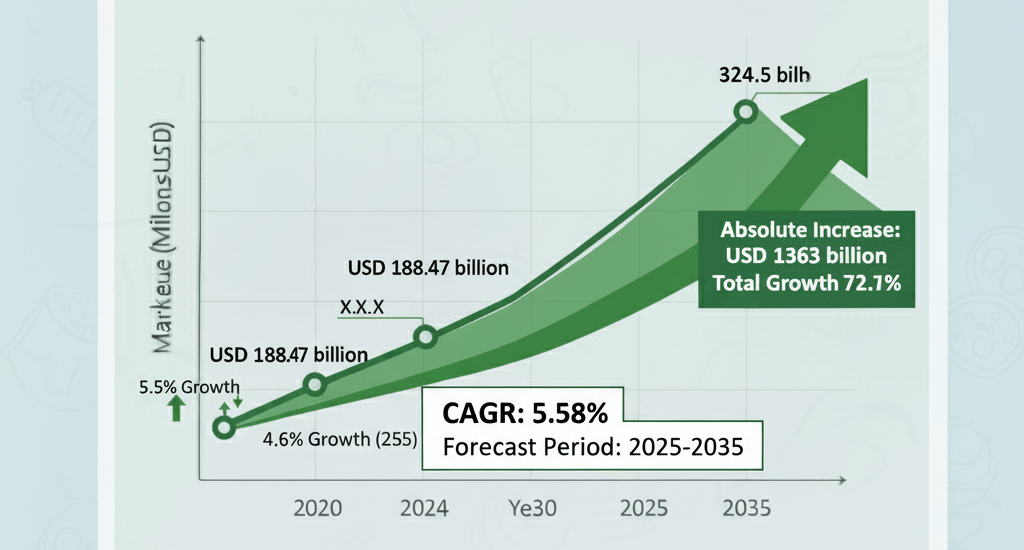
Future Market Insights (FMI), a leading provider of market intelligence and consulting services, today announced the release of its comprehensive report, “Eyewear Market Size, Demand & Growth 2025 to 2035.” The eyewear market is set to grow from USD 188.47 billion in 2025 to USD 324.5 billion by 2035 is set to witness 5.58% CAGR during the forecast period. Fashions and new technology in eyewear are going to be the drivers for the growth of the business. Due to a rise in vision defects, the introduction of new fashion ideas, and advancements in technology, the industry is set to witness growth in the next ten years.Authored by industry expert Rahul Pandita, the report highlights how evolving fashion trends, technological innovations, and rising vision health concerns are reshaping the market, offering critical insights for stakeholders to navigate opportunities in a dynamic landscape. With North America poised to maintain dominance and Asia Pacific emerging as a high-growth hub, this report underscores the eyewear sector’s pivotal role in blending functionality, style, and sustainability to meet global consumer demands.
Eyewear Market Insights: Trends, Growth Drivers, Challenges, and Opportunities:
The eyewear market is on an upward trajectory, driven by a confluence of health, fashion, and tech factors. Key trends include the proliferation of blue-light filtering lenses to combat digital eye strain from increased screen time, the rise of smart eyewear integrated with augmented reality (AR) and artificial intelligence (AI), and a strong push toward eco-friendly materials like biodegradable frames and recycled plastics. The report details how unisex designs are gaining traction for their versatility, appealing to a broader consumer base with neutral colors and timeless styles. Online sales channels are revolutionizing accessibility, fueled by AR-powered virtual try-ons and AI-driven prescription recommendations, which have boosted e-commerce adoption to 72% in regions like the USA, UK, and China.
Growth drivers are multifaceted: a surge in vision defects due to aging populations and digital lifestyles, heightened eye care awareness through government initiatives in markets like India and China, and increasing disposable incomes enabling demand for premium and designer frames. Technological advancements, such as auto-adjusting lenses and smart contact lenses with heads-up displays, are expected to transform the industry from 2025 to 2035. Sustainability remains a core driver, with manufacturers adopting zero-waste processes and bio-based materials to attract environmentally conscious consumers—62% of survey respondents in Europe and Australia/New Zealand prioritize eco-friendly options.
However, challenges persist. High prices for premium products (often USD 300-600) exclude price-sensitive demographics, while intense competition from disruptors like Warby Parker, offering glasses at USD 95, pressures traditional players. Market consolidation, with conglomerates controlling about 39% of the global share, raises monopoly concerns and regulatory scrutiny. Supply chain disruptions from key hubs in China and Italy, coupled with counterfeits and tariffs, add volatility. Alternatives like LASIK surgery and emerging smart tech could erode demand for conventional eyewear. Despite these hurdles, opportunities abound in emerging markets, where rising incomes and eye care access in India (6.7% CAGR) and China (7% CAGR) signal untapped potential. The report’s competitive deep dive reveals strategies like vertical integration and DTC models as pathways to differentiation.
Eyewear Market Update: Evolving Landscape and Future Projections:
From 2020 to 2024, the eyewear industry weathered the pandemic by pivoting to online platforms and addressing digital eye strain, with blue-light lenses becoming mainstream and sustainable practices gaining momentum. Sales surged in prescription glasses and AR-enabled smart products, while e-commerce revolutionized retail through virtual fittings. Looking ahead to 2025-2035, the landscape will shift dramatically: AI and brain-computer interface (BCI) integrations will redefine smart eyewear for navigation, translation, and biometric monitoring. Zero-waste production and self-healing materials will set new sustainability standards, while 3D-printed customization enables hyper-personalized solutions. Regulatory updates, including government mandates for AI-driven eye health monitoring and blockchain for ethical sourcing, will shape innovations. Emerging markets will drive adoption, with per capita spending varying from USD 245.30 in the USA to USD 65.70 in India. The comparative analysis in the report contrasts past shifts (e.g., IoT-enabled glasses) with future trends (e.g., biohacking-inspired eyewear blending fashion and health), providing a roadmap for long-term strategy.
Recent developments underscore the market’s vitality. In early 2025, EssilorLuxottica reported a 9.4% rise in adjusted operating profit to €4.4 billion and full-year revenues of €26.5 billion, bolstered by the sale of 2 million Ray-Ban Meta smart glasses since launch—highlighting the boom in high-tech eyewear. The U.S. optical industry grew to $68.3 billion by January 2025, per The Vision Council, driven by premium and smart segments. Globally, Q2 2025 saw a seasonal $800 million sales dip, but trends like vibrant colors, technical minimalism, and statement frames are revitalizing demand. Luxury eyewear is projected to add USD 4,255 million in value from 2025-2029 at a 4.6% CAGR, while protective eyewear hits USD 2.94 billion in 2025. These updates reflect accelerating innovation, with smart glasses and sustainable designs leading the charge amid economic fluctuations.
Eyewear Market Applications: Strategic Benefits for Businesses:
This report equips diverse industries with actionable intelligence. For manufacturers and retailers, insights into segment-wise growth—such as sunglasses dominating for dual fashion-utility appeal or metal materials favored for durability—enable optimized product development and pricing strategies. E-commerce platforms can leverage data on online channel dominance to enhance AR tools and personalization, boosting conversion rates. Healthcare providers and optical clinics benefit from trends in prescription and blue-light products, informing inventory and patient education amid rising vision disorders. Fashion brands can capitalize on celebrity-driven sunglass demand and unisex trends to expand licensing deals. In emerging sectors like tech and sustainability, the report’s forecasts on AR/BCI integration and eco-materials guide R&D investments. Investors and policymakers gain from risk assessments, including monopoly pressures and supply chain vulnerabilities, to foster competitive, resilient ecosystems. Overall, businesses can use the report’s 5-year forecasts, regional splits across 8 regions and 60+ countries, and market attractiveness analyses to drive revenue growth, mitigate risks, and align with consumer preferences for health-focused, stylish eyewear.
Full Market Report available for delivery. For purchase or customization, please request here: https://www.futuremarketinsights.com/checkout/459
Request for Discount: https://www.futuremarketinsights.com/reports/sample/rep-gb-459
Eyewear Key Players Shaping the Market:
The competitive landscape features a mix of giants and innovators. EssilorLuxottica leads with 15-20% market share, offering comprehensive ranges from prescription lenses to Ray-Ban Meta smart glasses. Johnson & Johnson Vision Care (10-15%) excels in contact lenses and R&D-driven innovations. Bausch & Lomb Incorporated (8-12%) provides diverse eye health solutions, while Carl Zeiss AG (6-10%) focuses on precision optics. Hoya Corporation (5-8%) specializes in advanced lenses. Other key players include CooperVision, Safilo Group S.p.A., Marcolin S.p.A., De Rigo Vision S.p.A., Fielmann AG, and disruptors like Warby Parker and Zenni Optical, which command a combined 40-50% through affordable DTC models and niche strategies.
Explore More Related Studies Published by FMI Research:
Lace Up Boots Market: Projected to increase from USD 3,126 million in 2025 to USD 5,250 million by 2035, growing at a CAGR of 5.3%, driven by rising fashion trends and outdoor utility demand.
Contract Furniture Market: Valued at USD 167.7 billion in 2025, it will expand to USD 312.9 billion by 2035, reflecting strong demand for ergonomic, sustainable, and customizable office furniture amid urbanization.
Shaving Pen Market: Expected to grow from USD 1.5 billion in 2025 to USD 3.2 billion by 2035, at a CAGR of 7.8%, driven by precision grooming trends and innovation in personal styling tools.
About Future Market Insights (FMI)
Future Market Insights, Inc. (ESOMAR certified, recipient of the Stevie Award, and a member of the Greater New York Chamber of Commerce) offers profound insights into the driving factors that are boosting demand in the market. FMI stands as the leading global provider of market intelligence, advisory services, consulting, and events for the Packaging, Food and Beverage, Consumer Technology, Healthcare, Industrial, and Chemicals markets. With a vast team of over 400 analysts worldwide, FMI provides global, regional, and local expertise on diverse domains and industry trends across more than 110 countries.
Contact Us:
Future Market Insights Inc.
Christiana Corporate, 200 Continental Drive,
Suite 401, Newark, Delaware – 19713, USA
T: +1-347-918-3531
For Sales Enquiries: sales@futuremarketinsights.com
Website: https://www.futuremarketinsights.com
LinkedIn| Twitter| Blogs | YouTube




