The global Hydro-Processing Catalysts (HPC) industry is gearing up for a transformative decade driven by sustainability, innovation, and refinery modernization. Estimated at USD 2,233 million in 2025, the market is expected to climb to USD 2,858.5 million by 2035, expanding at a steady CAGR of 2.5%. This growth reflects the increasing demand for cleaner fuels, renewable energy solutions, and advanced refinery technologies that align with global climate goals.
Catalysts Fueling the Energy Transition
Hydro-processing catalysts are the unseen engines behind cleaner energy. They drive critical refinery processes such as hydrocracking, hydrodesulfurization, and hydrodenitrogenation, which enable the production of low-sulfur and high-quality fuels. As environmental regulations tighten worldwide, these catalysts are becoming indispensable for refineries striving to meet emission targets and efficiency standards.
In 2020, the market stood at USD 1,997 million, growing to USD 2,178.6 million by 2024. Year-over-year growth of 2.3% in 2025 signals sustained demand as the industry accelerates its transition toward cleaner energy. Petroleum refineries continue to dominate the segment, accounting for 72.7% of global demand, underscoring the indispensable role of HPCs in modern refining operations.
Hydrotreating Catalysts Lead the Charge
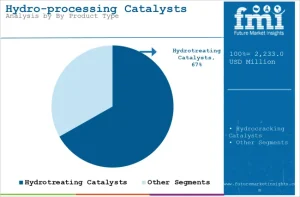
Hydrotreating catalysts remain at the forefront of the hydro-processing catalysts industry, holding a 66.8% share in 2024. They play a pivotal role in removing sulfur, nitrogen, and metals from crude oil—ensuring that refined fuels comply with the world’s strictest environmental standards.
Regions such as North America and the European Union—where sulfur content in fuels is heavily regulated—have witnessed rapid adoption of these catalysts. As a result, global refiners are upgrading units and investing in innovative hydrotreating systems to meet compliance standards efficiently.
Access Expert Analysis & Forecasts – Buy Now Before Prices Rise!
Metals-Based Catalysts Dominate with Strength and Versatility
Metal-based catalysts continue to lead the market with a 54.9% share in 2024. These catalysts, typically made of nickel, molybdenum, and cobalt, exhibit exceptional activity, durability, and efficiency. They are essential for hydrogenation and hydrocracking, two processes critical to refining crude oil into high-value products.
Established companies such as BASF SE, Johnson Matthey, and Haldor Topsoe have invested heavily in developing next-generation metal-based catalysts optimized for renewable diesel and sustainable aviation fuel (SAF) production. Their innovations are shaping a new era of eco-efficient refining.
Sustainability Drives New Applications
A remarkable trend propelling market growth is the integration of hydro-processing catalysts into waste-to-energy (WTE) technologies. These catalysts are increasingly being used to convert waste plastics and biomass into renewable fuels.
Programs such as the U.S. Department of Energy’s Waste-to-Energy Technical Assistance Program, managed by the National Renewable Energy Laboratory (NREL), are accelerating this transformation. By providing technical and regulatory support, these initiatives encourage states and industries to adopt catalyst-driven WTE technologies.
The U.S. Environmental Protection Agency (EPA) has also expanded its focus on sustainable refining, promoting the integration of hydro-processing catalysts in eco-friendly operations to reduce emissions and support circular economy principles.
Global Leaders and New Entrants Pushing Innovation
The global HPC market is moderately consolidated, with Tier-1 players such as ExxonMobil Chemical Company, Shell Catalysts & Technologies, Chevron Phillips Chemical Company, UOP LLC (Honeywell), and BASF SE commanding 50–55% of the total market share. These giants leverage large-scale operations, R&D capabilities, and global networks to introduce high-performance catalysts that meet evolving energy standards.
Meanwhile, Tier-2 and Tier-3 manufacturers—including Clariant International Ltd., Haldor Topsoe A/S, Johnson Matthey PLC, SABIC, and LG Chem Ltd.—focus on specialized applications and regional growth. These emerging manufacturers are increasingly forming strategic partnerships and joint ventures with refineries to co-develop hybrid catalysts that combine hydrocracking and hydrotreating functions.
For instance, Advanced Refining Technologies LLC, a Chevron–W.R. Grace & Co. joint venture, recently introduced ENDEAVOR™, a breakthrough hydroprocessing catalyst designed to convert 100% renewable feedstocks—such as vegetable oils and animal fats—into sustainable diesel and aviation fuel. This exemplifies how established and new players alike are innovating for a decarbonized future.
Regional Outlook: Asia and Latin America Lead the Momentum
The next decade will see robust growth across emerging economies, particularly in China, India, Saudi Arabia, South Korea, and Brazil, where refineries are expanding capacities and upgrading technologies.
- China is expected to grow at a 5.3% CAGR, driven by large-scale refinery upgrades and demand for ultra-low sulfur fuels.
- India follows closely with a 5.1% CAGR, supported by strong government initiatives promoting clean energy and biofuel production.
- Saudi Arabia, home to major refinery expansions under Vision 2030, is projected to reach USD 59.8 million by 2035, reflecting a 4.7% CAGR.
- South Korea’s petrochemical exports, exceeding USD 32 billion in 2022, continue to fuel demand for high-performance catalysts, reaching USD 111.8 million by 2035.
- Brazil, with its booming biofuel industry, is set to grow at a 4.2% CAGR, driven by large-scale biodiesel production initiatives from the Ministry of Mines and Energy (MME).
These regions illustrate the shifting landscape of global refining—where traditional petroleum-based processes are being replaced by low-carbon, catalyst-driven technologies.
Explore trends before investing — request a sample report today!
Challenges and Opportunities: Investment and Innovation
While the future looks promising, the industry faces a challenge in the high initial investment costs required for deploying advanced catalyst systems. Emerging refineries in Asia-Pacific and Africa often face capital constraints that limit large-scale adoption.
However, the development of hybrid multifunctional catalysts presents a transformative opportunity. By combining hydrocracking and hydrotreating properties into a single system, refineries can achieve greater efficiency, lower operating costs, and higher fuel yields. This innovation is likely to shape the next chapter of refinery optimization, particularly in regions balancing economic and environmental objectives.
Half-Yearly Growth Trends Signal Stronger Momentum
The hydro-processing catalysts industry continues to demonstrate steady momentum, with half-yearly CAGRs rising from 2.3% in H1 2025 to 2.7% in H2 2025, reflecting improving refinery margins and sustained demand for clean energy solutions. This consistent growth highlights the industry’s adaptability and readiness to meet global decarbonization targets.
About Future Market Insights (FMI)
Future Market Insights, Inc. (ESOMAR certified, recipient of the Stevie Award, and a member of the Greater New York Chamber of Commerce) offers profound insights into the driving factors that are boosting demand in the market. FMI stands as the leading global provider of market intelligence, advisory services, consulting, and events for the Packaging, Food and Beverage, Consumer Technology, Healthcare, Industrial, and Chemicals markets. With a vast team of over 400 analysts worldwide, FMI provides global, regional, and local expertise on diverse domains and industry trends across more than 110 countries.
Contact Us:
Future Market Insights Inc.
Christiana Corporate, 200 Continental Drive,
Suite 401, Newark, Delaware – 19713, USA
T: +1-347-918-3531
For Sales Enquiries: sales@futuremarketinsights.com
Website: https://www.futuremarketinsights.com
LinkedIn| Twitter| Blogs | YouTube