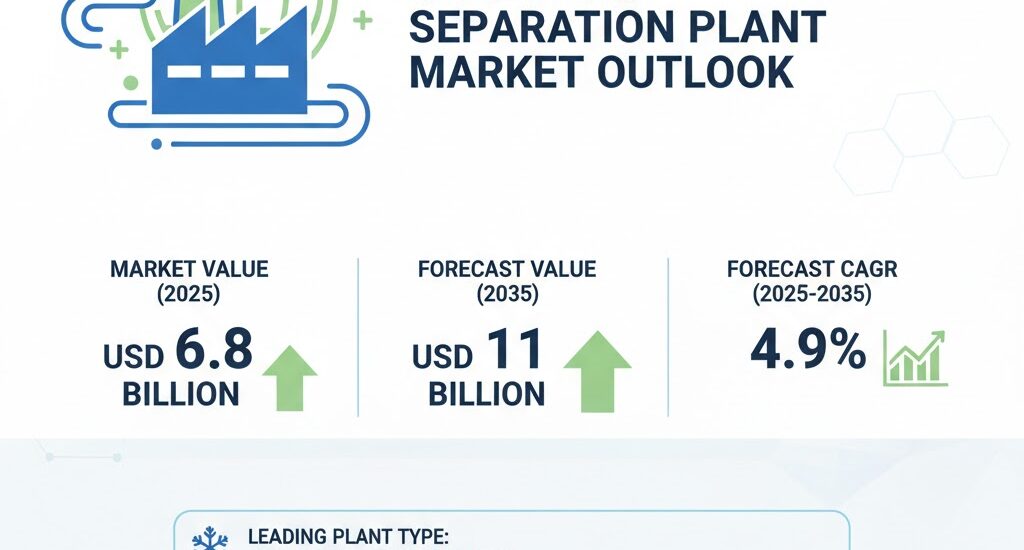
The global Air Separation Plant (ASP) market is entering a decisive decade of expansion, evolving from a USD 6.8 billion valuation in 2025 to an impressive USD 11 billion by 2035. With a forecast CAGR of 4.9%, this growth marks a pivotal shift toward high-efficiency, digitally connected, and low-carbon industrial gas systems that empower manufacturers across the steel, chemical, and healthcare industries.
A Decade Defined by Technology and Efficiency
From 2025 to 2030, the market will add USD 1.8 billion in new value, driven primarily by cryogenic separation systems. Steel production growth and the rising demand for high-purity gases will push manufacturers to adopt automated process control systems and energy-optimized solutions as standard.
Between 2030 and 2035, the industry will accelerate toward energy-efficient and modular ASUs, integrating seamlessly with digital management platforms and smart factory ecosystems. This stage will see the widespread application of AI-enabled monitoring, predictive maintenance, and hydrogen-compatible systems that align with global decarbonization goals.
Cryogenic Separation: The Cornerstone of Industrial Gas Innovation
Cryogenic Air Separation Systems maintain their dominance, commanding 60.2% market share thanks to unmatched gas purity, high throughput, and robust automation capabilities. For manufacturers, this means achieving 99.9% gas purity while maintaining operational reliability and cost control.
These systems are now the foundation of large-scale industrial operations—particularly in iron and steel manufacturing, which accounts for 28% of total market demand. By delivering oxygen enrichment critical to blast furnaces and electric arc furnaces, air separation technology ensures consistent output, reduced downtime, and improved product quality.
Shifting Revenue Models: From Capex Projects to Smart Services
The ASP market’s revenue structure is evolving. Currently, 42% of revenue comes from new plant construction, while 28% is tied to on-site operations under BOO/BOT contracts. By 2030, this landscape will shift toward modular, scalable systems (38–42%) and digital optimization services (18–22%).
Manufacturers are increasingly adopting value-based pricing models—combining hardware, commissioning, digital analytics, and uptime guarantees. This integrated approach allows clients to transition from capital-heavy projects to data-driven, efficiency-oriented partnerships.
Meeting Manufacturers’ Core Challenges
Today’s manufacturers face mounting pressure to increase production efficiency while meeting sustainability and digitalization mandates. The Air Separation Plant market responds directly to these needs through three defining imperatives:
- Efficiency by Design – Automated control, energy optimization, and real-time purity monitoring ensure peak performance with reduced energy intensity.
- Digitization Readiness – Plants equipped with DCS connectivity, predictive maintenance, and smart energy management achieve operational resilience and cost savings.
- Turnkey Integration – Providers now deliver comprehensive engineering, operator training, and digital monitoring frameworks as part of standard project delivery.
These solutions transform air separation from a standalone utility to a strategic enabler of manufacturing excellence.
Buy Now & Save: Premium Market Report at $5,000 | Discount Details Inside:- https://www.futuremarketinsights.com/reports/sample/rep-gb-2886
Regional Growth: Asia Leads, North America Sustains, Europe Modernizes
China and India emerge as global growth leaders, expanding at 5.7% and 5.0% CAGR respectively. Both markets leverage industrial expansion programs emphasizing steel and healthcare infrastructure. In China, Hebei and Shandong provinces are key deployment zones for integrated cryogenic systems, while India’s Mumbai and Hyderabad facilities focus on oxygen security for both industrial and medical use.
South Korea demonstrates technological leadership through ultra-high purity systems tailored for semiconductor and electronics production, while North America—particularly the United States and Canada—maintains stability through advanced chemical complexes, LNG projects, and merchant gas supply networks.
Europe, led by Germany, France, and the UK, showcases modernization across chemical parks, decarbonization pilots, and low-carbon steel initiatives. Germany alone accounts for over 23% of the European market, reflecting its engineering expertise and commitment to EU energy efficiency standards.
Future Market Drivers: Building for the Next Industrial Era
The coming decade’s market trajectory is shaped by powerful structural forces:
- Steel Production Expansion: Rising global demand for oxygen-intensive blast furnace operations drives large-scale cryogenic installations.
- Healthcare Infrastructure Growth: Medical oxygen supply becomes a strategic priority post-pandemic, with on-site ASUs ensuring reliability and safety.
- Chemical and Specialty Gas Demand: Consistent nitrogen and argon requirements for chemical and electronics manufacturing fuel long-term supply contracts.
- Digital Transformation: Predictive analytics, process automation, and digital twins elevate plant performance and maintenance efficiency.
- Decarbonization Initiatives: Integration of hydrogen-ready ASUs and carbon capture capabilities positions the market at the forefront of sustainable manufacturing.
Competitive Landscape: Engineering Strength and Digital Advantage
The market remains moderately consolidated, with 15–20 credible players and the top five to seven companies commanding 65–70% of global revenue. Key players—Linde plc, Air Liquide, Air Products and Chemicals Inc., Taiyo Nippon Sanso, and Messer Group—lead through engineering excellence, long-term operational contracts, and process innovation.
While basic PSA systems are becoming commoditized, competitive advantage now lies in digital integration, process optimization, and turnkey operation services. Companies that merge physical plant reliability with smart digital ecosystems will capture the next wave of industrial transformation.
Toward a Digitally Connected, Low-Carbon Future
The air separation plant industry is no longer just about producing gases—it is about producing performance, efficiency, and resilience. By aligning technology with manufacturers’ core goals—higher productivity, energy efficiency, and sustainability—the market is reshaping the industrial gas landscape for a new era.
As the world moves toward Industry 4.0 and beyond, air separation plants stand as a cornerstone of the global manufacturing infrastructure—providing not only the oxygen and nitrogen that industries breathe but also the intelligence and efficiency that will define their future growth.
Click Here to Purchase the Report:- https://www.futuremarketinsights.com/checkout/2886
About Future Market Insights (FMI)
Future Market Insights, Inc. (ESOMAR certified, recipient of the Stevie Award, and a member of the Greater New York Chamber of Commerce) offers profound insights into the driving factors that are boosting demand in the market. FMI stands as the leading global provider of market intelligence, advisory services, consulting, and events for the Packaging, Food and Beverage, Consumer Technology, Healthcare, Industrial, and Chemicals markets. With a vast team of over 400 analysts worldwide, FMI provides global, regional, and local expertise on diverse domains and industry trends across more than 110 countries.
Contact Us:
Future Market Insights Inc.
Christiana Corporate, 200 Continental Drive,
Suite 401, Newark, Delaware – 19713, USA
T: +1-347-918-3531
For Sales Enquiries: sales@futuremarketinsights.com
Website: https://www.futuremarketinsights.com
LinkedIn| Twitter| Blogs | YouTube