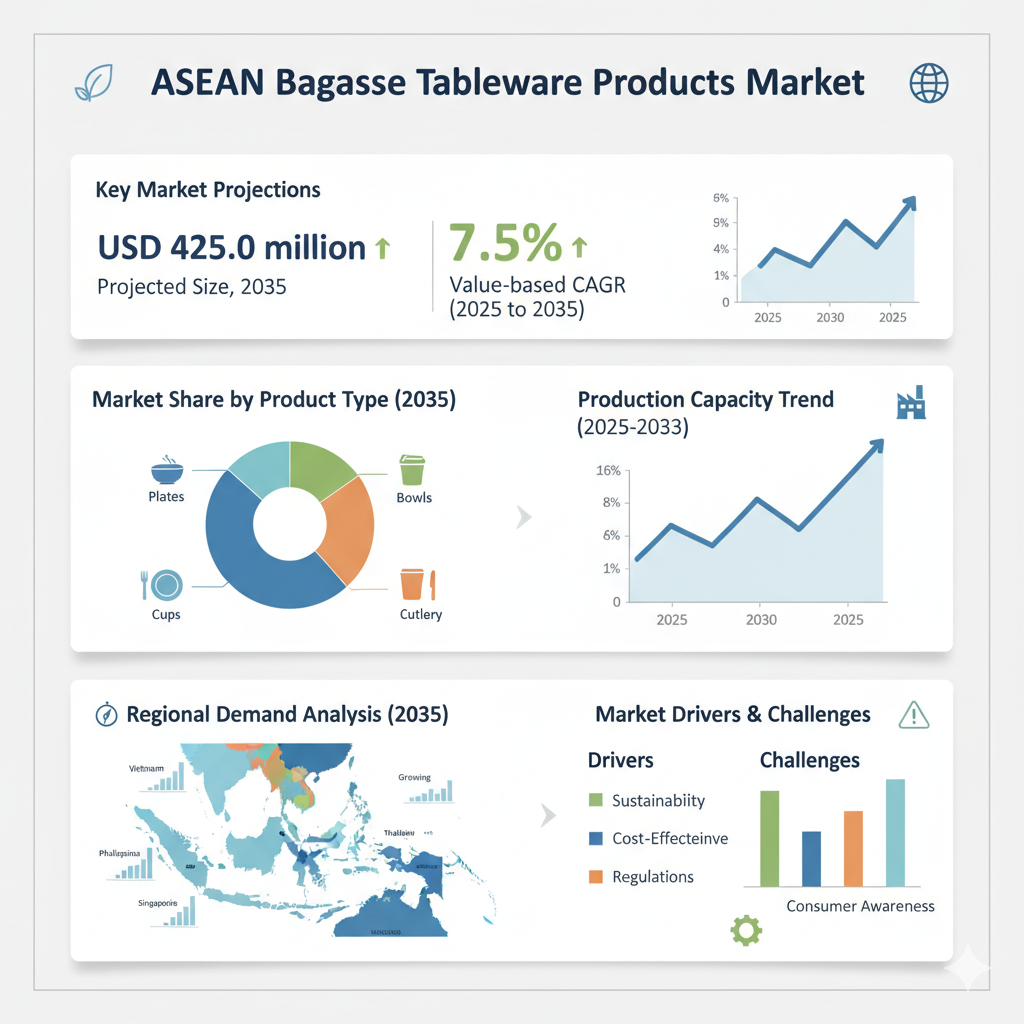
The ASEAN bagasse tableware market is entering an exciting phase of expansion, innovation, and opportunity. Driven by rapid urbanization, the rise of sustainable dining, and regional bans on single-use plastics, this fast-growing market is expected to more than double in value over the next decade.
As demand for eco-friendly tableware surges across Southeast Asia, both established manufacturers and new entrants are stepping up to expand their businesses and introduce breakthrough technologies that redefine how disposable food packaging is made and used.
Established Manufacturers Scaling Toward a Greener Future
Long-standing industry leaders are leveraging their experience and large-scale capabilities to meet the region’s growing appetite for sustainable alternatives. Companies with established manufacturing networks are expanding production lines, upgrading technology, and shifting toward completely compostable and biodegradable bagasse-based products.
These mature players are focusing on developing non-laminated tableware—an area expected to dominate future demand due to its full compostability and reduced chemical use. With improved pulp processing systems, precision molding, and enhanced product-finishing technologies, established producers are positioned to deliver high-volume, high-quality products while lowering environmental impact.
Strategic partnerships and acquisitions are also becoming key growth tools for established companies. By investing in smaller, innovation-driven firms or collaborating with regional distributors, they’re not only strengthening their supply chains but also accelerating the adoption of new, sustainable materials and coatings.
New Entrants Driving Local Innovation and Agility
Alongside these global and regional leaders, a new wave of mid-sized and local manufacturers is entering the market with agility and purpose. These companies are filling supply gaps across rapidly growing markets such as Thailand, Vietnam, Malaysia, and the Philippines—countries where sustainable dining culture and government initiatives are taking center stage.
New players are introducing flexible business models, localized sourcing of sugarcane bagasse, and modern production lines that make small-batch or customized tableware viable. With reduced setup costs and a focus on innovation, they are carving out niches through creativity—developing stylish, durable, and fully compostable tableware designed for cafés, quick-service restaurants, and food-delivery brands.
Digital technologies such as automated forming, precision quality-control systems, and AI-driven resource optimization are helping these emerging manufacturers compete on efficiency and price while maintaining eco-credentials.
Technology and Sustainability: The Core of Future Growth
The ASEAN bagasse tableware market is moving beyond basic production—innovation in design, materials, and processing is taking center stage. As the market matures, companies are investing in next-generation technologies to enhance product performance, appearance, and sustainability.
Among the most promising developments are:
- Non-laminated bagasse products: expected to account for the majority of market share, offering a fully compostable solution free of plastic coatings.
- Smart manufacturing systems: including automated pulp forming, moisture control, and thermal finishing, enabling higher throughput and consistent quality.
- Digital traceability tools: ensuring transparency in raw material sourcing and sustainability certifications.
- Advanced product design and forming: allowing for intricate shapes like clamshells, bowls, and trays that meet food-service industry needs.
These advancements not only enhance operational efficiency but also align with consumers’ growing preference for environmentally responsible brands.
ASEAN: The Hotspot for Sustainable Tableware
The ASEAN region represents one of the most dynamic and promising markets for biodegradable packaging worldwide. Rapidly growing populations, booming tourism, and a vibrant food-service industry are fueling sustained demand for eco-friendly tableware.
Countries such as Indonesia, Thailand, Vietnam, and Malaysia are implementing strong plastic-reduction policies and encouraging businesses to switch to compostable alternatives. Food-service operators—from street vendors and cafés to hotels and quick-service chains—are turning to bagasse tableware for its strength, leak resistance, and natural aesthetic.
By 2035, commercial use is expected to account for a dominant share of total market demand, underscoring the strong influence of restaurants, catering services, and mobile food vendors on the industry’s growth trajectory.
Opportunities for Manufacturers: Expanding Markets, Evolving Expectations
For both established and emerging producers, now is the time to act. The ASEAN bagasse tableware market offers a rare combination of rapid growth potential and long-term stability, driven by policy support and evolving consumer behavior.
To capture this opportunity, manufacturers should focus on:
- Scaling production to meet the surge in demand while maintaining sustainability standards.
- Investing in innovation—from materials research to automated equipment and digital quality monitoring.
- Building partnerships with regional distributors, hospitality groups, and government initiatives to enhance market presence.
- Strengthening brand positioning through sustainability certifications, transparent sourcing, and environmentally responsible packaging.
Those who move swiftly will be best positioned to lead as the market matures and sustainability becomes an expectation rather than an option.
About the Report
The “ASEAN Bagasse Tableware Products Market: Growth, Demand & Forecast 2025–2035” report analyzes market trends, regional insights, product segmentation, and key growth factors shaping the future of sustainable tableware across Southeast Asia. It highlights opportunities for established manufacturers and startups to innovate, expand, and align with global sustainability goals.