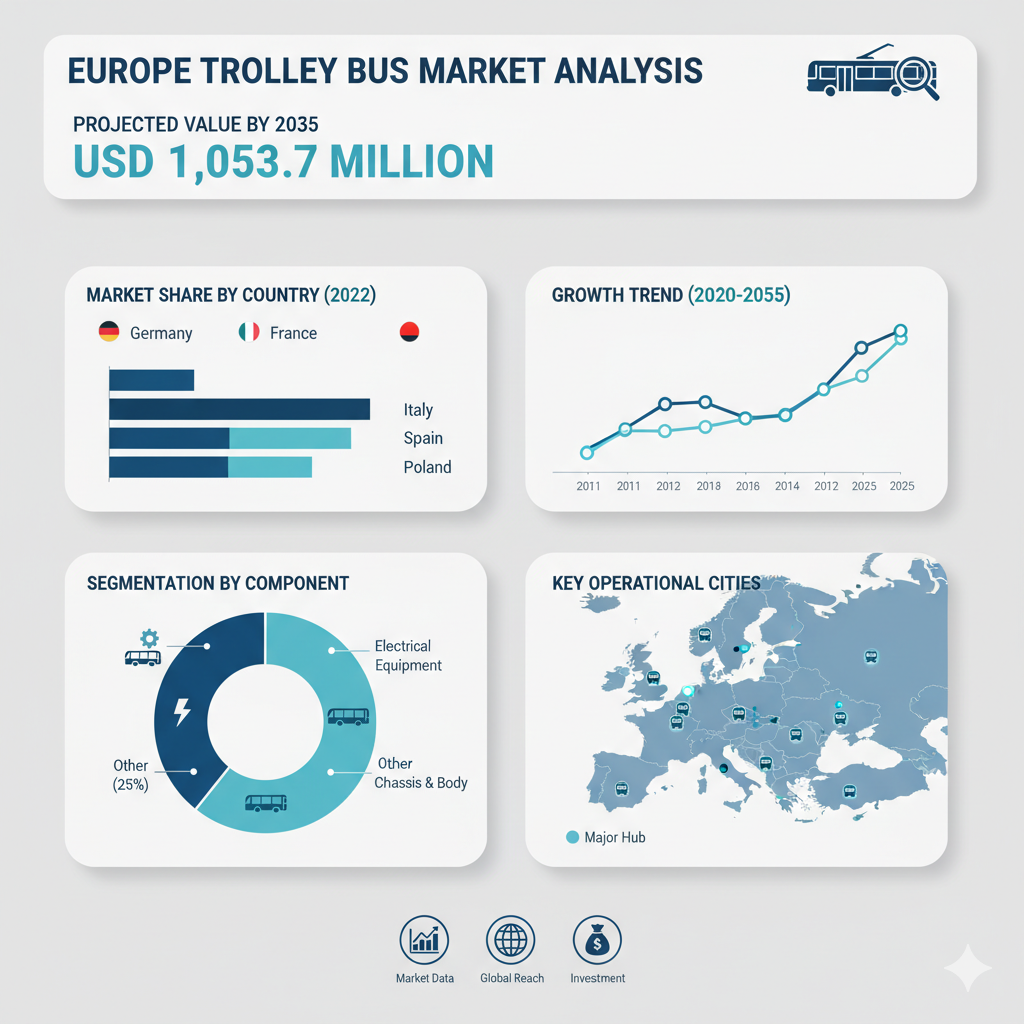
As Europe accelerates its transition to cleaner and smarter public transport, the latest industry insights reveal a powerful movement among both established manufacturers and ambitious newcomers within the continent’s trolley bus sector. The European trolley bus market is forecast to surpass USD 1 billion by 2035, driven by government mandates for low-emission transport, urban modernization, and increasing passenger demand for sustainable transit options.
This next phase of growth presents a pivotal opportunity for manufacturers — whether long-standing industry leaders or new entrants — to strengthen their technological advantage, align with evolving city mobility strategies, and capture a greater share of Europe’s expanding electric transport landscape.
Established Leaders Pave the Way
Several well-established manufacturers continue to set the pace for innovation and reliability in Europe’s trolley bus industry.
ŠKODA Electric, a division of ŠKODA Transportation, remains a prominent leader through its development of dual-mode trolley buses that operate seamlessly across both overhead-electric and battery-assisted networks. This hybrid approach enables cities to expand routes without overhauling existing infrastructure, offering flexibility and efficiency for modern transit systems.
Solaris Bus & Coach of Poland has become a symbol of sustainable European engineering. Its battery-integrated trolley buses and regenerative braking technology are helping cities such as Berlin, Milan, and Zurich meet their net-zero transport goals.
Belgium’s Van Hool NV, known for its high-capacity, lightweight articulated designs, continues to redefine comfort and durability for urban commuters, while Switzerland’s Hess AG and Germany’s Kiepe Electric GmbH are advancing drive systems and long-term fleet performance through cutting-edge energy-management and control technologies.
Together, these players account for a substantial portion of Europe’s trolley bus market, establishing benchmarks in safety, modular design, and operational efficiency. Their shared focus on dual-power systems, enhanced battery life, and regenerative technologies underscores the industry’s transition toward fully electrified, zero-emission transport.
New Entrants: Innovating for Expansion
While established brands consolidate leadership, new and emerging manufacturers are entering the market with fresh energy, forward-thinking technology, and region-specific innovation strategies. The modernization of urban transit infrastructure across Central and Eastern Europe — including in Poland, the Czech Republic, Hungary, and the Baltics — is creating fertile ground for new entrants with scalable and cost-efficient solutions.
Opportunities abound for companies developing:
- 12-metre trolley buses designed for compatibility with existing overhead wiring networks.
- 18-metre articulated buses tailored for dense, high-traffic urban corridors.
- Smart connectivity systems leveraging IoT-enabled fleet management and predictive maintenance.
- Advanced energy storage solutions that integrate with renewable grids and hybrid charging systems.
- Custom platforms for airport shuttles, tourist zones, and industrial campuses — expanding applications beyond conventional city routes.
For these rising players, the competitive edge lies in sustainability, operational flexibility, and intelligent design. The European market increasingly rewards manufacturers who deliver both reliable performance and forward-compatible technology, making it an ideal time for innovation-driven entrants to establish a foothold.
Key Market Drivers and Strategic Imperatives
The European trolley bus market is evolving at the intersection of environmental policy, technological progress, and urban planning. With many European cities phasing out diesel fleets, trolley buses offer a bridge between fully electric systems and legacy infrastructure — using existing power lines while incorporating extended battery range for routes without full overhead coverage.
Beyond environmental goals, economic factors are also fueling adoption. Trolley buses present lower total cost of ownership compared to traditional diesel buses, with reduced fuel costs, minimal mechanical wear, and longer operational life spans. Urban planners also favor their quiet operation, which improves passenger experience and reduces noise pollution.
However, challenges remain. High upfront infrastructure costs, the need for reliable power distribution, and digital integration across fleets require both technical expertise and cross-sector partnerships. Manufacturers who can offer not just vehicles but comprehensive mobility solutions — including grid support, digital analytics, and after-sales service — are expected to emerge as long-term winners.
The Road Ahead: Collaboration and Growth
As cities move closer to their climate-neutrality targets, collaboration between manufacturers, energy providers, and public authorities will be critical. The next generation of trolley buses will likely combine adaptable charging modes, lightweight materials, and AI-assisted fleet management — merging sustainability with intelligent mobility.
For established manufacturers, the strategy is clear: double down on innovation, invest in R&D, and form partnerships that expand network coverage and service integration.
For new players, success depends on agility — developing modular designs, adopting scalable production, and aligning products with regional funding programs and green transport policies.
In this new era of urban mobility, Europe’s trolley bus industry stands as a model of transformation. The combination of environmental responsibility, engineering excellence, and market collaboration is redefining what modern public transport looks like. The race toward a cleaner, connected, and more efficient future has begun — and the time to invest, innovate, and expand is now.