

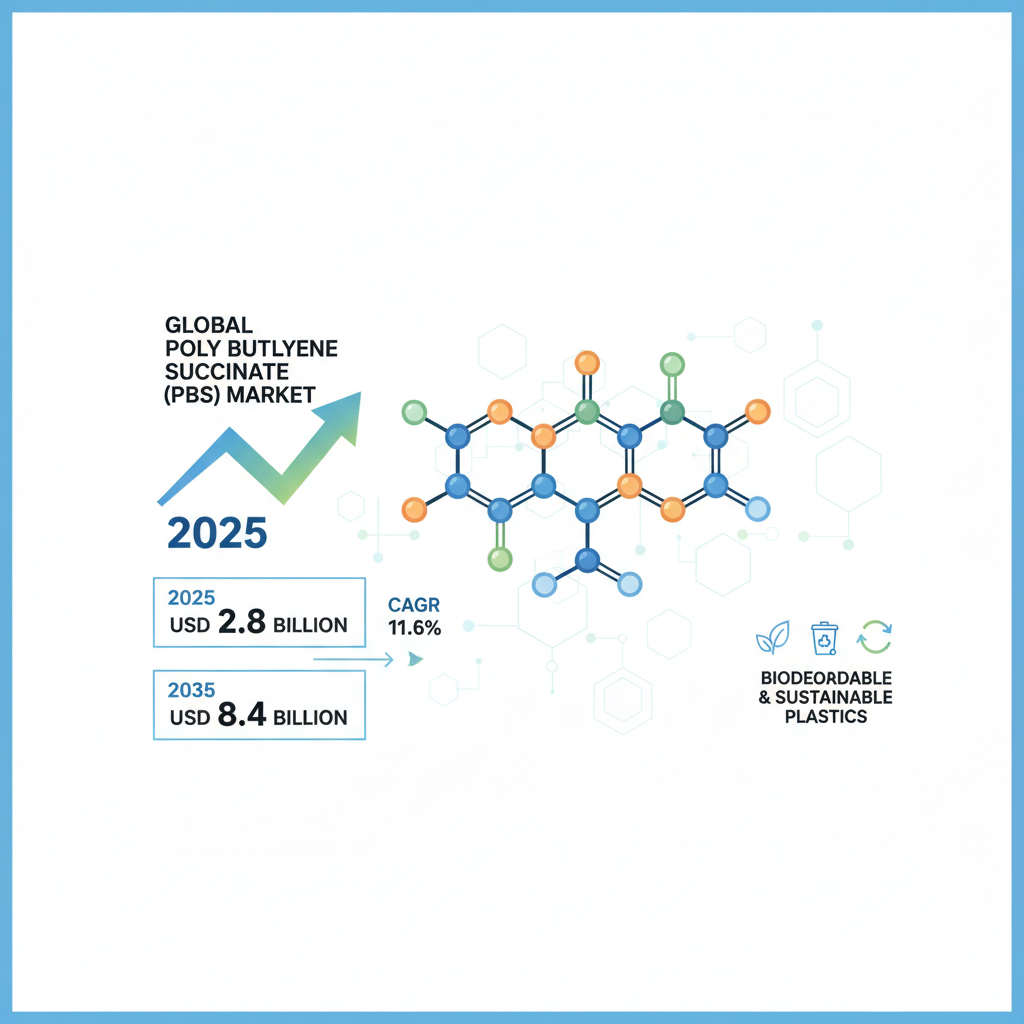
The global Poly Butylene Succinate market is entering an era of transformative expansion, driven by an accelerated shift toward sustainable materials and biodegradable plastics. According to the latest report, “Poly Butylene Succinate Market Size and Share Forecast Outlook 2025–2035,” the market is projected to reach USD 2.8 billion by 2025 and expand at a robust CAGR of 11.6%, achieving a valuation of USD 8.4 billion by 2035.
Rising regulatory mandates, growing environmental consciousness, and the pursuit of a circular economy are driving both established producers and new entrants to participate in this fast-evolving sector. The report identifies dynamic opportunities for global chemical manufacturers and emerging biopolymer innovators to scale production capacity, enhance technological innovation, and form strategic partnerships that cater to the world’s shift away from petroleum-based plastics.
Full Market Report available for delivery. For purchase or customization, please request here – https://www.futuremarketinsights.com/reports/sample/rep-gb-516
Growth Drivers: Sustainability and Innovation at the Core
The demand for PBS is primarily driven by its biodegradability, compostability, and compatibility with existing plastic processing systems. These properties make it a preferred choice for applications in sustainable packaging, agriculture, textiles, and medical devices.
In packaging, PBS-based compostable films, disposable trays, and rigid containers are rapidly replacing polyethylene and polypropylene-based equivalents. Regulatory actions such as the European Union’s Single-Use Plastics Directive (EU 2019/904), alongside parallel bans in China, South Korea, and Japan, have significantly boosted PBS consumption among major FMCG and retail brands seeking greener material alternatives.
Agriculture remains another key growth segment, with PBS utilized in mulch films, seedling trays, and irrigation components. NatureWorks LLC recently underscored the material’s environmental benefits, noting that PBS “enhances soil health and reduces plastic residues” — a transformative development for sustainable farming.
Technological Advancements in Feedstock and Production
Breakthroughs in bio-based feedstock fermentation, low-energy catalysts, and AI-driven process optimization are transforming PBS manufacturing economics. Roquette Frères’ investment in bio-succinic acid production in Italy and the emergence of cost-efficient biorefinery models across Asia have lowered production barriers and improved scalability.
Research organizations such as TNO (Netherlands) and KITECH (South Korea) are pioneering enzymatic depolymerization and new catalyst developments to further enhance yield, thermal performance, and cost competitiveness. These advancements are opening new horizons for smaller manufacturers to enter the market with innovative, cost-effective solutions.
Opportunities for Market Expansion and Collaboration
Global leaders like Mitsubishi Chemical Corporation, BASF SE, and Showa Denko K.K. are consolidating their product portfolios with bio-based and petro-based PBS resins, polymers, and composites customized for packaging, automotive, and industrial uses. Emerging producers such as Anhui Sealong Biotechnology and NaturePlast are focusing on renewable feedstocks and eco-friendly product design, enabling synergies between sustainability and scalability.
In the Asia-Pacific region, collaborative initiatives under Thailand’s Bio-Circular-Green (BCG) Economy Model and China’s Bioplastics Action Plan are fostering joint ventures and regional manufacturing hubs. These policies reinforce Asia’s position as the fastest-growing PBS production base, with Japan, South Korea, and India leading innovation in high-performance bioplastics for automotive, electronics, and healthcare applications.
Evolving Market Segments: Bio-Based and Petro-Based PBS
Bio-based PBS continues to attract strong investment due to its lower carbon footprint and renewable sourcing. Applications in sustainable packaging and textiles are expanding rapidly, fueled by growing consumer and regulatory demand for compostable materials. The integration of natural fibers and advanced biopolymer composites is enhancing durability, making PBS viable for technical textiles, sporting apparel, and medical sutures.
Meanwhile, petro-based PBS maintains relevance due to its consistent performance and cost advantages in industrial packaging, automotive, and electronic components. Hybrid PBS formulations that combine bio-based and petrochemical inputs are expected to dominate the next phase of industrial adoption, bridging performance with sustainability.
Processing Technologies Power the Next Wave of Growth
The injection molding and extrusion segments are propelling PBS manufacturing efficiency. Injection-molded PBS components are gaining traction in automotive interiors, electronics casings, and medical packaging, while extrusion techniques enable large-scale production of biodegradable films and textile fibers. AI-assisted mold design, automated process control, and advanced copolymer blending are enhancing production scalability and flexibility for manufacturers targeting mass-market applications.
Regional Momentum and Market Leadership
Europe continues to lead PBS adoption through strong policy frameworks like the EU Green Deal, while North America benefits from USDA and DOE-backed R&D programs promoting bio-based products. The Asia-Pacific region, however, is projected to dominate global growth between 2025 and 2035, supported by low-cost production bases and national sustainability mandates.
Leading companies — including Mitsubishi Chemical Corporation (15–20% market share), Anhui Sealong Biotechnology (12–16%), Showa Denko K.K. (10–14%), BASF SE (8–12%), and NaturePlast (5–9%) — are strengthening their global reach through innovation partnerships, AI-driven polymer synthesis, and expansion of compostable packaging portfolios.
Access PDF Brochure Now: https://www.futuremarketinsights.com/reports/brochure/rep-gb-516
Challenges and Future Outlook
Despite rapid advancements, PBS still faces scaling challenges due to high production costs and feedstock variability. However, government incentives, advanced biorefining, and AI-enabled material optimization are steadily closing these gaps. Between 2025 and 2035, the PBS industry will witness full-scale commercialization, expanded end-use applications, and integration into circular economy frameworks.
The next decade will see manufacturers — both established players and emerging innovators — investing aggressively in technology, automation, and sustainable practices to capture the growing market potential of Poly Butylene Succinate, establishing it as a cornerstone material for the global transition toward sustainable plastics.
About Future Market Insights (FMI)
Future Market Insights, Inc. (ESOMAR certified, recipient of the Stevie Award, and a member of the Greater New York Chamber of Commerce) offers profound insights into the driving factors that are boosting demand in the market. FMI stands as the leading global provider of market intelligence, advisory services, consulting, and events for the Packaging, Food and Beverage, Consumer Technology, Healthcare, Industrial, and Chemicals markets. With a vast team of over 400 analysts worldwide, FMI provides global, regional, and local expertise on diverse domains and industry trends across more than 110 countries.
Contact Us:
Future Market Insights Inc.
Christiana Corporate, 200 Continental Drive,
Suite 401, Newark, Delaware – 19713, USA
T: +1-347-918-3531
For Sales Enquiries: sales@futuremarketinsights.com
Website: https://www.futuremarketinsights.com
LinkedIn| Twitter| Blogs | YouTube




