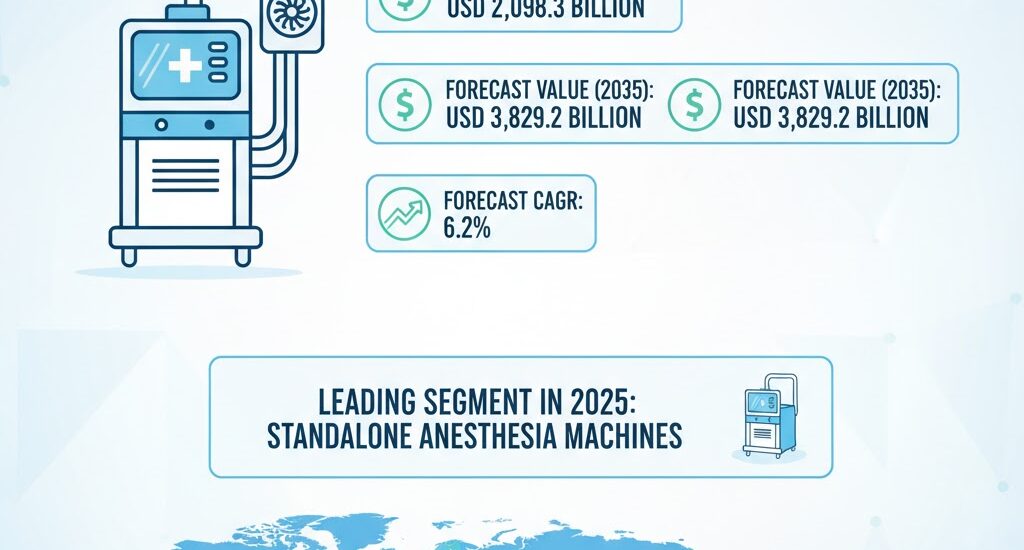
The global anesthesia machines market is entering a transformative phase, projected to grow from USD 2,098.3 billion in 2025 to USD 3,829.2 billion by 2035, reflecting a CAGR of 6.2%. This growth trajectory is driven by an increasing number of surgical procedures, continued healthcare infrastructure upgrades, and heightened regulatory focus on patient safety and environmental compliance.
Manufacturers across the healthcare technology spectrum are recognizing this as a pivotal decade. With advancements in digital integration, low-flow anesthesia, and automated delivery systems, the anesthesia machines market is shifting toward solutions that not only enhance clinical precision but also meet sustainability goals and streamline hospital operations.
Standalone Anesthesia Machines Take the Lead
By 2025, standalone anesthesia machines will dominate with a commanding 93.4% share of total market revenue, affirming their position as the cornerstone of modern surgical and critical care environments. Their widespread adoption stems from reliability, adaptability, and comprehensive performance across multiple surgical specialties, including neurosurgery, orthopedics, and cardiac care.
These machines are engineered to integrate seamlessly into complex surgical workflows, offering advanced ventilation modes, precise anesthetic gas delivery, and real-time patient monitoring. Their user-friendly interfaces and compatibility with electronic health records (EHR) make them indispensable for hospitals and surgical centers focused on safety, compliance, and efficiency.
For manufacturers, the rising preference for such integrated systems underscores a vital opportunity: the demand for devices that merge precision engineering with digital intelligence is expected to accelerate product development cycles and elevate competitive differentiation over the next decade.
Hospitals Lead the Procurement Surge
Hospitals continue to represent the largest end-user segment, accounting for 39.7% of anesthesia machine installations worldwide. Driven by centralized procurement strategies and a focus on replacing legacy equipment, hospitals are prioritizing anesthesia systems that combine ventilation, hemodynamic monitoring, and digital recordkeeping.
With surgical volumes climbing—particularly in general, orthopedic, and oncologic procedures—hospitals are actively expanding their installed bases of anesthesia workstations. Regulatory mandates emphasizing perioperative safety and emission control have reinforced the need for modernized, compliant solutions. This dynamic presents manufacturers with a dual imperative: deliver high-performance, regulatory-ready systems and support healthcare providers with robust training and maintenance programs.
Compact and Smart Systems: The Next Frontier
A pronounced shift toward compact, portable, and digitally integrated anesthesia machines is reshaping the competitive landscape. Manufacturers are embedding AI-driven decision support and real-time patient monitoring into smaller, mobile systems designed for outpatient and minimally invasive procedures. These developments are enabling clinicians to enhance safety, optimize gas usage, and extend care capabilities beyond traditional operating theaters.
Integration with EHRs and telemedicine platforms is another key trend. Smart anesthesia workstations capable of transmitting patient data securely across hospital networks are becoming essential to value-based healthcare models. For forward-thinking manufacturers, this marks a critical juncture to invest in interoperability and software-driven innovation, ensuring that their devices align with the digitized future of surgical care.
Challenges in Cost, Compliance, and Training
While growth prospects are strong, the market faces challenges that require strategic foresight from equipment manufacturers. High acquisition and maintenance costs remain barriers in cost-sensitive markets, while stringent regulatory approval processes—overseen by bodies such as the FDA and EMA—extend product development timelines and add compliance complexity.
Additionally, the shortage of skilled anesthesia personnel capable of operating advanced systems emphasizes the need for manufacturers to offer robust training and support frameworks. Addressing these operational and regulatory hurdles will be crucial for accelerating adoption and expanding into emerging healthcare economies.
Global Market Outlook: Regional Insights
The United States remains the industry powerhouse, projected to grow at a CAGR of 7.4% through 2035. Its advanced healthcare infrastructure and high surgical volumes position it as the largest and most innovation-driven market. The ongoing rise in outpatient and ambulatory procedures continues to fuel demand for portable, efficient systems with advanced automation and connectivity.
In Europe, Germany (4.5% CAGR) and France (4.2% CAGR) demonstrate steady growth, supported by stringent safety standards, premium equipment demand, and aging populations requiring more surgical interventions. The United Kingdom (4.0% CAGR) maintains its focus on efficiency and digital integration through NHS modernization efforts, while Japan (3.8% CAGR) exemplifies the synergy between demographic need and precision engineering, reinforcing the steady uptake of digitally enhanced systems.
These mature markets, combined with rising procedural volumes in emerging economies, create a dual growth opportunity for manufacturers: sustain innovation in established regions while expanding access to affordable, compliant anesthesia systems in developing healthcare sectors.
Buy Now & Save: Premium Market Report at $5,000 | Discount Details Inside:- https://www.futuremarketinsights.com/reports/sample/rep-gb-789
Competitive Landscape: Innovation as the Catalyst
The competitive field is defined by technological innovation and strategic expansion. Industry leaders such as DRE Medical, Maquet Getinge Group, GE Healthcare, Penlon Inc., Drägerwerk AG, Mindray Medical International Limited, and Spacelabs Healthcare are pioneering next-generation designs emphasizing modularity, portability, and enhanced monitoring.
Recent milestones highlight this momentum. In 2025, Dräger’s Atlan® A350/A350XL earned Vizient’s Innovative Technology Designation, recognizing its contribution to patient safety, efficiency, and sustainability through low-flow anesthesia. Similarly, ICU Medical expanded its portfolio with advanced workstations and hemodynamic monitoring systems designed to improve outcomes in anesthesia and minimally invasive surgery.
Manufacturers are increasingly pursuing mergers, acquisitions, and strategic collaborations to diversify product portfolios and strengthen global presence. The growing demand for portable anesthesia machines—particularly in ambulatory and field hospital settings—is inspiring designs that blend mobility, precision, and intuitive operation.
A Decade of Opportunity for Manufacturers
The decade ahead promises sustained expansion and technological evolution in the anesthesia machines market. As global healthcare systems prioritize safety, sustainability, and digital transformation, manufacturers equipped to deliver connected, intelligent, and eco-efficient solutions will capture the greatest share of this growth.
From advanced standalone units to smart, portable systems, the market’s future lies in harmonizing precision engineering with data-driven innovation. The anesthesia machines industry stands at the intersection of medicine, technology, and manufacturing excellence—poised to define the next era of surgical care worldwide.
Click Here to Purchase the Report:- https://www.futuremarketinsights.com/checkout/789
About Future Market Insights (FMI)
Future Market Insights, Inc. (ESOMAR certified, recipient of the Stevie Award, and a member of the Greater New York Chamber of Commerce) offers profound insights into the driving factors that are boosting demand in the market. FMI stands as the leading global provider of market intelligence, advisory services, consulting, and events for the Packaging, Food and Beverage, Consumer Technology, Healthcare, Industrial, and Chemicals markets. With a vast team of over 400 analysts worldwide, FMI provides global, regional, and local expertise on diverse domains and industry trends across more than 110 countries.
Contact Us:
Future Market Insights Inc.
Christiana Corporate, 200 Continental Drive,
Suite 401, Newark, Delaware – 19713, USA
T: +1-347-918-3531
For Sales Enquiries: sales@futuremarketinsights.com
Website: https://www.futuremarketinsights.com
LinkedIn| Twitter| Blogs | YouTube