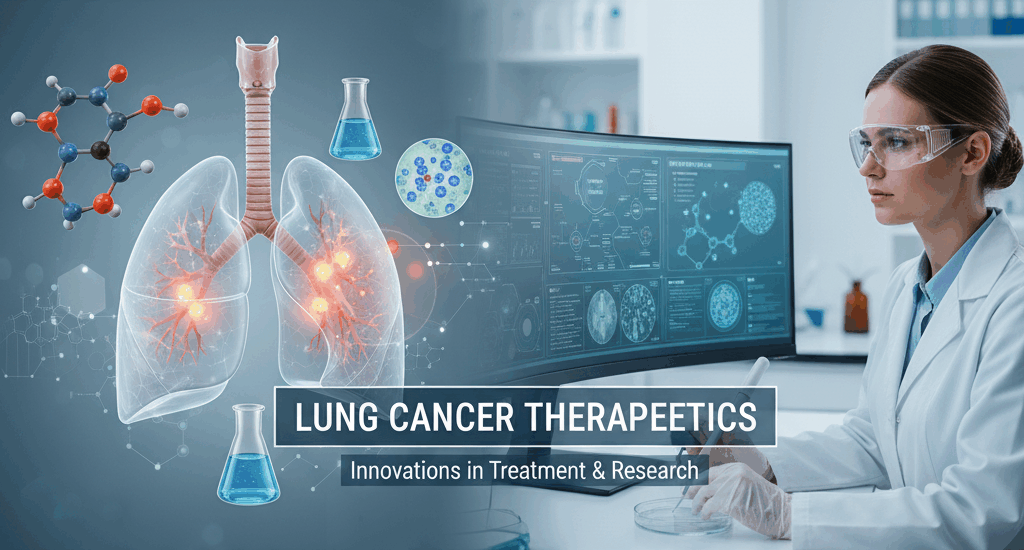
The global lung cancer therapeutics market is entering a transformative decade. Valued at USD 41.8 billion in 2025, it is projected to soar to USD 126.5 billion by 2035, expanding at an impressive CAGR of 11.7%, according to the recent report Lung Cancer Therapeutics Market Size, Share, and Forecast Outlook 2025–2035. This remarkable growth underscores a new era of personalized medicine, digital integration, and cross‑sector collaboration shaping the oncology landscape.
As lung cancer continues to stand among the world’s most lethal diseases—accounting for about 13% of all new cancer diagnoses globally—the need for targeted and effective treatment options has never been greater. The sustained rise in cases, attributed to smoking, environmental exposure, and genetic predispositions, has fueled pharmaceutical innovation at an unprecedented pace.
Get this Report at $5000 | Exclusive Discount Inside!
Next‑Generation Therapies Lead Market Evolution
Established leaders such as AstraZeneca, Roche, Pfizer, Bristol Myers Squibb, and Novartis continue to set benchmarks with precision therapeutics. Their advancements in immunotherapies and targeted drug delivery systems are redefining treatment standards and extending survival outcomes for patients worldwide.
AstraZeneca’s Tagrisso and Imfinzi, Roche’s Alecensa, and Merck’s Keytruda have become cornerstones in non‑small cell lung cancer (NSCLC) management. Meanwhile, technological enablers—artificial intelligence (AI), biomarker analytics, and real‑world data integration—are transforming research pipelines and patient care.
Bryan Hanson, CEO of Zimmer Biomet Holdings, recently reflected on the role of technology in advancing patient outcomes: “Our focus remains on advancing medical innovations that improve patient mobility and recovery times.” Although referencing orthopedics, his sentiment resonates across oncology, where cutting‑edge approaches are continuously redefining clinical success.
Targeted and Injectable Therapies Dominate
Targeted therapies remain central to the market, projected to represent over 90% of the global share in 2025. Their focus on specific molecular alterations, such as EGFR mutations and ALK rearrangements, delivers higher efficacy with reduced systemic toxicity compared to traditional chemotherapy.
Injectable formulations, meanwhile, account for nearly 59% of the market, driven by demand for rapid, direct, and efficient drug delivery. Companies including Merck & Co., Bristol Myers Squibb, and Genentech are expanding production of injectable biologics that deliver strong outcomes for patients with metastatic or advanced‑stage disease.
Technological Integration Accelerating Therapeutic Impact
The integration of smart technologies is proving pivotal to improving diagnostic precision and treatment adaptability.
- Roche uses AI‑driven diagnostics paired with genomic profiling for biomarker‑matched therapy decisions.
- AstraZeneca coordinates digital monitoring with immunotherapy sequencing through partnerships with Tempus.
- Pfizer deploys machine learning and precision analytics to refine its patient stratification models for drugs like Lorbrena.
- Novartis employs digital trial platforms to fast‑track novel drug approvals, notably with Tabrecta for METex14‑mutated NSCLC.
These innovations allow companies to design personalized regimens that evolve with patient response—marking a shift from one‑size‑fits‑all oncology to adaptive, data‑driven therapeutics.
Global Dynamics and Regional Growth
While North America continues to dominate the market through early adoption and mature healthcare systems, the Asia Pacific region is poised for the fastest growth. China and India, both seeing steep rises in lung cancer prevalence, are investing heavily in clinical trials, domestic manufacturing, and healthcare infrastructure.
In India, companies such as Dr. Reddy’s Laboratories, Cipla, and Sun Pharmaceutical are leveraging competitive manufacturing advantages and partnerships to expand access to immunotherapies like Nivolumab and generic Erlotinib. India’s pharmaceutical sector is projected to grow at a CAGR of 17.6%, outpacing global averages.
China, with leading firms like Hengrui Medicine and Jiangsu Hengrui, continues to launch groundbreaking therapies including Camrelizumab and Sunitinib, reflecting the country’s robust research ecosystem and strong policy support for cancer innovation.
Germany remains a European frontrunner with advanced R&D facilities and a focus on biomarker‑driven therapeutics. Its adoption of AI and machine learning in clinical processes is expected to further streamline drug development and patient care optimization.
Emerging Players Changing the Competitive Landscape
Tier‑2 and emerging pharmaceutical firms are becoming pivotal contributors to this evolving ecosystem. Hengrui Medicine, Zymeworks, and Cipla are developing cost‑effective alternatives and exploring innovative collaborations to compete in specialized markets. As governments broaden insurance coverage and increase investments in early detection, market access barriers for new entrants continue to ease.
Recent product approvals signal sustained momentum:
- Imdelltra™ (Tarlatamab‑dlLe) received FDA approval in May 2024 as the first T‑cell engager therapy for small cell lung cancer.
- Dr. Reddy’s launched Versavo, a biosimilar to Roche’s Avastin, expanding affordable treatment access in the UK.
- Amneal Pharmaceuticals introduced PEMRYDI RTU, the first ready‑to‑use pemetrexed formulation in the US market.
Secure Your Discounted Report Today
The Road Ahead
From 2025 onward, strong R&D pipelines, global collaborations, and supportive policy frameworks are expected to sustain double‑digit growth. While the first half of the next decade is projected to post a steady CAGR of 11.7%, the second half may see a marginal moderation to 11.2%, representing a stabilized maturity phase of innovation adoption.
As the oncology community continues to embrace smart technology and data‑driven medicine, both established pharmaceutical giants and emerging innovators are jointly advancing the frontier of lung cancer therapeutics—making tomorrow’s treatments more precise, accessible, and life‑changing for millions worldwide.
About Future Market Insights (FMI)
Future Market Insights, Inc. (ESOMAR certified, recipient of the Stevie Award, and a member of the Greater New York Chamber of Commerce) offers profound insights into the driving factors that are boosting demand in the market. FMI stands as the leading global provider of market intelligence, advisory services, consulting, and events for the Packaging, Food and Beverage, Consumer Technology, Healthcare, Industrial, and Chemicals markets. With a vast team of over 400 analysts worldwide, FMI provides global, regional, and local expertise on diverse domains and industry trends across more than 110 countries.
Contact Us:
Future Market Insights Inc.
Christiana Corporate, 200 Continental Drive,
Suite 401, Newark, Delaware – 19713, USA
T: +1-347-918-3531
For Sales Enquiries: sales@futuremarketinsights.com
Website: https://www.futuremarketinsights.com
LinkedIn| Twitter| Blogs | YouTube