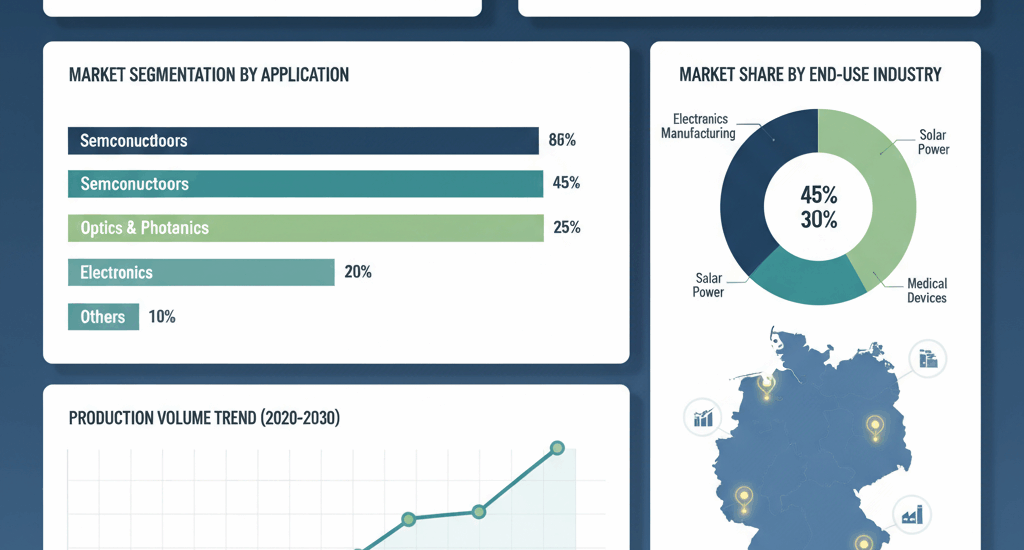
The German synthetic quartz market is charting a transformative path forward as demand surges in advanced manufacturing, electronics, and green-energy sectors. According to the latest market analysis, the sector is projected to grow at a compound annual growth rate (CAGR) of approximately 5.3% through 2030, ultimately reaching a value of around USD 123.6 million.
At the heart of this growth are two complementary forces: long-standing industry titans consolidating their technological leadership, and new manufacturers adopting novel processes, smart automation, and sustainability investments to capture rising demand. The market narrative is evolving—and fast.
Established players double down on leadership
Companies such as Heraeus Group and Saint-Gobain Quartz have reaffirmed their commitment to the German synthetic quartz arena by investing heavily in high-purity material production, Industry 4.0 manufacturing, and green process innovation. Heraeus, for instance, is actively advancing R&D methods aimed at boosting quartz purity and manufacturing efficiency.
These established companies are uniquely placed to serve cutting-edge applications such as semiconductor substrates, advanced optics, high-frequency resonators, and automotive electronics in electric vehicles (EVs). Germany’s established manufacturing ecosystem—with its precision engineering expertise—remains a powerful springboard for further expansion.
New manufacturers and technologies pave fresh inroads
Meanwhile, the market is also opening doors for newer entrants and niche players who are embracing technological innovation, agility, and sustainability. Several emerging firms and joint ventures are focusing on the production of ultra-high purity quartz substrates tailored for next-generation electronic components.
Research institutions like the Fraunhofer Institute are driving eco-efficient, energy-saving synthetic quartz processes—an area that smaller, agile firms can leverage to differentiate themselves. By combining smart technology integration with sustainable practices, these innovators are positioning themselves as the next growth engines in the market.
Why now? The convergence of high-tech and green megatrends
Three major demand drivers are fueling this growth surge:
- Semiconductors and electronics – With Germany rapidly advancing its semiconductor ecosystem and the global rollout of 5G and 6G networks, synthetic quartz is increasingly crucial in high-frequency oscillators and precision substrates.
- Automotive and EV adoption – As vehicle electrification accelerates, automotive electronics and sensors require high-performance quartz materials. German automotive OEMs and their supply chains stand to gain significantly.
- Renewable energy and sustainability – Germany’s commitment to the energy transition means greater demand for materials that enable smart grids, photovoltaics, and sustainable manufacturing—areas where synthetic quartz plays an essential role.
Opportunities for expansion – and the challenges ahead
For manufacturers looking to expand, the landscape is rich with opportunity. Increasing penetration of quartz into high-value niches, localization of supply chains, and the demand for higher purity and specialty formats all signal a new wave of innovation and investment. German firms—both established and emerging—can capitalize on the country’s strong engineering foundation, infrastructure for advanced materials, and supportive sustainability policies.
However, challenges persist. Domestic producers face stiff cost competition from large-scale Asian manufacturers who benefit from lower labor and energy expenses. High operational costs, strict environmental regulations, and raw-material sourcing constraints also create hurdles. To overcome these, companies are focusing on process optimization, automation, and strategic collaborations to maintain competitiveness.
Call to action: Why this matters for manufacturers
Established manufacturers looking to deepen market share must prioritize product innovation, strategic partnerships—particularly with research institutions—and strong sustainability credentials. For new entrants, now is the time to invest in process technology, precision manufacturing, and niche applications such as optoelectronics and aerospace coatings that deliver added value beyond commoditized quartz.
Germany’s synthetic quartz market is no longer defined merely by volume—it is defined by performance, purity, and innovation. Companies that align their strategies with these priorities stand to thrive in the next chapter of this evolving industry.
About the Report
The Germany Synthetic Quartz Market Report provides an in-depth analysis of market structure, growth prospects, competitive dynamics, and key segments by application (electronics, automotive, energy) and end-use industries (telecommunications, industrial, and renewable energy).