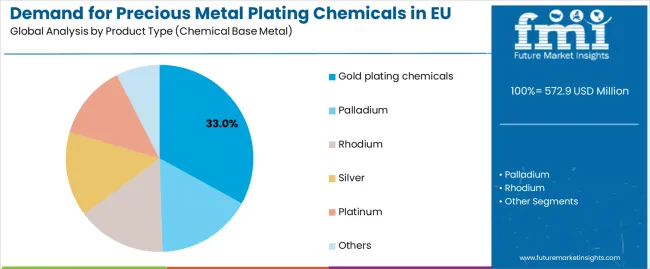
The demand for precious metal plating chemicals across the European Union is entering a decisive decade of transformation. Valued at USD 572.9 million in 2025, the market is forecast to reach USD 856.2 million by 2035, expanding at a CAGR of 4.1%. This steady rise underscores the indispensable role of advanced electroplating chemistries in industries where performance, reliability, and aesthetics converge — from semiconductors and electric vehicles to luxury goods and medical implants.
Growth is being shaped by the dual imperatives of miniaturization in electronics and sustainability in manufacturing, as EU regulations and end users push for higher-purity, low-waste, and cyanide-free plating systems. Both established and emerging players are responding with technology-driven innovations and regional expansions aimed at improving process efficiency, material recovery, and environmental compliance.
Electronics and Automotive Sectors Anchor Market Expansion
The electronics industry remains the heart of this market, accounting for 44% of total demand. Here, gold and palladium plating enable superior conductivity, corrosion resistance, and microchip performance essential for next-generation circuit boards and semiconductor packaging. With the EU’s ongoing focus on building semiconductor self-reliance, precious metal chemistries are becoming critical to supply chain stability.
Meanwhile, the automotive sector — particularly the electric vehicle (EV) segment — is accelerating adoption. Precious metal coatings on battery connectors, sensors, and charging pins ensure reliability and safety in electrified powertrains. As automakers across Europe, including those in Germany, France, and Spain, scale up EV production, they are actively engaging suppliers capable of delivering consistent, high-purity formulations for complex substrates and automated plating systems.
Medical, Aerospace, and Luxury Applications Add Structural Strength
Beyond industrial use, medical devices and implants are a growing frontier. Gold and platinum coatings are valued for their biocompatibility and corrosion resistance, enhancing both performance and patient safety. In parallel, the aerospace and defense sectors continue to rely on palladium and platinum-based coatings for high-reliability components that withstand extreme conditions.
In contrast, the decorative coatings segment — particularly in jewelry, watches, and luxury accessories — provides a stable revenue base that cushions the market against cyclical downturns. Italy’s renowned jewelry hubs and Switzerland’s watchmaking ecosystem continue to support steady demand for rhodium and gold plating chemicals, preserving Europe’s leadership in luxury craftsmanship.
Innovation: The Bridge Between Regulation and Competitiveness
Environmental pressure is rapidly changing the chemistry of plating operations. As the EU tightens restrictions on cyanide-based processes under REACH, suppliers are pivoting toward sulfite, pyrophosphate, and neutral pH formulations that maintain deposit quality while reducing toxicity. Companies investing in closed-loop systems and precious metal recovery technologies are winning favor among eco-conscious manufacturers and brand owners.
R&D focus is expanding toward longer bath life, reduced drag-out losses, and formulations compatible with advanced substrates used in flexible electronics and miniaturized circuits. Between 2025 and 2030, value gains of nearly USD 128.4 million are projected as these sustainable technologies become mainstream in plating lines across Europe.
Regional Growth Led by Rest of Europe, Spain, and Italy
The Rest of Europe region is emerging as a growth engine, expected to register a CAGR of 4.9% through 2035. Expanding electronics manufacturing capacity in Central and Eastern Europe, coupled with new investments in automotive electronics, is driving strong consumption of precious metal plating chemicals.
Spain follows with a 4.2% CAGR, buoyed by automotive sector expansion and rising electronics production. Italy continues to leverage its luxury goods and jewelry industries, maintaining steady demand for gold and rhodium plating solutions. France benefits from aerospace and defense applications, while Germany — Europe’s industrial powerhouse — sustains demand through its deep-rooted electronics and automotive infrastructure.
Purchase this Report for USD 5,000 Only | Get an Exclusive Discount Instantly! https://www.futuremarketinsights.com/checkout/27234
Everything You Need—within Your Budget. Request a Special Price Now! https://www.futuremarketinsights.com/reports/sample/rep-gb-27234
Established Players Set the Pace, New Entrants Bring Agility
The competitive landscape is shaped by both global leaders and agile newcomers investing in EU-compliant innovations. Heraeus Holding, Umicore, Johnson Matthey, Metalor Technologies (Tanaka), and Technic Inc. collectively anchor the market, accounting for over 40% of total sales.
- Heraeus leads with integrated precious metal refining and advanced electroplating formulations, ensuring material security and customer reliability.
- Umicore leverages its closed-loop recycling systems and catalytic expertise to deliver sustainable plating solutions.
- Johnson Matthey combines metallurgical precision with strong presence in electronics and medical sectors.
- Metalor Technologies, backed by Tanaka, continues to dominate in decorative and high-end industrial applications.
- Technic Inc., known for semiconductor plating innovation, is expanding its European footprint to meet microelectronics demand.
Emerging regional suppliers are not far behind. Many are specializing in customized chemistries, local distribution, and environmentally safer substitutes, offering competitive flexibility to mid-scale manufacturers. These newer players are crucial to the EU’s broader industrial resilience strategy, which emphasizes supply chain diversity and green transition.
Balancing Growth and Volatility
Despite promising growth, the market faces ongoing risks tied to precious metal price fluctuations and long qualification cycles in electronics and automotive sectors. However, strategic sourcing, metal hedging, and adoption of metal recovery systems are helping mitigate cost pressures. Efficiency in chemical usage and the shift toward automated plating lines will remain defining factors of competitiveness between 2025 and 2035.
About Future Market Insights (FMI)
Future Market Insights, Inc. (ESOMAR certified, recipient of the Stevie Award, and a member of the Greater New York Chamber of Commerce) offers profound insights into the driving factors that are boosting demand in the market. FMI stands as the leading global provider of market intelligence, advisory services, consulting, and events for the Packaging, Food and Beverage, Consumer Technology, Healthcare, Industrial, and Chemicals markets. With a vast team of over 400 analysts worldwide, FMI provides global, regional, and local expertise on diverse domains and industry trends across more than 110 countries.
Contact Us:
Future Market Insights Inc.
Christiana Corporate, 200 Continental Drive,
Suite 401, Newark, Delaware – 19713, USA
T: +1-347-918-3531
For Sales Enquiries: sales@futuremarketinsights.com
Website: https://www.futuremarketinsights.com
LinkedIn| Twitter| Blogs | YouTube