

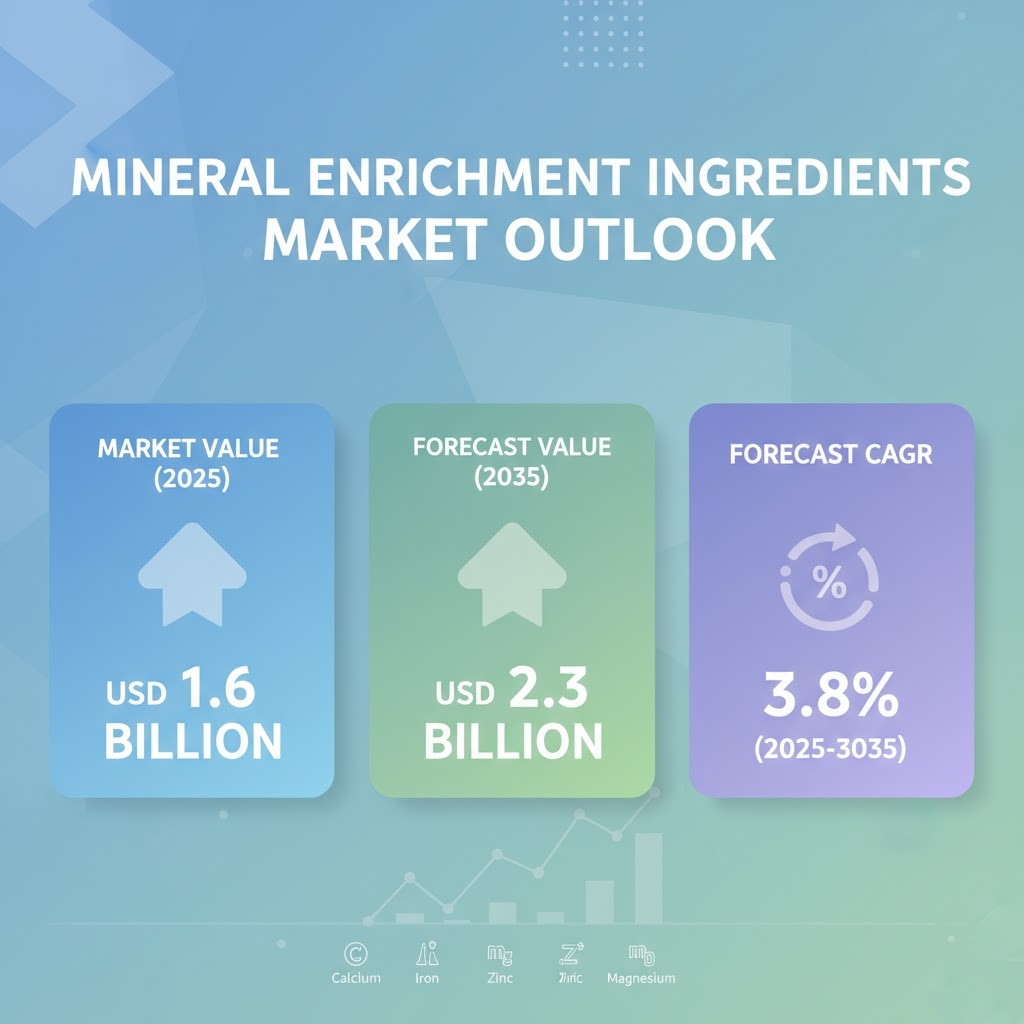
The global mineral enrichment ingredients market is on a steady growth trajectory, projected to reach USD 2.3 billion by 2035, up from USD 1.6 billion in 2025, expanding at a CAGR of 3.8%. The market is expected to grow 1.4 times in value during the forecast period, fueled by rising awareness of nutritional deficiencies, the expansion of fortified food and beverage products, and the growing consumer preference for preventive health and wellness solutions.
Market Overview
Mineral enrichment ingredients—such as calcium, zinc, iron, magnesium, and potassium—play a pivotal role in improving population health outcomes. Increasing government-led fortification programs, coupled with innovation from ingredient manufacturers, are setting the stage for robust market growth. Despite regulatory challenges and formulation complexities, industry leaders are embracing bioavailable mineral formulations, taste-masking technologies, and microencapsulation advancements to overcome sensory and stability issues.
Between 2025 and 2030, the market is projected to grow from USD 1.6 billion to USD 1.9 billion, followed by an increase to USD 2.3 billion by 2035—driven by clean-label, organic fortification trends and partnerships between ingredient suppliers and food manufacturers.
Key Market Statistics
- Market Value (2025): USD 1.6 billion
- Forecast Value (2035): USD 2.3 billion
- CAGR (2025–2035): 3.8%
- Leading Form: Powder
- Primary End Use: Food Industry, Dairy, Bakery & Confectionery
- Top Players: Cargill Incorporated, DSM Nutritional Products, BASF SE, Kerry Group, Archer Daniels Midland (ADM), Nestlé, Glanbia Nutritionals, Wilmar International, Clover Hill Food Ingredients Ltd, ADM WILD Europe GmbH & Co.KG
Market Drivers
- Growing Micronutrient Deficiencies: Over two billion people worldwide suffer from mineral deficiencies, driving demand for fortified foods.
- Government Fortification Programs: Over 80 countries have mandatory fortification for staples like flour, rice, and cooking oil.
- Advancements in Technology: Breakthroughs in microencapsulation and chelation technologies enhance mineral stability and absorption while minimizing taste impacts.
- Preventive Healthcare Trends: Consumers increasingly prefer fortified foods over supplements for convenient nutrition.
Restraints
- Taste and Texture Challenges: Minerals can alter product flavor and mouthfeel.
- Complex Regulations: Country-specific standards and labeling rules increase compliance costs.
- Bioavailability Barriers: Mineral interactions can limit absorption efficiency without proper formulation
Key Market Trends
- Clean-Label and Organic Formulations: Consumers favor natural and easily recognizable ingredients.
- Personalized Nutrition: Targeted fortification tailored to specific age groups or health conditions.
- Microencapsulation: A growing innovation trend that ensures better taste, shelf life, and nutrient protection.
- Expansion in Plant-Based Foods: Fortified dairy alternatives, cereals, and functional snacks are gaining ground.
Key Market Segments
By Form
- Powder (58.6% Market Share)
Powder-based minerals dominate due to superior dispersibility, cost-effectiveness, and ease of processing across dairy, bakery, and beverage applications. Powdered forms ensure even distribution, better absorption, and versatility in formulations. - Granule (41.4% Market Share)
Granular forms are preferred for their flowability, stability, and suitability for tablet, coating, and instant beverage fortification
By Ingredient Type
- Calcium (28.4%) – Leading the segment for bone health, widely used in dairy, cereals, and plant-based milk.
- Zinc (21.7%) – Rising demand for immunity support post-pandemic boosts zinc fortification.
- Iron (19.6%) – Essential in combating anemia, especially in developing markets.
- Sodium (12.3%), Potassium (8.9%), Phosphorous (5.4%), Magnesium (3.7%) – Used in sports nutrition and functional beverages.
By End Use
- Food Industry (42.3%) – Major application in fortified staples and processed foods.
- Dairy (24.6%) – Includes fortified milk, yogurt, and plant-based alternatives.
- Bakery & Confectionery (16.8%) – Growing use in breads, cookies, and bars.
- Breakfast Cereals (8.4%), Meat & Fish (4.7%), Ready-to-Eat Meals (3.2%) – Expanding adoption in convenience nutrition
Regional Outlook
- China (5.1% CAGR): Fastest-growing market driven by fortified dairy, clinical nutrition, and e-commerce-friendly stick formats.
- India (4.8% CAGR): Strong fortification mandates and local manufacturing boost adoption in oils, flour, and dairy.
- Germany (4.4% CAGR): Technological hub emphasizing bioavailability and documentation quality.
- United States (3.6% CAGR): Mature market led by RTD protein drinks, gummies, and fortified snacks.
- United Kingdom (3.2% CAGR): Consistent fortification programs in bakery and cereals.
- Japan (2.9% CAGR): Precision formulations for beverages, jellies, and supplements focusing on clean taste and transparency.
Competitive Landscape
The mineral enrichment ingredients industry exhibits moderate concentration, with the top three players—Cargill, DSM, and BASF—collectively holding about 35–42% market share. These established giants lead through innovation, regulatory expertise, and extensive partnerships with global food manufacturers.
Meanwhile, emerging players such as Clover Hill Food Ingredients Ltd, Glanbia Nutritionals, and Kerry Group are investing in specialized formulations, localized production, and faster customer support systems to capture niche markets.
Technological innovation is central to the competition. Manufacturers are developing minerals with improved absorption, enhanced taste masking, and better stability under varying pH and temperature conditions. This innovation race supports clean-label, plant-based, and functional food applications worldwide.
Strategic Outlook: Collaboration and Expansion
Established players are focusing on sustainability, scalable manufacturing, and compliance excellence, while new entrants target regional customization and cost-effective formulations.
Opportunities for Stakeholders:
- Governments: Expand mandatory fortification programs and harmonize regulations to boost public health outcomes.
- Industry Bodies: Define best practices and strengthen certification frameworks for mineral fortification claims.
- Manufacturers: Invest in microencapsulation, bioavailable chelates, and taste-neutral mineral systems.
- Food Brands: Incorporate fortification into everyday products with transparent, health-focused labeling.
- Investors: Support R&D and regional expansion in emerging markets with high malnutrition rates.
Key Companies Featured
- Cargill Incorporated
- DSM Nutritional Products
- BASF SE
- Kerry Group
- Archer Daniels Midland Company
- Glanbia Nutritionals
- Nestlé
- Wilmar International Limited
- ADM WILD Europe GmbH & Co.KG
- Clover Hill Food Ingredients Ltd
This Report Now at Just $3500 | Limited-Time Discount Offer! https://www.futuremarketinsights.com/reports/sample/rep-gb-6662
Checkout Now to Access Industry Insights: https://www.futuremarketinsights.com/checkout/6662
About Future Market Insights (FMI)
Future Market Insights, Inc. (ESOMAR certified, recipient of the Stevie Award, and a member of the Greater New York Chamber of Commerce) offers profound insights into the driving factors that are boosting demand in the market. FMI stands as the leading global provider of market intelligence, advisory services, consulting, and events for the Packaging, Food and Beverage, Consumer Technology, Healthcare, Industrial, and Chemicals markets. With a vast team of over 400 analysts worldwide, FMI provides global, regional, and local expertise on diverse domains and industry trends across more than 110 countries.
Contact Us:
Future Market Insights Inc.
Christiana Corporate, 200 Continental Drive,
Suite 401, Newark, Delaware – 19713, USA
T: +1-347-918-3531
For Sales Enquiries: sales@futuremarketinsights.com
Website: https://www.futuremarketinsights.com
LinkedIn| Twitter| Blogs | YouTube
