The global chiral amino alcohols market is projected to grow from USD 54.9 million in 2025 to USD 112.2 million by 2035, advancing at a CAGR of 7.4%. This growth highlights the increasing reliance on chiral intermediates in pharmaceuticals, biotechnology, and fine chemical synthesis. These compounds, prized for their enantioselective properties, are essential in producing optically active drugs and advanced active pharmaceutical ingredients (APIs).
Historically, pricing for chiral amino alcohols has remained higher than commodity variants due to complex synthesis requirements and the need for high enantiomeric purity. Yet, manufacturers are seeing stability in pricing, as continued innovation in catalytic synthesis and biocatalytic production methods helps reduce costs while maintaining high performance.
Between 2025 and 2030, the market is expected to grow to USD 78.5 million, marking the first phase of expansion driven by increased pharmaceutical R&D and widespread adoption of enantioselective catalysis. From 2030 to 2035, a second phase of growth will take the market to USD 112.2 million, supported by automation in synthesis, integration of green chemistry, and enhanced chiral precision technologies.
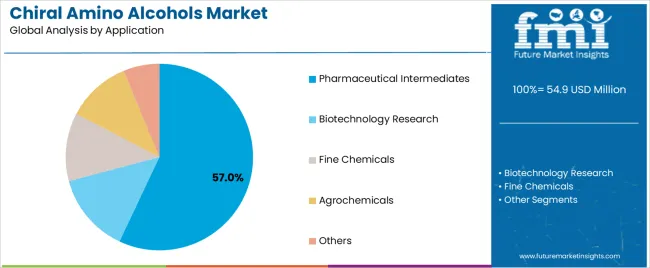
Pharmaceutical Sector Leads with 57% Market Share
Pharmaceutical intermediates continue to represent the largest share of the market, accounting for 57% of global demand in 2025. Chiral amino alcohols play a crucial role in drug synthesis, enabling pharmaceutical companies to produce compounds with precise stereochemical configurations, critical for efficacy and safety.
The growing focus on enantioselective drug design, personalized medicine, and biologically active formulations is propelling demand. As drug pipelines diversify and new molecular targets emerge, manufacturers capable of producing high-purity, enantiomer-specific chiral amino alcohols are seeing growing partnerships with global pharmaceutical companies.
L-Alaninol Remains the Dominant Product Segment
Among all product types, L-alaninol holds a commanding 65% market share, solidifying its position as the most widely used chiral amino alcohol in pharmaceutical synthesis. Known for its superior stereochemical precision, L-alaninol is indispensable in asymmetric synthesis pathways, offering efficiency and reliability in API and intermediate production.
Manufacturers are now focusing on scaling up L-alaninol production with advanced purification systems and automated synthesis technologies, ensuring consistency, high optical purity, and cost competitiveness. As a result, L-alaninol continues to underpin modern chiral synthesis across global pharmaceutical operations.
Emerging and Established Players Accelerate Technological Innovation
The competitive landscape of the chiral amino alcohols market includes a blend of established leaders and innovative new entrants.
Jiangxi Yuneng Pharmaceutical leads with a strong presence in pharmaceutical intermediate manufacturing, while Shaoxing Zhongchang Chemical and Jiangxi Xiankang Pharmaceutical are advancing custom synthesis technologies. Hangzhou Aolishen Chemical and Yancheng Huahong Chemical are enhancing production capabilities for high-purity amino alcohols used in research and specialty drug formulations.
Meanwhile, global firms like Porton Pharma Solutions, Abiochem Biotechnology, and Biosynth are driving partnerships and investing in automated chiral synthesis systems, biocatalytic methods, and green production technologies. This collaborative momentum is bridging the gap between traditional fine chemical production and the new wave of sustainable, precision-oriented synthesis.
New manufacturers, especially in Asia-Pacific and Europe, are entering the market with innovations in enantioselective catalysis, biocatalytic enzyme systems, and AI-based synthesis optimization—marking a significant transformation in chiral compound manufacturing.
Asia-Pacific and North America Lead Regional Growth
The Asia-Pacific region dominates global market growth, led by China and India, with forecasted CAGRs of 10.0% and 9.3%, respectively. China’s strong fine chemical infrastructure and government-backed pharmaceutical development initiatives have positioned it as the world’s largest producer and consumer of chiral amino alcohols. India follows closely, leveraging its expanding pharmaceutical manufacturing capacity and contract research capabilities.
North America shows stable growth at 7.0% CAGR, supported by robust pharmaceutical R&D, innovation in chiral synthesis, and a growing focus on biotechnological drug production. The United States leads in integrating automated synthesis systems, enhancing throughput and precision across pharmaceutical operations.
In Europe, Germany demonstrates technological leadership with an 8.5% CAGR, driven by its advanced chemical manufacturing base and focus on green synthesis solutions. The UK, France, and Italy also exhibit steady expansion due to increasing pharmaceutical research and fine chemical production.
Emerging markets such as Brazil (7.8% CAGR) and Japan (5.6% CAGR) are also contributing to global demand, driven by increasing local pharmaceutical production and biotechnological research initiatives.
Purchase this Report for USD 5,000 Only | Get an Exclusive Discount Instantly! https://www.futuremarketinsights.com/checkout/27274
Everything You Need—within Your Budget. Request a Special Price Now! https://www.futuremarketinsights.com/reports/sample/rep-gb-27274
Innovation Pathways and Growth Opportunities
The decade ahead will see major growth avenues across multiple innovation pathways.
Specialized derivatives such as L-alaninol and (R)-3-amino-1-butanol are expected to attract premium pricing due to their precision and purity levels, with estimated revenue opportunities ranging between USD 12 million and USD 25 million. Automated chiral synthesis and process optimization systems will improve production efficiency, while green chemistry and enzymatic synthesis methods will enhance environmental sustainability.
Manufacturers are increasingly focusing on custom synthesis services, analytical-grade production, and regional manufacturing expansion to meet global pharmaceutical requirements. These strategies are particularly impactful in Asia-Pacific, where local manufacturing capabilities are rapidly scaling to reduce dependence on imports and shorten supply chains.
Profitability Shaped by Technology and Integration
Profitability in the chiral amino alcohols market varies by segment, with specialty pharmaceutical applications offering higher margins due to regulatory complexity and quality standards. Producers with GMP-certified facilities, feedstock integration, and custom enantiomer synthesis capabilities are best positioned to capture premium returns.
Raw material price volatility—particularly in petrochemical derivatives and catalysts—remains a challenge, but the growing shift toward fermentation-based and biocatalytic processes is reducing dependence on traditional feedstocks, stabilizing cost structures, and supporting sustainable profitability.
About Future Market Insights (FMI)
Future Market Insights, Inc. (ESOMAR certified, recipient of the Stevie Award, and a member of the Greater New York Chamber of Commerce) offers profound insights into the driving factors that are boosting demand in the market. FMI stands as the leading global provider of market intelligence, advisory services, consulting, and events for the Packaging, Food and Beverage, Consumer Technology, Healthcare, Industrial, and Chemicals markets. With a vast team of over 400 analysts worldwide, FMI provides global, regional, and local expertise on diverse domains and industry trends across more than 110 countries.
Contact Us:
Future Market Insights Inc.
Christiana Corporate, 200 Continental Drive,
Suite 401, Newark, Delaware – 19713, USA
T: +1-347-918-3531
For Sales Enquiries: sales@futuremarketinsights.com
Website: https://www.futuremarketinsights.com
LinkedIn| Twitter| Blogs | YouTube