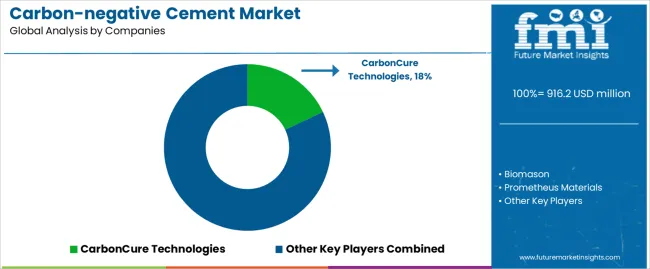
The construction industry is undergoing a profound transformation as the global carbon-negative cement market enters a decade defined by innovation, sustainability, and scale. Valued at USD 916.2 million in 2025, the market is projected to reach USD 1,579.9 million by 2035, recording an absolute increase of USD 663.7 million and an impressive 72.4% total growth. The market’s expansion, at a CAGR of 5.6%, highlights the construction sector’s growing commitment to climate-positive materials that not only reduce emissions but actively capture carbon dioxide during production and curing.
Carbon-negative cement has emerged as a cornerstone of sustainable building practices. Unlike traditional Portland cement—which contributes roughly 8% of global CO₂ emissions—these next-generation binders are designed to absorb or offset more carbon than they emit. From laboratory innovation to industrial-scale production, the technology is gaining traction across key markets including China, India, Germany, and the United States, where construction modernization, infrastructure expansion, and green building initiatives are accelerating demand.
Between 2030 and 2035, the market is expected to grow from USD 1,203.2 million to USD 1,579.9 million, accounting for more than half of the total decade-long expansion. This growth phase will be driven by industrial-scale carbon utilization technologies, biogenic carbon sequestration systems, and multi-functional cement platforms that combine structural strength with environmental performance. The rise of green certification programs such as LEED, BREEAM, and DGNB is further encouraging developers to prioritize materials with verifiable climate benefits.
At the heart of this evolution is innovation in materials science. Research and development are reshaping the very chemistry of cement. Novel binders are being formulated from bio-based and waste-derived materials such as fly ash, blast furnace slag, rice husk ash, and biochar. Companies are also pioneering microbial-induced calcite precipitation (MICP)—a bio-mineralization process that uses bacteria to form cement-like materials, capturing CO₂ in the process. These scientific breakthroughs are redefining cost efficiency, durability, and scalability, positioning carbon-negative cement as a viable alternative for mainstream construction.
A major technological leap is the integration of AI and digital twin systems into cement formulation. Advanced artificial intelligence platforms simulate binder compositions, predict compressive strength, and analyze hydration kinetics in real time. Digital twins—virtual replicas of physical production systems—enable manufacturers to test mix designs under simulated curing and environmental conditions, drastically shortening R&D cycles. This predictive modeling allows for customized formulations tailored to diverse climates, from tropical humidity to arid deserts and marine environments.
Durability remains a key focus for researchers and builders alike. Carbon-negative cements must maintain strength under extreme weather conditions—salinity, freeze-thaw cycles, and seismic activity—without compromising integrity. To achieve this, manufacturers are refining microstructures, optimizing pore distribution, and testing performance through accelerated aging studies. Cross-industry collaborations between construction firms, universities, and materials research institutes are ensuring that carbon-negative cements meet the rigorous demands of large-scale infrastructure and long-term performance standards.
Commercialization is now moving beyond pilot programs. Demonstration plants that once produced experimental batches are being converted into fully operational production facilities capable of manufacturing thousands of tons annually. Modular reactors, automated curing chambers, and carbon capture utilization (CCU) integrations are addressing the scalability challenge, making cost-effective mass production feasible. This shift signals the market’s readiness to supply the next generation of climate-responsible construction projects.
Leading the charge are established innovators like Biomason, Prometheus Materials, and Basilisk, who have turned laboratory breakthroughs into scalable solutions. Biomason, recognized for its pioneering bio-cement grown from microorganisms, continues to expand its global footprint, working with infrastructure firms to deploy bio-mineralized concrete in commercial and urban projects. Prometheus Materials is advancing its algae-based cement formulations that mimic coral reef calcification, while Basilisk, a Netherlands-based company, has commercialized self-healing cement capable of repairing microcracks while absorbing atmospheric CO₂.
Alongside these trailblazers, a new wave of emerging manufacturers—including CarbonCure Technologies, Solidia Technologies, Carbicrete, Blue Planet Ltd, and Fortera Corporation—are scaling their proprietary carbon capture and mineralization technologies. CarbonCure, based in Canada, injects captured CO₂ into fresh concrete where it mineralizes and becomes permanently embedded, reducing lifecycle emissions by up to 30%. Similarly, California’s Blue Planet Ltd and Fortera Corporation are developing cement that turns CO₂ into synthetic limestone aggregates, further enhancing the carbon-negative profile of construction materials.
Purchase this Report for USD 5,000 Only | Get an Exclusive Discount Instantly! https://www.futuremarketinsights.com/checkout/27299
Everything You Need—within Your Budget. Request a Special Price Now! https://www.futuremarketinsights.com/reports/sample/rep-gb-27299
Meanwhile, rising companies such as Brimstone Energy, Minus Materials, and Terraform Technologies are targeting regional markets through localized production models and advanced bio-based formulations. Their decentralized strategies are reducing transportation emissions and ensuring that eco-efficient materials are accessible for fast-growing construction regions in Asia-Pacific and Latin America.
The construction sector remains the largest application segment, accounting for 62.4% of demand in 2025. This dominance reflects the industry’s urgency to integrate low-carbon materials into urban development, infrastructure expansion, and commercial building projects. As cities pursue climate neutrality goals, demand for carbon-negative cement is expected to surge across residential, commercial, and industrial construction. Infrastructure developers are also embracing the material for bridges, tunnels, and coastal defense systems where long-term resilience and sustainability are paramount.
Geographically, China leads global growth with a projected 7.6% CAGR, followed by India (7%), both driven by rapid urbanization and ambitious government mandates for green infrastructure. Germany, growing at 6.4%, anchors Europe’s technological leadership, emphasizing advanced building materials and energy-efficient construction. The United States, at 5.3%, continues to invest heavily in construction innovation, while countries like Brazil, the UK, and Japan are expanding adoption through modernization and automation initiatives.
About Future Market Insights (FMI)
Future Market Insights, Inc. (ESOMAR certified, recipient of the Stevie Award, and a member of the Greater New York Chamber of Commerce) offers profound insights into the driving factors that are boosting demand in the market. FMI stands as the leading global provider of market intelligence, advisory services, consulting, and events for the Packaging, Food and Beverage, Consumer Technology, Healthcare, Industrial, and Chemicals markets. With a vast team of over 400 analysts worldwide, FMI provides global, regional, and local expertise on diverse domains and industry trends across more than 110 countries.
Contact Us:
Future Market Insights Inc.
Christiana Corporate, 200 Continental Drive,
Suite 401, Newark, Delaware – 19713, USA
T: +1-347-918-3531
For Sales Enquiries: sales@futuremarketinsights.com
Website: https://www.futuremarketinsights.com
LinkedIn| Twitter| Blogs | YouTube