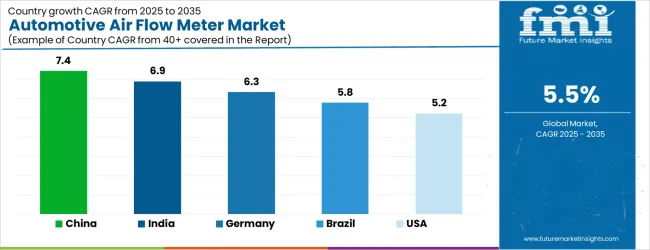
The Automotive Air Flow Meter Market is estimated to be valued at USD 1.3 billion in 2025 and is projected to reach USD 2.3 billion by 2035, registering a compound annual growth rate (CAGR) of 5.5% over the forecast period.
The global Automotive Air Flow Meter Market is gaining significant momentum, driven by the rising demand for fuel-efficient vehicles, stringent emission standards, and the ongoing shift toward intelligent engine management systems. Automotive air flow meters play a crucial role in measuring the amount of air entering the engine, ensuring optimal air-fuel mixture for combustion and improved vehicle performance.
As the automotive industry embraces electrification, hybridization, and stricter emission norms, air flow meters are evolving with digital sensing technologies, integrated sensors, and compact designs to deliver higher accuracy and reliability.
- Growing Emphasis on Fuel Efficiency and Emission Reduction
Global initiatives to reduce greenhouse gas emissions have increased the adoption of precise air flow measurement systems across both passenger and commercial vehicles.
Automotive air flow meters help maintain an ideal air-fuel ratio, improving combustion efficiency and reducing exhaust pollutants.
With the implementation of regulations such as Euro 6, BS VI, and EPA Tier 3, automakers are investing heavily in advanced mass air flow (MAF) and manifold absolute pressure (MAP) sensors to meet performance and sustainability standards.
- Technological Advancements in Air Flow Meter Design
The industry is witnessing rapid innovation in sensor design, with the transition from mechanical vane-type meters to solid-state and hot-film sensors.
Recent advancements include:
- Digital and MEMS-Based Air Flow Meters: Deliver superior accuracy and long-term stability.
- Self-Cleaning and Maintenance-Free Designs: Reduce downtime and improve sensor longevity.
- Temperature and Humidity Compensation: Enhance sensor response under varying environmental conditions.
These developments enable automakers to achieve higher precision in fuel delivery and engine control, improving overall vehicle performance and reducing emissions.
- Integration with Electronic Control Units (ECUs)
Modern vehicles rely on a network of sensors, including air flow meters, that communicate with the engine control unit (ECU) to optimize air intake, fuel injection, and ignition timing.
This integration supports real-time engine tuning, predictive diagnostics, and adaptive cruise control systems. As connected and smart vehicles become mainstream, air flow meters are increasingly equipped with digital communication interfaces (CAN, LIN, or SENT), enhancing data accuracy and system responsiveness.
- Rising Demand Across Vehicle Segments
The demand for air flow meters spans across:
- Passenger Cars: Enhanced fuel efficiency and reduced emissions.
- Commercial Vehicles: Improved load efficiency and performance under variable driving conditions.
- Hybrid and Electric Vehicles (HEVs): Optimized airflow management for range-extender engines and thermal systems.
Additionally, aftermarket sales are witnessing steady growth due to replacement demand and performance upgrades in older vehicles.
- Regional Insights
- Asia-Pacific: Leads the global market, driven by rising vehicle production in China, India, and Japan, alongside growing emission compliance efforts.
- Europe: Witnesses strong demand due to stringent emission standards and the presence of key automakers.
- North America: Focuses on engine performance optimization and digital sensor integration in both passenger and off-road vehicles.
These regions are expected to sustain growth as governments and manufacturers prioritize sustainability and intelligent powertrain control.
- Key Market Players
Prominent companies in the Automotive Air Flow Meter Market include:
- Bosch GmbH
- Denso Corporation
- Delphi Technologies
- Hitachi Automotive Systems, Ltd.
- Continental AG
- Valeo SA
- Sensata Technologies
- Honeywell International Inc.
These manufacturers are focusing on sensor miniaturization, improved calibration algorithms, and enhanced thermal response capabilities to maintain a competitive edge in the evolving market.
- Future Outlook
The Automotive Air Flow Meter Market is expected to experience steady growth through 2035, propelled by:
- Adoption of digital sensors in connected and smart vehicle platforms.
- Integration of AI-driven diagnostics for predictive maintenance.
- Expansion of hybrid and low-emission vehicle segments globally.
As vehicle powertrains evolve toward intelligent and efficient energy systems, the air flow meter will remain a critical component for ensuring precise engine control, lower emissions, and optimal performance in both traditional and next-generation vehicles.
Get Instant Access for Only $5000 | Don’t Miss This Exclusive Offer!
https://www.futuremarketinsights.com/reports/sample/rep-gb-5245
Checkout Now to Access Industry Insights:
https://www.futuremarketinsights.com/checkout/5245
About Future Market Insights (FMI)
Future Market Insights, Inc. (ESOMAR certified, recipient of the Stevie Award, and a member of the Greater New York Chamber of Commerce) offers profound insights into the driving factors that are boosting demand in the market. FMI stands as the leading global provider of market intelligence, advisory services, consulting, and events for the Packaging, Food and Beverage, Consumer Technology, Healthcare, Industrial, and Chemicals markets. With a vast team of 400 analysts worldwide, FMI provides global, regional, and local expertise on diverse domains and industry trends across more than 110 countries.
Contact Us:
Future Market Insights Inc.
Christiana Corporate, 200 Continental Drive,
Suite 401, Newark, Delaware – 19713, USA
T: +1-845-579-5705
For Sales Enquiries: sales@futuremarketinsights.com
Website: https://www.futuremarketinsights.com
LinkedIn| Twitter| Blogs | YouTube