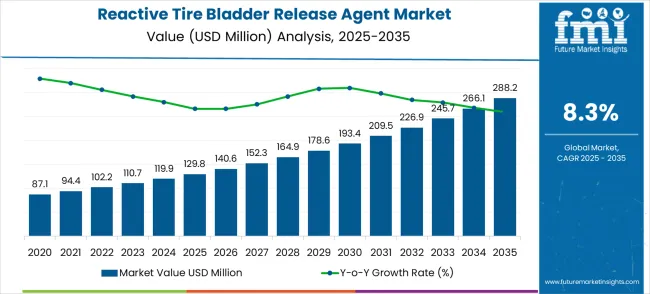
The global reactive tire bladder release agent market is witnessing significant growth, driven by the rising demand for high-performance and durable tires across the automotive industry. Reactive release agents, which chemically bond with tire bladder surfaces, offer superior performance compared to conventional agents by providing long-lasting release properties, reduced defects, and improved operational efficiency in tire manufacturing.
As automotive OEMs and tire manufacturers continue to emphasize production quality and sustainability, reactive tire bladder release agents are becoming a crucial component in the modern tire curing process.
Market Overview
Reactive tire bladder release agents are specialized chemical formulations used in the vulcanization and molding of tires, facilitating easy separation between the cured tire and the bladder without compromising surface finish or uniformity. These agents react with the bladder material to form a durable, non-transferable coating, ensuring consistent performance over multiple production cycles.
The growing adoption of radial and high-performance tires, coupled with increasing demand for fuel-efficient and electric vehicles, is fueling the need for efficient manufacturing processes—boosting the uptake of reactive release agents globally.
Key Market Drivers
- Rising Tire Production Worldwide
The increasing production of passenger and commercial vehicle tires is one of the key factors propelling market growth. Leading tire manufacturers are integrating advanced release agents to enhance production speed and maintain uniform quality. - Improved Process Efficiency and Cost Reduction
Reactive agents eliminate the need for frequent reapplication, reducing downtime and improving productivity. This results in lower material consumption and extended bladder life, ultimately reducing overall production costs. - Sustainability and Environmental Compliance
With growing environmental regulations, manufacturers are focusing on low-VOC (volatile organic compound) and water-based formulations. Reactive agents support these sustainability goals by minimizing waste and chemical transfer to the tire surface. - Technological Innovations in Tire Manufacturing
Advancements in tire curing and molding technologies are driving the demand for reactive agents that can withstand higher temperatures and offer enhanced chemical stability, particularly in the production of advanced EV tires.
Application Insights
- Passenger Vehicle Tires:
Increasing global automotive production and the trend toward lightweight, fuel-efficient cars have elevated the demand for consistent and smooth tire finishing, benefiting reactive release agent usage. - Commercial Vehicle Tires:
The heavy-duty and high-mileage requirements of commercial tires demand robust molding performance and durability, making reactive release agents essential for minimizing defects and downtime. - Specialty and Performance Tires:
The rise of high-performance and racing tires has encouraged the use of reactive release agents that deliver uniform surface texture, reduced contamination, and enhanced rubber-to-metal adhesion characteristics.
Regional Insights
- Asia-Pacific:
Asia-Pacific dominates the global market, led by major tire-producing nations such as China, India, Japan, and South Korea. Rapid industrialization, expanding automotive production, and technological advancements in tire manufacturing continue to drive market growth in the region. - Europe:
The region’s strong focus on sustainability and the presence of premium tire manufacturers like Michelin, Continental, and Pirelli contribute to the adoption of eco-friendly reactive release agents. - North America:
Increasing investments in tire manufacturing facilities and the growing replacement tire market in the U.S. are creating steady opportunities for reactive release agent suppliers.
Competitive Landscape
Key players in the market include Chem-Trend L.P., McGee Industries, LORD Corporation, Lion Specialty Chemicals, and Wacker Chemie AG, among others. These companies are actively investing in R&D for water-based formulations, automation-friendly application methods, and sustainable chemical compositions. Strategic partnerships with tire OEMs and process innovation remain key competitive strategies in the sector.
Future Outlook
The reactive tire bladder release agent market is projected to grow steadily as manufacturers prioritize production efficiency, tire quality, and environmental compliance. The market will benefit from increasing automotive electrification, technological upgrades in curing systems, and adoption of eco-friendly release formulations.
As the global automotive landscape continues to evolve, reactive tire bladder release agents will remain indispensable to achieving high-quality tire manufacturing with minimal environmental impact and maximum operational performance.
Get Instant Access for Only $5000 | Don’t Miss This Exclusive Offer!
https://www.futuremarketinsights.com/reports/sample/rep-gb-27038
Checkout Now to Access Industry Insights:
https://www.futuremarketinsights.com/checkout/27038
About Future Market Insights (FMI)
Future Market Insights, Inc. (ESOMAR certified, recipient of the Stevie Award, and a member of the Greater New York Chamber of Commerce) offers profound insights into the driving factors that are boosting demand in the market. FMI stands as the leading global provider of market intelligence, advisory services, consulting, and events for the Packaging, Food and Beverage, Consumer Technology, Healthcare, Industrial, and Chemicals markets. With a vast team of 400 analysts worldwide, FMI provides global, regional, and local expertise on diverse domains and industry trends across more than 110 countries.
Contact Us:
Future Market Insights Inc.
Christiana Corporate, 200 Continental Drive,
Suite 401, Newark, Delaware – 19713, USA
T: +1-845-579-5705
For Sales Enquiries: sales@futuremarketinsights.com
Website: https://www.futuremarketinsights.com
LinkedIn| Twitter| Blogs | YouTube