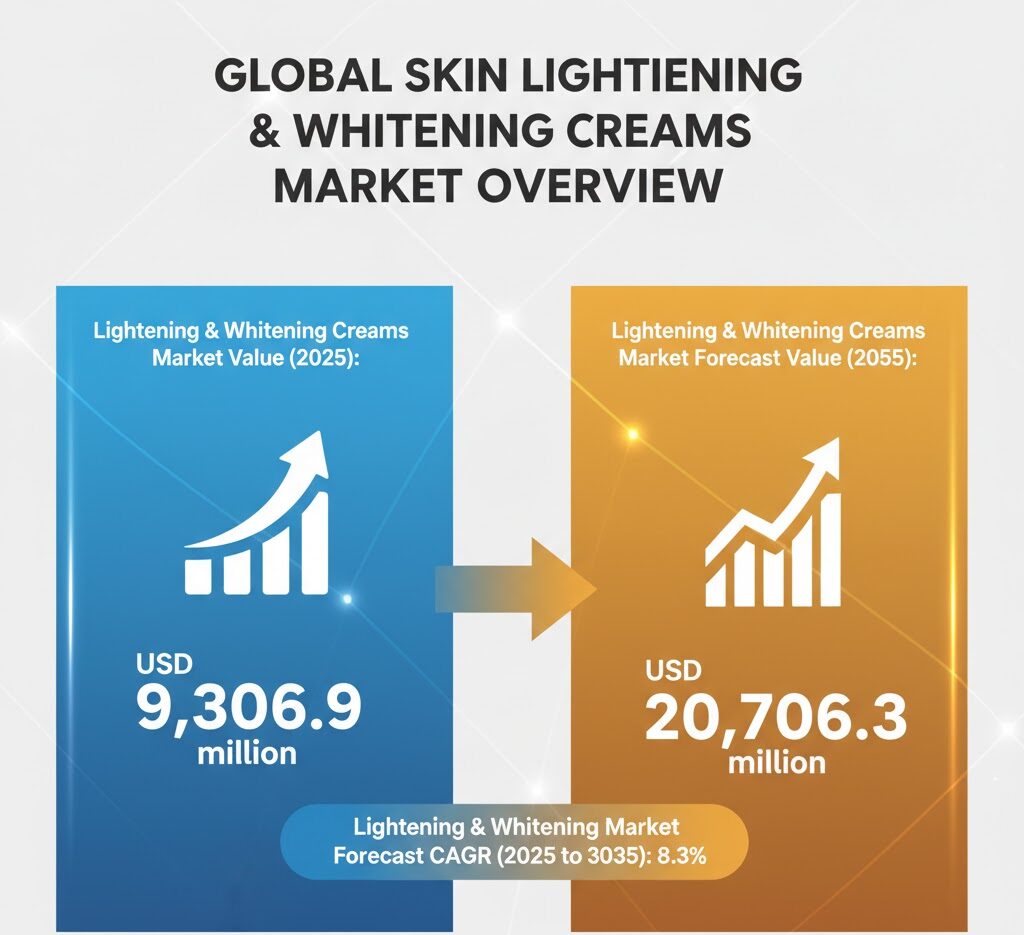
The global Lightening & Whitening Creams Market is poised for remarkable expansion, forecast to reach USD 20,706.3 million by 2035, growing from USD 9,306.9 million in 2025—a surge of 193% over the decade. This growth represents a robust CAGR of 8.3% between 2025 and 2035, highlighting a strong consumer shift toward dermatologist-tested, clean, and personalized brightening skincare solutions.
Market Overview
The first half of the decade (2025–2030) will witness steady market progress, expanding by USD 4,575.2 million as consumers increasingly adopt daily brightening creams and dark spot correctors enriched with antioxidant actives and non-hydroquinone ingredients. Antioxidant brighteners—primarily vitamin C and niacinamide—are expected to lead with a 57.3% market share in 2025.
From 2030 to 2035, the industry accelerates, adding USD 6,824.2 million in value. This phase will be driven by AI-powered skincare personalization, biotech-enhanced brightening actives, and premium formulations utilizing tyrosinase inhibitors and peptides. Combined, serums and creams are projected to account for more than 80% of total market value by 2035.
Quick Market Insights
- Market Value (2025): USD 9,306.9 million
- Forecast Value (2035): USD 20,706.3 million
- Forecast CAGR (2025–2035): 8.3%
- Leading Segment (2025): Antioxidant Brighteners (57.3%)
- High-Growth Regions: Asia-Pacific, Europe, North America
- Top Brands: Olay, L’Oréal Paris, Garnier, Shiseido, Pond’s, Clinique, The Ordinary, Kiehl’s, Innisfree, Melano CC
Key Market Takeaways
- Global Expansion: Market size expected to nearly double over the next decade.
- Rising Clean Beauty Demand: Consumers favor non-hydroquinone, dermatologist-approved formulations with niacinamide and vitamin C.
- AI & Digital Transformation: Personalized skincare diagnostics expected to account for 20% of consumer touchpoints by 2035.
- Regional Growth Leaders: India (9.3% CAGR) and China (8.3% CAGR) lead global growth, driven by digital beauty platforms and innovation in tone-evening actives.
- New Entrants & Innovation: Emerging brands are focusing on biotechnology, peptides, and probiotics, intensifying competition in the premium and mass-affordable segments.
Why the Market Is Growing
- Consumer Shift to Safe and Transparent Ingredients
The move away from hydroquinone has pushed brands to develop safe alternatives using kojic acid, arbutin, and licorice extract, ensuring efficacy without irritation. Transparency and clean labeling are now top purchasing factors. - Digitalization and AI-Driven Personalization
Skincare brands are embracing AI-powered diagnostics and data-based formulation tools to tailor brightening products for individual skin types. Digital consultations and subscription models are transforming customer loyalty and lifetime value. - Expanding E-Commerce and Social Beauty Influence
Online beauty retail in Asia and Europe has revolutionized access to premium and affordable whitening creams. Social media influencers, particularly on platforms like TikTok, WeChat, and Instagram, are accelerating product discovery and consumer education. - Inclusivity and Ethical Marketing Trends
Major players including Olay, L’Oréal Paris, and Shiseido are transitioning from “whitening” to “radiance” and “even-tone” positioning, aligning with inclusive beauty narratives and regulatory guidelines.
Segmental Market Insights
By Product Type
- Daily Brightening Creams
- Targeted Dark Spot Correctors
- Night Creams
- Serums (42.7% share in 2025)
Serums dominate due to their fast-absorbing, high-efficacy formulations featuring vitamin C, niacinamide, and arbutin. As AI-personalized skincare expands, serums will remain central to daily skincare routines.
By Active Class
- Tyrosinase Inhibitors (39.2%)
- Antioxidant Brighteners
- Exfoliating Systems (AHA/PHA)
Tyrosinase inhibitors are gaining traction as safer, clinically proven solutions for melanin suppression, delivering visible tone correction with minimal side effects.
By Skin Concern
- Dark Spots (46.1% share)
- Uneven Tone
- Post-Acne Marks
Dark spot correction remains the largest segment, with rising consumer preference for niacinamide-based complexes and peptide-infused systems that address pigmentation and dullness.
By Distribution Channel
- E-commerce (Fastest-growing)
- Pharmacies & Drugstores
- Specialty Beauty Retail
- Mass Retail
Digital beauty ecosystems dominate, supported by AI-driven tools, influencer campaigns, and cross-border e-commerce platforms.
By End User
- Women (Largest share)
- Men
- Unisex
Growing demand from men and unisex categories reflects the broadening inclusivity of brightening skincare products.
Regional Outlook
- Asia-Pacific: The growth powerhouse, led by India (9.3% CAGR) and China (8.3% CAGR). E-commerce, local brand innovation, and AI-integrated skincare drive rapid adoption.
- Europe: Steady 5.0% CAGR as consumers prioritize clean, sustainable, and inclusive “radiance” formulations. Germany remains a leader in dermatologist-endorsed, eco-certified brightening skincare.
- North America: Moderate 3.4% CAGR, driven by clinical serums and digital dermatology platforms. The U.S. market is seeing a pivot from “whitening” to “skin clarity” and “brightening.”
- Japan: 6.7% CAGR, anchored by probiotic and peptide-based skincare innovation.
- Middle East & Africa / Latin America: Growing awareness of UV-induced pigmentation and adoption of online beauty channels sustain positive momentum.
Key Industry Players and Emerging Innovators
The market is moderately fragmented, led by Olay (8.1%), L’Oréal Paris, Shiseido, Pond’s, Kiehl’s, Clinique, Melano CC, The Ordinary, and Innisfree.
Emerging manufacturers from Asia are leveraging biotechnological actives, botanical extracts, and localized AI-based skin diagnostics to compete with established brands. Collaborations with dermatologists, digital influencers, and e-commerce platforms continue to strengthen their global presence.
New entrants focusing on vegan, cruelty-free, and microbiome-friendly formulations are reshaping the market landscape, emphasizing efficacy with sustainability.
Market Trends and Developments
- Shift from Whitening to Radiance (2025)
Leading brands rebranded whitening ranges under terms like “radiance”, “clarity”, and “tone-evening”, reflecting inclusive and ethical marketing. - AI and Biotechnology Integration
Companies such as The Ordinary, Garnier, and Innisfree launched AI-based diagnostic apps and bioengineered ingredient innovations, including peptides, tranexamic acid, and fermented brighteners. - Rising Demand for Clean, Clinical Skincare
Dermatologist-endorsed, fragrance-free, and non-hydroquinone formulations are gaining ground, particularly in the U.S., Europe, and Japan. - Sustainability & Packaging Innovation
Eco-friendly packaging, recyclable materials, and sustainable sourcing are becoming key differentiators among global and regional brands.
Key Segments of the Lightening & Whitening Creams Market (2025–2035)
- By Product Type: Daily Brightening Creams, Targeted Dark Spot Correctors, Night Creams, Serums
- By Active Class: Tyrosinase Inhibitors, Antioxidant Brighteners, Exfoliating Systems (AHA/PHA)
- By Skin Concern: Melasma & Dark Spots, Uneven Tone, Post-Acne Marks
- By Channel: E-commerce, Pharmacies/Drugstores, Specialty Beauty Retail, Mass Retail
- By End User: Women, Men, Unisex
- By Region: North America, Europe, Asia-Pacific, Latin America, Middle East & Africa
This Report Now at Just $2000 | Limited-Time Discount Offer! https://www.futuremarketinsights.com/reports/sample/rep-gb-27247
Checkout Now to Access Industry Insights: https://www.futuremarketinsights.com/checkout/27247
About Future Market Insights (FMI)
Future Market Insights, Inc. (ESOMAR certified, recipient of the Stevie Award, and a member of the Greater New York Chamber of Commerce) offers profound insights into the driving factors that are boosting demand in the market. FMI stands as the leading global provider of market intelligence, advisory services, consulting, and events for the Packaging, Food and Beverage, Consumer Technology, Healthcare, Industrial, and Chemicals markets. With a vast team of over 400 analysts worldwide, FMI provides global, regional, and local expertise on diverse domains and industry trends across more than 110 countries.
Contact Us:
Future Market Insights Inc.
Christiana Corporate, 200 Continental Drive,
Suite 401, Newark, Delaware – 19713, USA
T: +1-347-918-3531
For Sales Enquiries: sales@futuremarketinsights.com
Website: https://www.futuremarketinsights.com
LinkedIn| Twitter| Blogs | YouTube