

The European Union’s demand for biomass pellets is on a remarkable trajectory, expected to rise from USD 3.2 billion in 2025 to USD 5.7 billion by 2035, reflecting an impressive 6.1% CAGR and a total expansion of nearly 1.8 times over the decade. This strong growth underscores Europe’s accelerating transition toward renewable energy, with biomass pellets playing a central role in replacing fossil fuels across heating, industrial, and power generation systems.
Between 2025 and 2030, sales are projected to climb to USD 4.2 billion, driven by widespread residential conversions from oil and gas heating systems, expanding use of pellets in utility-scale co-firing, and the mainstreaming of ENplus-certified premium pellets. By the 2030–2035 period, market value will surge another USD 1.5 billion, supported by the introduction of advanced torrefied black pellets, growing adoption of agricultural residue-based fuels, and Europe’s broader push for carbon neutrality under RED II and RED III frameworks.
Renewable Energy Mandates and Heating Modernization Drive Market Growth
Europe’s renewable energy mandates and decarbonization targets are the cornerstone of this market expansion. Homeowners and utilities are increasingly turning to biomass pellets as cost-effective, carbon-neutral alternatives to coal, oil, and gas. These pellets offer consistent heat output, low emissions, and easy handling—qualities that have made them indispensable in modern renewable heating systems.
Manufacturers are scaling production of premium ENplus A1 pellets and expanding supply of certified ecological biomass that meets strict EU environmental criteria. Demand for torrefied black pellets, capable of replacing coal in utility boilers without retrofitting, is also gaining momentum. These high-energy-density fuels are emerging as a key enabler of Europe’s energy independence, combining low moisture content with superior combustion efficiency.
Leading Segments: Wood Pellets Dominate as Agricultural Pellets Gain Momentum
In 2025, wood pellets account for approximately 65.9% of total demand, maintaining leadership due to their high energy density, uniform size, and compatibility with automated heating systems. They are expected to hold a 63% share by 2035, as agricultural and waste-derived pellets gain traction in rural and industrial energy applications.
Agricultural pellets—produced from straw, corn stover, and husks—are witnessing double-digit growth as part of Europe’s circular economy initiatives. These feedstocks offer ecological and economic advantages, reducing pressure on forest resources while valorizing agricultural residues. Countries such as France, Spain, and Poland are at the forefront of agricultural pellet development, integrating bioenergy with sustainable waste management systems.
Residential and Utility Heating Lead the Application Landscape
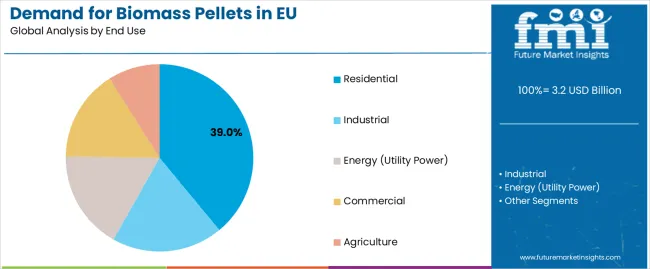
The residential segment, representing 39% of the EU biomass pellet market in 2025, continues to anchor demand. Homeowners across Germany, Italy, and France are increasingly replacing fossil fuel boilers with automated pellet stoves and hybrid systems. Government subsidies and low operating costs are propelling installations, making biomass heating both affordable and sustainable for households.
Meanwhile, utility power generation, holding 22% of market share, is projected to rise to 24% by 2035 as coal-fired power plants across the Netherlands, the UK, and Scandinavia transition to biomass. Utilities such as Drax and RWE are leading large-scale conversions, sourcing millions of tonnes of certified pellets annually to meet carbon reduction mandates and ensure grid stability.
Technological Innovation Reshaping Biomass Energy
Modern manufacturers are redefining the sector through advanced torrefaction and black pellet technologies. These processes enhance energy density to above 5.5 kWh/kg, reduce moisture absorption, and allow storage stability comparable to coal—essential for large-scale utility use. Companies in Scandinavia and the Netherlands are setting up dedicated black pellet facilities to supply European power producers seeking high-performance, low-carbon fuels.
At the same time, agricultural pellet technology is rapidly evolving. Producers are collaborating with farmers and research institutions to transform crop residues and other waste into reliable, high-energy pellets. This not only reduces waste but also supports rural energy independence and bioeconomic diversification across southern and eastern Europe.
Certification, Traceability, and Environmental Integrity
The EU biomass pellet market is deeply influenced by certification programs ensuring ecological transparency and product quality. Approximately 82% of biomass pellets in 2025 are certified under ENplus, SBP, or FSC, and this share is expected to grow to 88% by 2035. These certifications verify sustainable forestry practices, supply chain traceability, and strict quality metrics, such as moisture below 10%, ash content under 0.7%, and energy density exceeding 4.6 kWh/kg.
Consumers and utilities alike now prefer certified pellets, valuing consistency, appliance safety, and verified environmental compliance. Certification has become both a market differentiator and an entry requirement for manufacturers seeking long-term supply contracts with power companies and distributors.
Purchase this Report for USD 5,000 Only | Get an Exclusive Discount Instantly! https://www.futuremarketinsights.com/checkout/27140
Everything You Need—within Your Budget. Request a Special Price Now! https://www.futuremarketinsights.com/reports/sample/rep-gb-27140
Country Insights: Germany Leads, Spain and the Netherlands Accelerate
Germany maintains the largest market share at over 40%, driven by widespread residential heating adoption and a mature bioenergy infrastructure. Government incentives and a strong ecological culture continue to sustain domestic pellet demand and production.
Spain, growing at a 6.5% CAGR, is leveraging its agricultural resources to develop crop-residue-based pellets while expanding rural heating systems. The Netherlands, at 6.4% CAGR, serves as a critical import and distribution hub for biomass, supported by the port of Rotterdam’s advanced logistics network and large-scale co-firing projects. Italy and France also contribute robustly, backed by renewable heating incentives and expanding agricultural pellet capacities.
Competitive Landscape: Established Leaders and Emerging Innovators
The EU biomass pellet market is characterized by a healthy balance between established producers and emerging innovators. Leading companies such as Graanul Invest, Drax Group, and Pinnacle Renewable Energy maintain significant production capacity and long-term utility partnerships. Graanul Invest, holding nearly 9% market share, continues to expand across the Baltics with vertically integrated forestry operations ensuring ecological sourcing and high-volume output.
Drax Group, operating through both European and North American assets, holds about 7.5% share, leveraging supply security for large utility clients. Pinnacle Renewable Energy, now part of Drax, contributes another 6%, focusing on SBP-certified pellets for European utilities.
Emerging producers across Eastern Europe and Scandinavia are seizing opportunities through feedstock diversification, torrefied pellet innovation, and ENplus A1 certification programs. Smaller regional companies are increasingly forming partnerships with agricultural cooperatives to produce next-generation ecological pellets aligned with EU sustainability standards.
About Future Market Insights (FMI)
Future Market Insights, Inc. (ESOMAR certified, recipient of the Stevie Award, and a member of the Greater New York Chamber of Commerce) offers profound insights into the driving factors that are boosting demand in the market. FMI stands as the leading global provider of market intelligence, advisory services, consulting, and events for the Packaging, Food and Beverage, Consumer Technology, Healthcare, Industrial, and Chemicals markets. With a vast team of over 400 analysts worldwide, FMI provides global, regional, and local expertise on diverse domains and industry trends across more than 110 countries.
Contact Us:
Future Market Insights Inc.
Christiana Corporate, 200 Continental Drive,
Suite 401, Newark, Delaware – 19713, USA
T: +1-347-918-3531
For Sales Enquiries: sales@futuremarketinsights.com
Website: https://www.futuremarketinsights.com
LinkedIn| Twitter| Blogs | YouTube




