

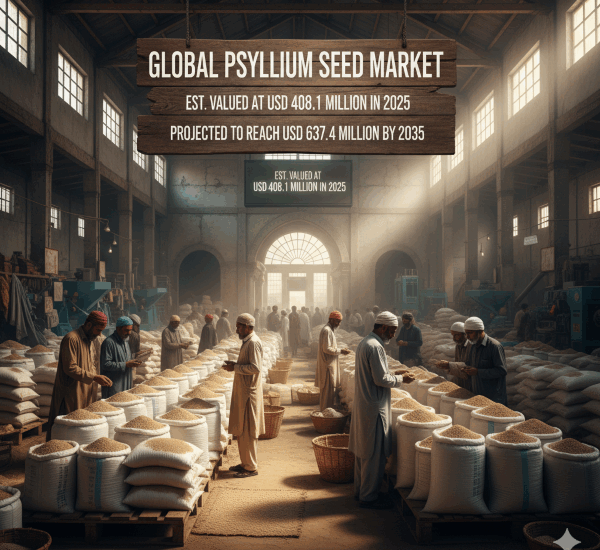
The global Psyllium Seed Market is on a steady growth trajectory, projected to rise from USD 408.1 million in 2025 to USD 637.4 million by 2035, registering a CAGR of 4.6% over the forecast period. This expansion is fueled by rising consumer awareness about digestive health, cholesterol management, and the benefits of soluble dietary fiber. The latest report, “Psyllium Seed Market Size and Share Forecast Outlook 2025 to 2035,” highlights how both established industry leaders and emerging manufacturers are accelerating innovation and expanding their global reach through new technologies and sustainable production models.
Get this Report at $3500 | Grab Your Market Insights Today: https://www.futuremarketinsights.com/reports/sample/rep-gb-3282
Rising Health Awareness Powers Market Momentum
The growing focus on gut health, weight management, and glycemic control has positioned psyllium seeds as a staple in the functional food, nutraceutical, and pharmaceutical industries. As consumers seek natural and organic ingredients, psyllium’s reputation as a clean-label, plant-based fiber has made it a preferred ingredient among health-driven product developers.
According to industry experts, the surge in self-care trends and preventive healthcare awareness has been pivotal in boosting psyllium seed demand. Manufacturers are also developing innovative formulations such as fiber-enriched snacks, gluten-free bakery products, and psyllium-based beverages to cater to the evolving preferences of wellness-conscious consumers.
Thickening Agent Function Leads Product Demand
In terms of function, the thickening agent segment dominates the market, accounting for 22.7% of revenue in 2025. Psyllium’s ability to enhance texture, viscosity, and stability in food and pharmaceutical formulations has made it a natural substitute for synthetic stabilizers. Its multifunctional applications in soups, sauces, beverages, and gluten-free baked goods further boost its industrial appeal.
As food and beverage producers embrace clean-label formulations and plant-derived alternatives, psyllium’s natural properties continue to align with consumer demand for transparent and health-centric ingredients.
B2B Segment Dominates Industrial Applications
The B2B segment is projected to account for 61.3% of market revenue in 2025, driven by bulk procurement from food, nutraceutical, and pharmaceutical companies. Psyllium seeds are extensively used in commercial production of high-fiber foods, digestive health supplements, and cholesterol-control formulations.
Manufacturers are forming strategic partnerships and supply chain collaborations to ensure quality consistency and efficient distribution. With rising global demand for fiber-enriched products, B2B integration remains the backbone of psyllium’s industrial expansion.
Organic Psyllium Leads Market Shift
The organic segment is anticipated to capture 60% of market share in 2025, reflecting the rapid consumer shift toward non-GMO and chemical-free products. Growing concerns around sustainability, soil health, and eco-friendly farming are driving the adoption of organic cultivation methods.
Producers investing in organic certification and traceable sourcing are expected to gain a competitive advantage. This not only enhances consumer trust but also allows farmers and companies to command premium pricing in both domestic and export markets.
Regional and Country Insights
North America, Asia-Pacific, and Europe lead global psyllium consumption, with emerging markets in Latin America and Africa showing significant potential.
- United States: Accounts for 23.1% of global revenue, driven by the strong market for digestive health supplements and functional foods.
- Germany: Exhibits a CAGR of 8.5%, reflecting increasing awareness about soluble fiber and metabolic wellness.
- Australia: Leads with a CAGR of 9.3%, indicating rapid expansion in functional foods and dietary fiber products.
- India and China: Represent the heart of psyllium cultivation and export, supported by growing domestic awareness and government initiatives promoting plant-based nutrition.
Innovation and Technology Transform Psyllium Farming
Agricultural innovation is reshaping psyllium cultivation across key producing regions such as India, Pakistan, and Iran. The integration of precision farming, drone monitoring, and advanced irrigation systems is improving yield quality, while seed genetics and pest-resistant strains enhance sustainability and resilience against climate change.
This Agri-Tech revolution is creating opportunities for both small and large producers to optimize output and reduce costs, ensuring consistent supply to meet growing industrial demand.
Market Structure and Competitive Outlook
The psyllium seed supply chain is distributed across multiple tiers—
- 30% led by large multinational corporations and agribusiness leaders,
- 50% shared by mid-sized regional producers and cooperatives, and
- 20% held by small-scale local suppliers and niche distributors.
These dynamics foster healthy competition while enabling efficient processing and distribution across food, pharmaceutical, and cosmetics industries.
Leading companies such as Keyur Industries, JYOT Overseas Pvt. Ltd., Atlas Industries, Satnam Psyllium Industries, Abhyuday Industries, and Shree Mahalaxmi Psyllium Pvt. Ltd. are advancing their market positions by focusing on R&D, product diversification, and sustainable sourcing. Meanwhile, emerging firms like Ispasen Remedies and Shubh Psyllium Industries are investing in advanced processing technologies to expand their production capacity and export potential.
Access Premium Reports – Get Your Copy Today: https://www.futuremarketinsights.com/checkout/3282
Future Outlook: Psyllium’s Expanding Role in Global Nutrition
As global consumers increasingly prioritize digestive wellness and clean-label nutrition, psyllium seeds are expected to remain a cornerstone ingredient in next-generation food and supplement formulations.
From organic certification initiatives to technological innovations in farming, the industry’s evolution reflects a broader movement toward sustainability, health, and transparency. The next decade will see continued collaboration between new entrants and established players to enhance psyllium’s global accessibility, ensuring that this natural fiber continues to contribute to a healthier, more sustainable world.
About Future Market Insights (FMI)
Future Market Insights, Inc. (ESOMAR certified, recipient of the Stevie Award, and a member of the Greater New York Chamber of Commerce) offers profound insights into the driving factors that are boosting demand in the market. FMI stands as the leading global provider of market intelligence, advisory services, consulting, and events for the Packaging, Food and Beverage, Consumer Technology, Healthcare, Industrial, and Chemicals markets. With a vast team of over 400 analysts worldwide, FMI provides global, regional, and local expertise on diverse domains and industry trends across more than 110 countries.
Contact Us:
Future Market Insights Inc.
Christiana Corporate, 200 Continental Drive,
Suite 401, Newark, Delaware – 19713, USA
T: +1-347-918-3531
For Sales Enquiries: sales@futuremarketinsights.com
Website: https://www.futuremarketinsights.com
LinkedIn| Twitter| Blogs | YouTube
