

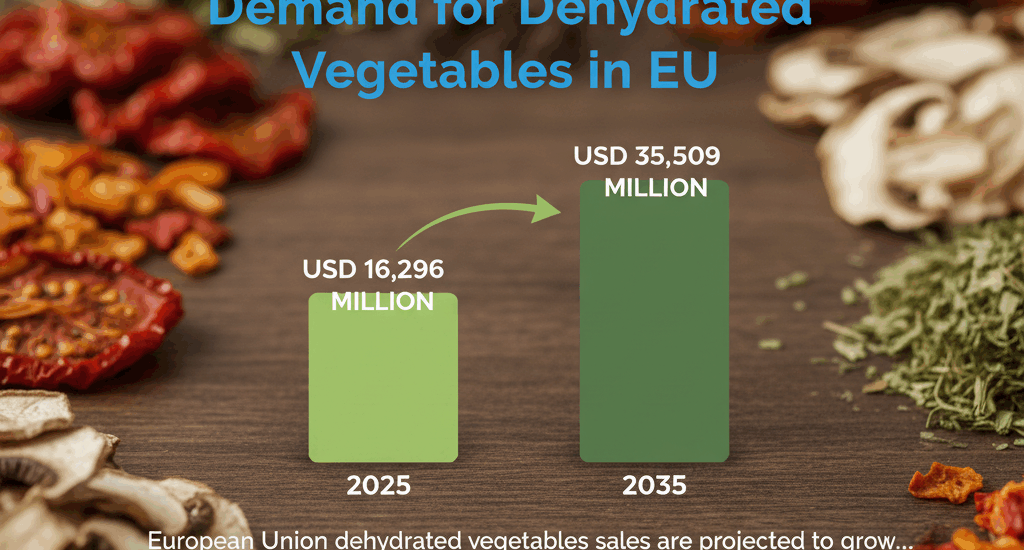
The EU Dehydrated Vegetables Market is set for strong expansion, with sales projected to rise from USD 16,296 million in 2025 to USD 35,509 million by 2035, registering a CAGR of 8.1%, according to the latest report “Demand for Dehydrated Vegetables in EU: Outlook and Forecast 2025–2035.” This rapid growth—an overall increase of 117.8% over the decade—reflects Europe’s accelerating shift toward convenient, shelf-stable, and nutritionally preserved food products.
Get this Report at $3500 | Get Your Discounted Report Now: https://www.futuremarketinsights.com/reports/sample/rep-gb-27188
Convenience-Driven Growth and Expanding Applications
Dehydrated vegetables have become a staple in modern European kitchens, serving both households and large-scale food manufacturers. The category’s growth is primarily driven by rising demand for convenient cooking solutions, food waste reduction efforts, and increasing adoption across the foodservice and manufacturing sectors.
Between 2025 and 2030, market value is expected to rise by over USD 7.8 billion, accounting for nearly 41% of the decade’s total increase. During this period, onions will dominate the product landscape with a 40% market share, while food manufacturers will remain the top end-users, representing 53% of total demand.
Established European manufacturers and emerging processors alike are enhancing their product portfolios with improved flavor retention, faster rehydration properties, and formulations that preserve natural color and nutrients. These innovations are reshaping consumer perceptions, making dehydrated vegetables a preferred alternative to frozen and canned formats.
Technology Transformation: From Hot-Air Drying to Advanced Dehydration
The industry is undergoing a technological transformation as manufacturers adopt freeze-drying, vacuum dehydration, and infrared drying technologies. These methods allow superior nutrient and flavor preservation, helping processors meet growing consumer expectations for freshness and quality.
Companies such as Olam Group, Symrise AG, and Dak Foods/BCFoods are at the forefront of this evolution—investing heavily in processing technology, quality enhancement, and pilot-scale testing to achieve better efficiency and consistency. This advancement is enabling both established and new entrants to strengthen their foothold in Europe’s rapidly evolving food ecosystem.
In addition, collaborative efforts between equipment suppliers, food scientists, and regional cooperatives are giving rise to scalable, energy-efficient dehydration systems, addressing sustainability concerns while maintaining competitive pricing.
The Rise of Organic and Clean-Label Dehydrated Vegetables
Health-conscious European consumers are increasingly favoring organic and clean-label dehydrated vegetables, pushing manufacturers to adopt traceable, pesticide-free sourcing and organic certification programs. The organic segment, which currently holds 18% market share, is forecast to grow to 26% by 2035, reflecting rising awareness of wellness and environmental responsibility.
Producers like Naturex S.A., Viva Bella Orchards, and Kiantama are aligning with these trends by developing organic-certified dehydration operations that emphasize natural processing methods and minimal intervention approaches. Packaging innovations showcasing clean-label credentials and certification logos are helping brands strengthen trust and transparency among consumers.
Sustainability and Local Sourcing at the Core
Sustainability is becoming central to competitive differentiation in the EU market. Manufacturers are focusing on local agricultural partnerships, renewable energy adoption, and carbon footprint reduction. The integration of solar drying, waste heat recovery, and renewable energy sources allows producers to create environmentally responsible products without compromising profitability.
Emerging players, particularly in Spain and the Netherlands, are leveraging efficient logistics and regional sourcing to position their operations as green, transparent, and future-ready. This approach not only appeals to eco-conscious consumers but also strengthens resilience across the supply chain.
Country-Level Growth Insights
The EU’s dehydrated vegetable demand is expanding across major economies, led by France (8.5% CAGR), Spain (8.4%), Italy (8.3%), the Netherlands (8.2%), and Germany (8.0%).
- Germany maintains the largest share at 32.7%, driven by its robust industrial base and advanced processing infrastructure.
- France shows the strongest growth trajectory, backed by expanding convenience food adoption and retail innovations by leading chains like Carrefour, Auchan, and Leclerc.
- Italy benefits from its deep-rooted culinary culture and growing acceptance of dehydrated ingredients in traditional cuisine.
- Spain’s strong agricultural foundation fuels processing investments and export potential.
- The Netherlands, acting as a key distribution hub, leverages logistics efficiency and technological sophistication to maintain competitiveness.
Competitive Landscape: Technology, Quality, and Expansion
The EU dehydrated vegetables industry remains highly fragmented, with both multinational ingredient suppliers and regional cooperatives competing for market share.
- Olam Group leads with an estimated 9% share, benefiting from integrated global sourcing and agricultural expertise.
- Symrise AG follows with 6%, capitalizing on its German processing capabilities and flavor technology specialization.
- Dak Foods/BCFoods, holding around 4%, focuses on supplying dehydrated ingredients to seasoning and spice-blend manufacturers.
Meanwhile, numerous small and medium-sized enterprises (SMEs) across Europe are making strategic moves—expanding processing capacities, embracing organic certification, and developing private-label partnerships with major retailers like Tesco, Edeka, and Aldi. These initiatives are broadening accessibility and driving consumer awareness.
Shop Market Research Reports Now: https://www.futuremarketinsights.com/checkout/27188
Future Outlook: From Convenience to Culinary Innovation
By 2035, the EU dehydrated vegetables market is expected to nearly double in size, underpinned by technological innovation, sustainability commitments, and diversification of product offerings. Manufacturers are focusing on premium organic lines, energy-efficient dehydration systems, and flavor-intense varieties that rival fresh vegetables in culinary performance.
As both established brands and new entrants continue to innovate, the European dehydrated vegetables market stands poised to redefine the continent’s convenience food landscape, offering consumers healthy, sustainable, and flavorful alternatives for modern living.
About Future Market Insights (FMI)
Future Market Insights, Inc. (ESOMAR certified, recipient of the Stevie Award, and a member of the Greater New York Chamber of Commerce) offers profound insights into the driving factors that are boosting demand in the market. FMI stands as the leading global provider of market intelligence, advisory services, consulting, and events for the Packaging, Food and Beverage, Consumer Technology, Healthcare, Industrial, and Chemicals markets. With a vast team of over 400 analysts worldwide, FMI provides global, regional, and local expertise on diverse domains and industry trends across more than 110 countries.
Contact Us:
Future Market Insights Inc.
Christiana Corporate, 200 Continental Drive,
Suite 401, Newark, Delaware – 19713, USA
T: +1-347-918-3531
For Sales Enquiries: sales@futuremarketinsights.com
Website: https://www.futuremarketinsights.com
LinkedIn| Twitter| Blogs | YouTube
