The reinforcement geosynthetics market is on a remarkable growth trajectory, with global valuations expected to climb from USD 3.4 billion in 2025 to USD 9.4 billion by 2035, registering an impressive compound annual growth rate (CAGR) of 10.7%. The growth is being fueled by the escalating demand for durable, cost-effective solutions in soil stabilization and structural reinforcement across civil engineering and infrastructure projects. Reinforcement geosynthetics have become essential in modern construction, offering engineers reliable means to enhance load-bearing capacities, control erosion, and extend the lifespan of roadways, embankments, bridges, and other critical infrastructures.
This expansion is not just a reflection of infrastructure growth but also a response to the evolving priorities in construction. Urbanization, the development of highway networks, airport pavements, and sustainable building practices are driving the adoption of advanced geosynthetic materials. Manufacturers are innovating with high-performance products that improve mechanical strength, adapt to variable soil conditions, and reduce maintenance frequency, making these materials a preferred choice for both government projects and private-sector developments.
Driving Forces Behind Market Expansion
The demand for reinforcement geosynthetics is largely anchored in their ability to deliver long-term structural stability while reducing the cost and time of maintenance. Technological advancements have significantly enhanced their performance, allowing them to withstand heavy loads, resist soil erosion, and function effectively in challenging terrains. Geosynthetics such as geotextiles, geo-composites, and geofoam are integral to a range of applications including road construction, embankments, retaining walls, landfill containment, railways, waterworks, and waste treatment systems.
Environmental sustainability is another key factor shaping the market. With increasing regulatory emphasis on reducing carbon footprints, reinforcement geosynthetics are preferred for their ability to minimize the use of natural aggregates, promote soil conservation, and ensure eco-friendly construction practices. As countries worldwide prioritize resilient and sustainable infrastructure, the market for geosynthetic solutions is expected to witness strong, sustained demand.
Segment Insights: Geotextiles Lead the Way
Among the various product types, geotextiles reinforcement geosynthetics are projected to capture 47.6% of the market share in 2025, establishing their position as the dominant segment. Their popularity is driven by their flexibility, ease of installation, and compatibility with a wide range of soil types. Geotextiles provide critical benefits such as enhanced soil stabilization, load distribution, reduced settlement, and accelerated construction timelines.
Urbanization and highway expansion are particularly boosting demand for geotextiles. Their ability to be quickly deployed while maintaining structural integrity and sustainability makes them a preferred solution in both developing and developed regions. In addition, manufacturers are leveraging innovative production technologies to create geotextiles that offer superior tensile strength, durability, and environmental compliance, ensuring their continued dominance in the market.
Applications: Roads and Embankments at the Forefront
The road construction and embankment segment is expected to account for 42.1% of the market in 2025, driven by the critical role of geosynthetics in enhancing pavement performance and embankment stability. Reinforcement geosynthetics help prevent differential settlement, distribute loads evenly, and reduce erosion, directly contributing to the long-term durability of road networks.
This segment benefits from large-scale public infrastructure investments and the adoption of sustainable construction practices. Governments and private developers alike are increasingly incorporating geosynthetic solutions in highway construction, elevated embankments, and urban road networks to reduce maintenance costs and environmental impact. The combination of cost-effectiveness, ease of installation, and performance reliability ensures that this application segment will remain a primary driver of market growth.
Market Overview and Mechanism
Reinforcement geosynthetics function as structural support systems, enhancing soil properties through tensioned reinforcement combined with fill material. When integrated with soil, these materials form reinforced composites with elevated compressive and tensile strengths. Applications range from rail tracks and shallow foundations to embankments and pavements. Their key functionalities include subgrade separation, base reinforcement, filtration, lateral drainage, and stress absorption, which collectively contribute to structural stability and performance.
Filtration and drainage are especially vital in preventing water accumulation and erosion while maintaining soil integrity. By facilitating uniform stress distribution, reinforcement geosynthetics reduce the likelihood of structural failures and extend the life of civil infrastructure. These attributes have cemented their role as indispensable components in modern construction practices, offering both functional and environmental advantages.
Regional Insights: Asia-Pacific Leads Growth
The market demonstrates varied growth rates across regions, with China leading the charge at a CAGR of 14.4%, followed by India at 13.4%. Rapid industrialization, urban expansion, and investments in transportation infrastructure are key drivers in these regions. In Europe, Germany, France, and the UK maintain steady growth with CAGRs of 12.3%, 11.2%, and 10.2% respectively, reflecting continued infrastructure development and modernization initiatives.
The United States is projected to grow at 9.1% CAGR, supported by highway expansions, airport developments, and sustainable construction mandates. Brazil, while exhibiting a slightly lower CAGR of 8.0%, remains an emerging market with opportunities arising from urbanization and industrial expansion. Overall, the global demand pattern underscores the increasing reliance on geosynthetics for resilient, cost-effective, and environmentally friendly infrastructure solutions.
Purchase this Report for USD 5,000 Only | Get an Exclusive Discount Instantly! https://www.futuremarketinsights.com/checkout/7942
Everything You Need—within Your Budget. Request a Special Price Now! https://www.futuremarketinsights.com/reports/sample/rep-gb-7942
Competitive Landscape: Established and Emerging Players
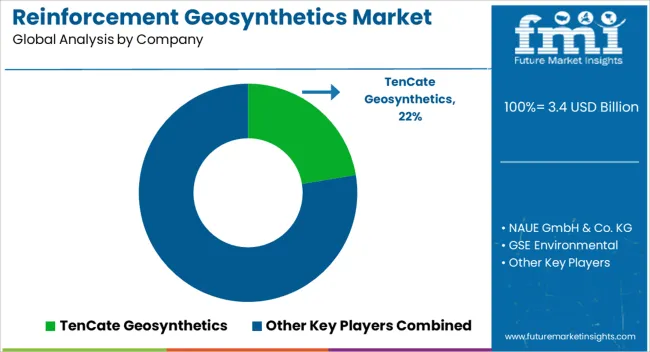
The reinforcement geosynthetics market is shaped by both established global leaders and innovative newcomers. Companies like TenCate Geosynthetics, NAUE GmbH & Co. KG, GSE Environmental, Officine Maccaferri, and Low & Bonar (Freudenberg) have long dominated the market, leveraging expansive distribution networks, extensive R&D capabilities, and a reputation for reliable products.
Meanwhile, HUESKER Group, Fibertex Nonwovens, and AGRU Kunststofftechnik are emerging players aggressively investing in technological innovation, modular product design, and high-performance solutions. These companies focus on creating geosynthetics that provide superior durability, ease of installation, and compliance with environmental regulations. Many are forming strategic partnerships and entering new regional markets to capture rising demand in Asia-Pacific, Latin America, and Africa.
Collaboration between established and emerging players is fostering innovation across material design, manufacturing processes, and application techniques. Innovations such as modular geocomposites and high-strength geotextiles are now enabling rapid deployment of infrastructure projects while ensuring long-term sustainability.
About Future Market Insights (FMI)
Future Market Insights, Inc. (ESOMAR certified, recipient of the Stevie Award, and a member of the Greater New York Chamber of Commerce) offers profound insights into the driving factors that are boosting demand in the market. FMI stands as the leading global provider of market intelligence, advisory services, consulting, and events for the Packaging, Food and Beverage, Consumer Technology, Healthcare, Industrial, and Chemicals markets. With a vast team of over 400 analysts worldwide, FMI provides global, regional, and local expertise on diverse domains and industry trends across more than 110 countries.
Contact Us:
Future Market Insights Inc.
Christiana Corporate, 200 Continental Drive,
Suite 401, Newark, Delaware – 19713, USA
T: +1-347-918-3531
For Sales Enquiries: sales@futuremarketinsights.com
Website: https://www.futuremarketinsights.com
LinkedIn| Twitter| Blogs | YouTube