

The global synthetic tackifiers market is positioned for significant expansion, expected to rise from USD 4.5 billion in 2025 to USD 7.7 billion by 2035, reflecting a compound annual growth rate (CAGR) of 5.5%. This growth trajectory is supported by an accelerating demand for advanced adhesive systems in key sectors such as packaging, construction, automotive, and electronics. As industries move toward faster, cleaner, and more sustainable bonding solutions, synthetic tackifiers have emerged as essential components that enhance adhesive performance, process efficiency, and material compatibility.
The shift toward performance-driven manufacturing has strengthened the market’s foundation, with both established companies and new entrants investing heavily in polymer innovation and resin development. Synthetic tackifiers enable strong initial adhesion, thermal stability, and long-lasting bond strength—key attributes that modern industrial applications demand. Their role in improving hot melt and pressure-sensitive adhesive performance is pivotal, making them indispensable in high-speed assembly lines and automated manufacturing systems.
Drivers of Growth: Efficiency, Sustainability, and Industrial Expansion
One of the main drivers of market growth is the increasing demand for high-performance adhesives that perform consistently across temperature extremes and diverse substrates. As manufacturing industries embrace automation and high-throughput production, adhesive performance reliability becomes crucial. Synthetic tackifiers, particularly hydrocarbon-based variants, are being engineered to enhance bonding speed and durability while reducing energy consumption and material waste.
The packaging and e-commerce industries are among the largest consumers of synthetic tackifiers. With the global boom in online retail, there is a soaring requirement for reliable hot melt adhesives that can bond diverse packaging materials quickly and cleanly. The market is also witnessing strong uptake in construction, where adhesives fortified with synthetic tackifiers provide superior bonding strength for flooring, insulation, and wall systems.
In parallel, sustainability trends are shaping product innovation. Leading manufacturers are developing bio-based and low-VOC tackifier resins to meet environmental regulations and corporate sustainability goals. As companies aim for greener formulations, these next-generation synthetic tackifiers balance performance with environmental responsibility, creating opportunities for both established brands and emerging innovators.
Hydrocarbon Tackifiers Lead the Market
In 2025, the hydrocarbon type segment is projected to dominate the market, accounting for 57.6% of global revenue. This leadership is attributed to hydrocarbon tackifiers’ versatility, cost efficiency, and compatibility with diverse adhesive systems such as hot melt and pressure-sensitive formulations. They offer consistent tack, thermal stability, and process reliability—qualities essential for high-speed industrial applications.
Industries value hydrocarbon tackifiers for their excellent adhesion performance, ease of processing, and stable chemical composition. Their ability to perform across multiple substrates, including paper, metal, and polymers, makes them an ideal choice for packaging and industrial adhesives. As more manufacturers aim to enhance operational reliability and reduce downtime, hydrocarbon tackifiers will continue to dominate due to their proven balance of cost and performance.
Meanwhile, phenolic tackifiers continue to play an important role in specialty adhesives where exceptional chemical resistance and durability are required. These are increasingly used in coatings, laminates, and high-performance bonding systems, reflecting the market’s shift toward niche applications with precise performance parameters.
Hot Melt Adhesives Dominate Applications
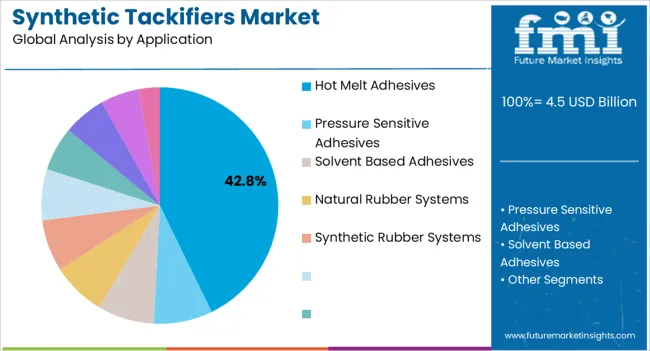
The hot melt adhesives application segment is forecasted to capture 42.8% of the market in 2025, marking it as the leading application area for synthetic tackifiers. These adhesives are prized for their fast-setting, solvent-free, and energy-efficient characteristics, which align perfectly with the global drive toward sustainable production and automation.
Hot melt adhesives are widely used in packaging, construction, automotive assembly, and textiles, where reliable performance and quick bonding are essential. As factories adopt automated production lines, the need for adhesives that deliver consistent tack without sacrificing processing speed becomes paramount. Synthetic tackifiers help optimize the rheological and adhesive properties of hot melt systems, ensuring superior performance under varying conditions.
The growth of pressure-sensitive adhesives (PSA), used in labels, tapes, and medical devices, also contributes to overall demand. As product manufacturers prioritize ease of application and long-term adhesion, synthetic tackifiers are becoming the preferred solution due to their flexibility and chemical resilience.
Paper and Packaging: The Leading End-Use Industry
Among end-use industries, the paper and packaging segment will command the largest share—39.4% of market revenue in 2025. This dominance is driven by expanding e-commerce, consumer goods, and food packaging sectors, where adhesives must provide strong bonds while meeting sustainability and recyclability standards.
Synthetic tackifiers enhance adhesive performance in packaging by improving bond integrity and flexibility, enabling high-speed production while reducing material waste. With growing consumer demand for eco-friendly and recyclable packaging, manufacturers are reformulating tackifiers to maintain adhesive strength without compromising sustainability goals.
Beyond packaging, synthetic tackifiers are gaining momentum in construction, medical devices, and textiles. In construction, they are used to reinforce sealants and coatings; in medical applications, they enhance adhesive tapes and patches; and in textiles, they aid in nonwoven fabric bonding. The material’s adaptability and performance consistency make it indispensable across these expanding industries.
Purchase this Report for USD 5,000 Only | Get an Exclusive Discount Instantly! https://www.futuremarketinsights.com/checkout/7864
Everything You Need—within Your Budget. Request a Special Price Now! https://www.futuremarketinsights.com/reports/sample/rep-gb-7864
Regional Insights: Asia-Pacific Leads Global Growth
The Asia-Pacific region is expected to be the powerhouse of the synthetic tackifiers market, driven by rapid industrialization and manufacturing growth in China and India, which are projected to grow at 7.4% and 6.9% CAGR respectively. Investments in packaging, construction, and automotive production are boosting regional demand, while local manufacturers are expanding their resin production capacities to serve global markets.
Europe continues to play a key role in product innovation, led by countries such as Germany (6.3% CAGR) and France (5.8% CAGR). German chemical firms are focusing on sustainable polymer chemistry and advanced tackifier formulations to meet strict EU environmental regulations. Meanwhile, the UK is modernizing its packaging and labeling sectors with advanced adhesive technologies.
In North America, the U.S. synthetic tackifiers market is expected to grow from USD 1.6 billion in 2025 to USD 2.5 billion by 2035, achieving a CAGR of 4.7%. Growth here is driven by expanding e-commerce packaging, construction adhesives, and high-performance coatings. Brazil leads Latin America with a CAGR of 4.1%, while Japan and South Korea remain key innovation hubs for high-purity tackifiers used in electronics and specialty adhesives.
Competitive Landscape: Established Leaders and Emerging Innovators
The synthetic tackifiers market is characterized by a mix of global chemical giants and emerging regional manufacturers. Leading companies such as Eastman Chemical Company, ExxonMobil Chemical, Arkema Group, Kraton Corporation, BASF SE, Henkel AG & Co. KGaA, Lawter (Harima Chemicals Group), and Zeon Corporation are actively shaping the competitive landscape through investments in R&D, product diversification, and global capacity expansion.
These established players are pioneering next-generation tackifier technologies that offer enhanced performance and environmental compatibility. For instance, innovations in low-odor and hydrogenated resins are helping address consumer and regulatory concerns about emissions and recyclability. Meanwhile, new entrants and mid-sized manufacturers in Asia and Eastern Europe are focusing on cost-effective production, customization, and regional distribution, aiming to capture market share from established leaders.
About Future Market Insights (FMI)
Future Market Insights, Inc. (ESOMAR certified, recipient of the Stevie Award, and a member of the Greater New York Chamber of Commerce) offers profound insights into the driving factors that are boosting demand in the market. FMI stands as the leading global provider of market intelligence, advisory services, consulting, and events for the Packaging, Food and Beverage, Consumer Technology, Healthcare, Industrial, and Chemicals markets. With a vast team of over 400 analysts worldwide, FMI provides global, regional, and local expertise on diverse domains and industry trends across more than 110 countries.
Contact Us:
Future Market Insights Inc.
Christiana Corporate, 200 Continental Drive,
Suite 401, Newark, Delaware – 19713, USA
T: +1-347-918-3531
For Sales Enquiries: sales@futuremarketinsights.com
Website: https://www.futuremarketinsights.com
LinkedIn| Twitter| Blogs | YouTube




