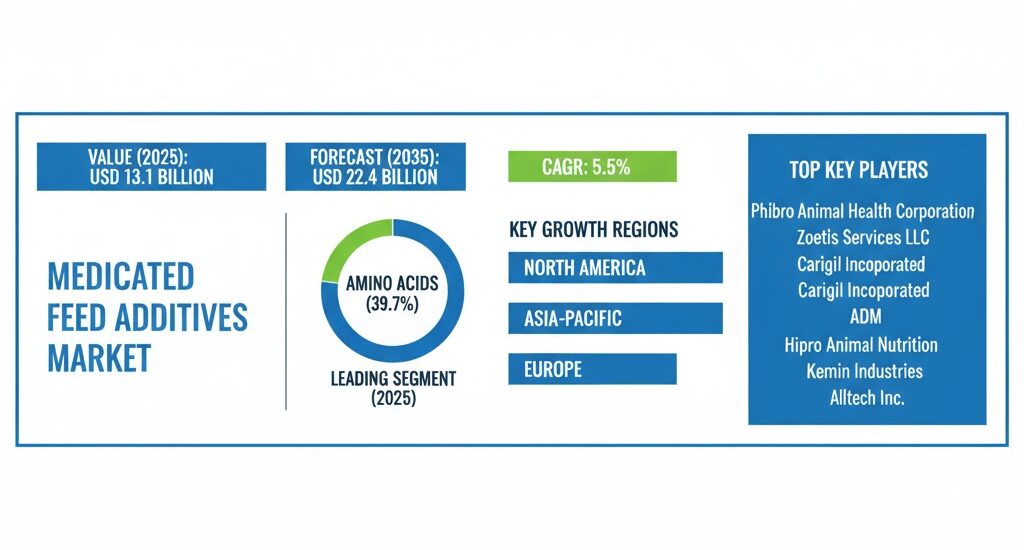
The global Medicated Feed Additives Market is on a strong growth trajectory, projected to rise from USD 13.1 billion in 2025 to USD 22.4 billion by 2035, registering a compound annual growth rate (CAGR) of 5.5%. This steady climb signals a pivotal shift in livestock nutrition, where innovation, sustainability, and performance-driven solutions are reshaping the future of animal feed production worldwide.
Driving Forces Behind Market Expansion
The global surge in demand for high-quality meat, milk, and dairy products is redefining the standards for animal health management. Livestock producers are increasingly turning to medicated feed additives — nutritional and therapeutic supplements designed to enhance growth, prevent disease, and optimize productivity.
In a market where disease control and growth efficiency remain top priorities, medicated feed additives offer a dual advantage: improving animal welfare while maintaining profitability. The shift toward intensive farming practices in developing economies, coupled with stricter regulations on antibiotic usage, is amplifying the demand for alternative, safe, and sustainable medicated feed solutions.
Technological breakthroughs in formulation science and delivery mechanisms are further driving this evolution. Manufacturers are investing in high-efficacy formulations that ensure cost efficiency, better absorption, and compliance with global feed standards. As a result, producers are gaining access to more advanced additives that not only enhance feed conversion but also align with regulatory frameworks prioritizing reduced antibiotic dependence.
Buy Now & Save: Premium Market Report at $5,000 | Discount Details Inside:- https://www.futuremarketinsights.com/reports/sample/rep-gb-2839
Segmental Highlights: Amino Acids Lead the Charge
Among product types, Amino Acids stand out as the most dominant category, expected to account for 39.7% of total market share in 2025. Their role in promoting protein synthesis, growth performance, and immunity makes them indispensable in modern feed formulations.
For manufacturers and producers, amino acid-based additives represent a clear value proposition:
- Enhanced feed efficiency through optimized protein utilization.
- Reduced reliance on antibiotics while meeting animal welfare expectations.
- Sustainability benefits by minimizing feed waste and maximizing nutrient absorption.
Continuous innovation in synthetic amino acids has enabled better stability and cost optimization, ensuring consistent quality across production cycles. As global protein consumption continues to rise, amino acid additives are expected to retain their leadership position, forming the backbone of performance-driven livestock nutrition.
Swine Segment Takes Center Stage
By animal type, the swine segment is forecasted to lead with 42.9% market share in 2025, propelled by the expanding global demand for pork — one of the world’s most consumed animal proteins.
Swine farming presents unique challenges: susceptibility to bacterial and viral infections, feed efficiency optimization, and ensuring animal survival rates. Medicated feed additives are playing a crucial role in addressing these challenges by delivering nutritional fortification and therapeutic protection in a single feed solution.
Across Asia Pacific and Europe, the rapid commercialization of pig farming and heightened concerns about zoonotic diseases have spurred investments in medicated feed programs. By reducing mortality and improving feed conversion, these additives are empowering producers to sustain productivity without compromising safety or quality.
Regional Insights: Asia Pacific Leads Global Momentum
The medicated feed additives market exhibits robust global momentum, with Asia Pacific emerging as the fastest-growing region.
- China leads with a CAGR of 7.4%, fueled by the country’s expanding swine and poultry sectors.
- India follows closely at 6.9% CAGR, driven by the modernization of its dairy and poultry industries.
In contrast, mature markets such as Germany (6.3%), France (5.8%), and the UK (5.2%) continue to grow steadily, supported by strong regulatory compliance and a shift toward antibiotic alternatives.
The USA, with a projected CAGR of 4.7%, remains a key hub for innovation, expected to reach USD 7.4 billion by 2035.
While Brazil trails slightly at 4.1% CAGR, the nation’s expanding livestock production still signals positive opportunities for feed additive manufacturers aiming to penetrate Latin America’s evolving market landscape.
Key Players and Industry Leadership
The market’s competitive landscape features a blend of global giants and specialized innovators driving advancements in medicated feed solutions. Key players include:
- Phibro Animal Health Corporation
- Zoetis Services LLC
- Cargill Incorporated
- ADM
- Hipro Animal Nutrition
- Adisseo
- Kemin Industries
- Alltech Inc.
These companies are spearheading initiatives that integrate research-driven formulations, precision nutrition technologies, and sustainability-focused product lines. Their efforts are paving the way for safer, more efficient, and more transparent feed systems that meet the growing expectations of farmers, regulators, and consumers alike.
Click Here to Purchase the Report:- https://www.futuremarketinsights.com/checkout/2839
A Sustainable Path Forward for Feed Manufacturers
As the livestock industry navigates evolving regulatory environments and changing consumer preferences, medicated feed additives stand as a strategic enabler of future-ready agriculture.
Manufacturers investing in this space are not merely producing feed enhancers — they are shaping the foundation of sustainable protein production. From amino acid innovation to probiotic integration, the focus remains on creating value-driven, environmentally conscious, and performance-oriented feed solutions.
With global demand accelerating and technology advancing, the medicated feed additives market is poised to redefine the future of livestock nutrition — offering manufacturers a powerful opportunity to expand their portfolios, optimize operations, and support a healthier global food chain.
About Future Market Insights (FMI)
Future Market Insights, Inc. (ESOMAR certified, recipient of the Stevie Award, and a member of the Greater New York Chamber of Commerce) offers profound insights into the driving factors that are boosting demand in the market. FMI stands as the leading global provider of market intelligence, advisory services, consulting, and events for the Packaging, Food and Beverage, Consumer Technology, Healthcare, Industrial, and Chemicals markets. With a vast team of over 400 analystsworldwide, FMI provides global, regional, and local expertise on diverse domains and industry trends across more than 110 countries.
Contact Us:
Future Market Insights Inc.
Christiana Corporate, 200 Continental Drive,
Suite 401, Newark, Delaware – 19713, USA
T: +1-347-918-3531
For Sales Enquiries: sales@futuremarketinsights.com
Website: https://www.futuremarketinsights.com
LinkedIn| Twitter| Blogs | YouTube