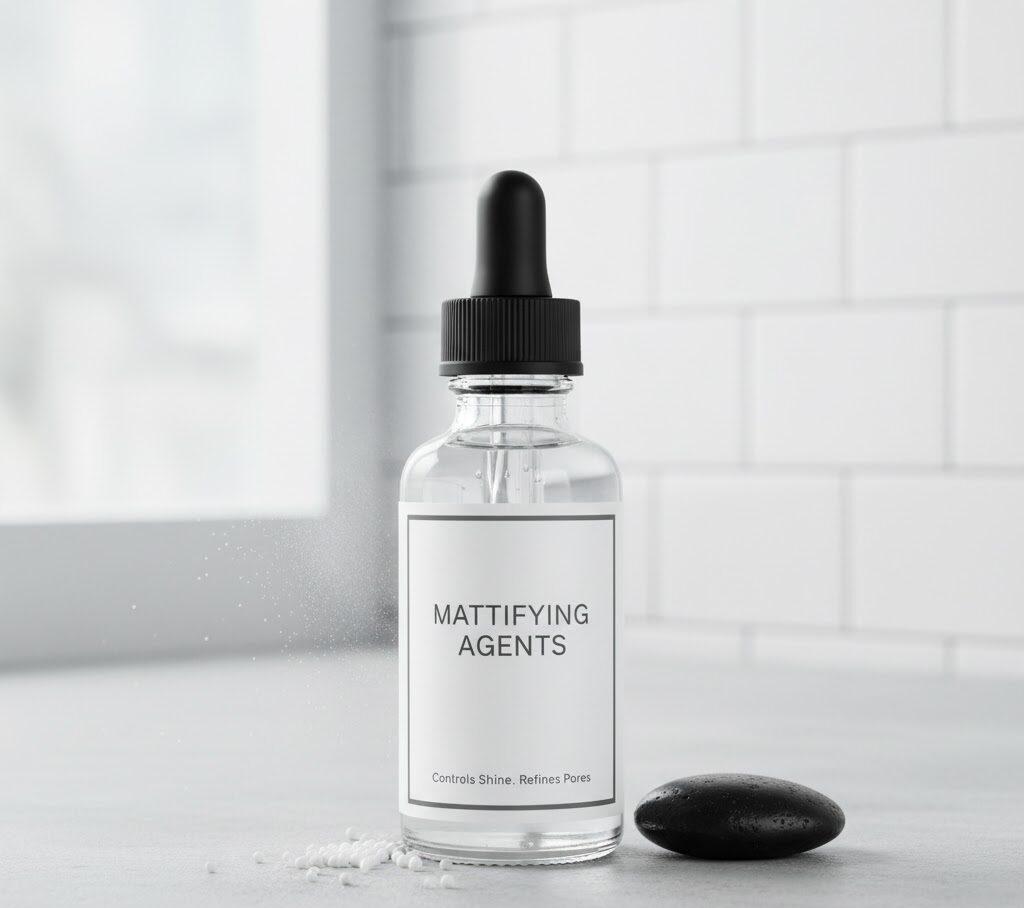
The global Mattifying Agents Market is poised for remarkable expansion, with a projected valuation of USD 1,453.7 million in 2025, accelerating to USD 3,106.7 million by 2035. This represents a striking growth of 113% over the decade, marking a compound annual growth rate (CAGR) of 7.9%. The surge reflects the beauty industry’s evolution toward oil-control, long-wear, and hybrid skincare formulations that merge aesthetic performance with skin health benefits.
Mattifying Agents Market Overview
Mattifying agents—key ingredients in color cosmetics and skincare—are essential for achieving oil-free, soft-focus finishes and enhanced texture stability. From BB creams and compact powders to mattifying serums and hybrid moisturizers, these actives are redefining how brands approach shine control and sensory experience in beauty formulations.
The silica and silica blends segment will continue to dominate in 2025, accounting for 41.5% of global revenue, driven by their transparency, oil-absorption capacity, and versatility. Meanwhile, emerging materials such as PMSQ microspheres, polymer film formers, and starch-derived powders are reshaping product innovation with eco-friendly and multifunctional benefits.
Growth Dynamics and Market Drivers
Between 2025 and 2030, the market is expected to add nearly USD 671 million, propelled by growing consumer demand for long-lasting, oil-free, and photo-ready cosmetic products. The second half of the decade (2030–2035) will see accelerated growth of USD 982 million, fueled by technological advancements in polymer chemistry and the shift toward dermocosmetic and premium skincare lines.
The rise of hybrid beauty—products that combine skincare and makeup benefits—is transforming consumer expectations. Today’s buyers are looking for more than coverage; they want breathable, non-comedogenic, and skin-balancing formulations that enhance complexion naturally. This shift is particularly strong in Asia-Pacific, where humid climates and high pollution drive preference for sebum-control products, and in Western markets, where clean, sustainable, and dermatologically tested ingredients dominate purchasing decisions.
Technological and Material Innovation
Leading ingredient manufacturers like Evonik, BASF, Croda, and Clariant are spearheading the next phase of product innovation. They are investing in surface-modified silica, PMSQ polymers, and biodegradable starch-silica composites to improve sensory experience, light diffusion, and texture uniformity.
Evonik recently expanded its AEROSIL® silica production line in Rheinfelden, Germany, enhancing performance transparency and uniformity in hybrid skincare systems. Meanwhile, BASF’s MattPower™ Natural series offers biodegradable starch microbeads and coated silica solutions that align with EU clean beauty regulations, replacing traditional microplastics without compromising performance.
Emerging players such as Kobo Products, Sensient, and Seppic are gaining traction through niche formulation expertise—developing dispersion-based mattifiers and sensory-enhanced microspheres designed for next-generation skincare-cosmetic hybrids. At the same time, Grant Industries and Wacker Chemie are pushing the boundaries of silicone-compatible polymer networks, ensuring long-wear matte finishes even in high humidity.
Key Market Trends
- Bio-Based and Clean-Label Revolution
Sustainability has become a defining theme in the market’s evolution. The push toward plant-derived, microplastic-free, and biodegradable ingredients is prompting both established and new manufacturers to rethink their formulation strategies. Starch-based mattifiers and natural polymeric powders are increasingly being adopted across eco-conscious brands, with double-digit growth expected by 2030. - Hybrid Formulations and Sensory Sophistication
The integration of skincare actives into cosmetics—known as the “skincare-makeup fusion”—is a major driver of innovation. Consumers want high-performance mattifiers that provide oil absorption, blurring effects, and hydration simultaneously. As a result, materials such as PMSQ microspheres and crosslinked polymer film formers are gaining traction in premium skincare, sunscreens, and tinted moisturizers. - Regional Customization and Climate-Based Formulation
Global brands are localizing their ingredient strategies to match regional climate conditions and skin profiles. For instance, India, China, and Japan emphasize strong oil-control performance for humid environments, while Europe and North America focus on lightweight, soft-focus finishes suited for daily use. This localization trend is fostering partnerships between global suppliers and regional cosmetic brands to create climate-adaptive formulations.
Regional Insights
Asia-Pacific remains the fastest-growing region, driven by innovation in China (CAGR 11.7%) and India (CAGR 13.1%). In China, domestic ingredient producers are scaling up affordable silica and PMSQ-based actives, catering to booming demand for hybrid skincare products. India’s rapid urbanization and climate challenges have made mattifying agents a core component of everyday skincare, spurring collaborations between local manufacturers and global suppliers to produce starch-based and encapsulated mattifiers.
Japan (CAGR 9.5%) continues to set benchmarks for sensory excellence, while Europe (CAGR 7.0%) leads in sustainable, clean-label innovations under strict regulatory frameworks. In the United States, the market—valued at USD 289.9 million in 2025—reflects a growing preference for wellness-oriented beauty products that merge performance with dermatological care. Polymer-based and breathable film formers are becoming mainstream in oil-free makeup and hybrid skincare lines.
Competitive Landscape
The global mattifying agents industry remains moderately fragmented, with top players like Evonik (8.5% share), BASF, and Croda leading through material innovation and sustainability integration. However, smaller specialists such as Kobo Products, Sensient, and Seppic are challenging incumbents by offering tailor-made solutions for emerging brands seeking differentiation through texture, sensory experience, and clean formulations.
Competition is shifting from pure chemistry innovation to application science—where performance, sustainability, and sensorial feel converge. Companies are investing heavily in AI-driven formulation tools, sensory evaluation labs, and data-backed product testing to create intelligent mattifying systems optimized for global consumer diversity.
Future Outlook
As the market doubles in size over the next decade, innovation will increasingly center around multifunctional, sustainable, and sensory-optimized mattifiers. The convergence of material science, data analytics, and clean formulation will redefine competitive boundaries. Established giants and emerging entrants alike are expanding R&D partnerships to co-develop next-generation mattifying systems that balance oil control, light diffusion, and skin compatibility.
The Mattifying Agents Market is not merely evolving—it’s transforming into a hub of smart cosmetic technology. By 2035, the industry’s focus will shift from basic oil absorption toward holistic skin aesthetics—delivering breathable, environmentally responsible, and clinically validated matte beauty for a new generation of conscious consumers.
This Report Now at Just $2000 | Limited-Time Discount Offer! https://www.futuremarketinsights.com/reports/sample/rep-gb-27095
Checkout Now to Access Industry Insights: https://www.futuremarketinsights.com/checkout/27095
About Future Market Insights (FMI)
Future Market Insights, Inc. (ESOMAR certified, recipient of the Stevie Award, and a member of the Greater New York Chamber of Commerce) offers profound insights into the driving factors that are boosting demand in the market. FMI stands as the leading global provider of market intelligence, advisory services, consulting, and events for the Packaging, Food and Beverage, Consumer Technology, Healthcare, Industrial, and Chemicals markets. With a vast team of over 400 analysts worldwide, FMI provides global, regional, and local expertise on diverse domains and industry trends across more than 110 countries.
Contact Us:
Future Market Insights Inc.
Christiana Corporate, 200 Continental Drive,
Suite 401, Newark, Delaware – 19713, USA
T: +1-347-918-3531
For Sales Enquiries: sales@futuremarketinsights.com
Website: https://www.futuremarketinsights.com
LinkedIn| Twitter| Blogs | YouTube